
GREENLAND, a large island, the greater portion of which lies within the Arctic Circle, while the whole is arctic in char acter. It is not connected with any portion of Europe or America except by suboceanic ridges ; but in the extreme north it is sepa rated only by a narrow strait from Ellesmere island in the Ca nadian Arctic archipelago. The Faroe-Icelandic ridge, about 300 fathoms deep at its deepest, unites Greenland with Iceland (across Denmark strait), the Faroes and Scotland, and another ridge ap parently joins north-east Greenland and Spitsbergen. A similar submarine ridge crosses Davis strait. Peary Land, in the north, is an integral part of Greenland and is not, as was once supposed, separated by a strait. Its most northerly point is Cape Morris Jesup in 83° 39' N. Cape Farewell, the most southerly point (on a small island), is in 45' N. The extreme length of Greenland is about 1,650 m. while its extreme breadth, which occurs about 70° N. is nearly Boo miles. The area is estimated at sq.miles. Greenland is a Danish possession.
The southern and south-western coasts have been known, since the loth century, when Norse settlers appeared there, but the communication between the Norse settlements and Norway was broken off in the 15th century, and the Norsemen's knowledge of their distant colony was gradually lost. The south and west coast of Greenland was re-discovered by John Davis in July 1585, though previous explorers, as Rining, Cortereal, Frobisher and others, had seen it, and at the end of the 16th and the beginning of the i7th century the work of Davis (1586-88), Hudson (i6io) and Baffin (1616), in the western seas, afforded some knowledge of the west coast. This was added to by later explorers and whal ers. Among explorers who, in the 19th century, were specially connected with the north-west coast may be mentioned E. A. Inglefield (1852), who sailed into Smith sound, E. K. Kane (1853-55) who worked northward through Smith sound into Kane basin, and C. F. Hall (1871) who explored the strait (Ken nedy) and Robeson channels to the north of this.
The northern east coast was sighted by Hudson (1607) in about 3o' N. (C. Hold with Hope), and during the 17th century and later this northern coast was probably visited by many Dutch whalers. The first who gave more accurate information was the Scottish whaler, Capt. W. Scoresby, Jr. (1822), who, with his father, explored the coast between 69° and 75° N., and gave the first fairly trustworthy map of it. Captains Edward Sabine and D. Clavering (18 23) visited the coast between 72° 5' and 75° 12' N. and met the only Eskimo ever seen in this part of Greenland. The German expedition in 1870, under C. Koldewey, reached 77° N. (Cape Bismarck) ; and the duke of Orleans in 1905 ascertained that this point was on an island and penetrated farther north to about 78° 16'. From this point the north-east coast re mained unexplored until a Danish expedition under Mylius Erich sen, with J. P. Koch, in 1906-08 explored it, discovering North east Foreland, the easternmost point. A. Wegener explored the ice sheet along that coast. E. Mikkelsen in 1910 mapped Dan mark fjord (see ARCTIC REGIONS). The southern part of the east coast was first explored by the Dane, W. A. Graah (1829-3o), between Cape Farewell and 65° 16' N. In 1883-85 the Danes, G. Holm and T. V. Garde, mapped the coast from Cape Farewell to Angmagsalik in 66° N. A. E. Nordenskiold, in the "Sophia," landed near Angmagsalik in 65° 36' N. in 1883. Capt. C. Ryder in 1891-92, mapped the large Scoresby sound, Lieut. G. Amdrup, in 1899, explored the coast from Angmagsalik, north to 67° 2 2' N. In 1899 Dr. A. G. Nathorst explored the land between Franz Josef fjord and Scoresby fjord, where the large King Oscar fjord, connecting Davy sound with Franz Josef fjord, was discovered. In 1900 Amdrup explored the still unknown east coast from 69° 1o' N. south to 67° N. In 1926 J. M. Wordie added details to the coast between Sabine island and Davy sound and in 1926-27 L. Koch explored from Scoresby sound to Danmark harbour.
Towards the close of the 19th century several explorers gave at tention to the North of Greenland, including L. A. Beaumont of the Nares expedition (1876) ; J. B. Lockwood, of the Greely ex pedition (1882), and R. E. Peary on several journeys (1892, 1895, and 1901). For details see ARCTIC REGIONS.
The scanty exploration of the great ice-cap, or inland ice, which covers the whole of the interior of Greenland, has been prosecuted chiefly from the west coast. In 1751 Lars Dalager, a Danish trader, took some steps in this direction from Frederiks haab. In 1867 E. Whymper and R. Brown made the first attempt of modern times to penetrate the interior, but failed. In 1870 A. E. Nordenskiold and S. Berggren walked 35 m. inland from the head of Aulatsivik fjord to an elevation of 2,200 feet. Jens Jensen reached, in 1878, the Jensen Nunataks (5,400 ft. above the sea), about 45 m. from the western margin in 62° 5o' N. Norden skiiild penetrated, in 1883, about 8o m. inland in 68° 20' N., and two Lapps of his expedition went still farther on skis to about W., at an elevation of 6,600 ft. Peary and Maigaard reached in 1886 about ioo m. inland, a height of 7,50o ft. in 69° 3o' N. Nansen, with five companions, in 1888 made the first complete crossing of the inland ice, working from the east coast to the west, about 64° 25' N., and reached a height of 8,922 feet. Peary and Astrup, in 1892, crossed the northern part of the inland ice between 78° and 82° N., reaching a height of about 8,000 ft., and determined the northern termination of the ice-covering. Peary made very nearly the same journey again in 1895. T. V. Garde, in 1893, between 61 ° and 62° N., reached a height of 7,08o ft. about 6o m. from the margin of the ice. M. Ericksen crossed its north-eastern corner in 1907 and E. Mitkkelsen in 191 o. In 1912 K. Rasmussen and P. Freuchen crossed from Inglefield gulf to Danmark fjord and back. In 1913 the Swiss, A. de Quervain, who had investigated the ice cap in 1909, crossed it from Disco bay to Angmagsalik, reaching a greatest altitude of 8,364 feet. The same year J. P. Koch and A. Wegener crossed from Louise Land on the north-east coast to near Proven, rising to 9,50o feet.
The station of Thule, founded in 191 o, in North Star bay (76° 32' N.) by K. Rasmussen has been the base of five Danish expeditions under Rasmussen and L. Koch, which have, since that date, explored the north of Greenland and investigated the Eskimo tribes. In 1926-27 L. Koch continued his researches in the Scoresby sound district on the east coast. In 1926-27 W. H. Hobbs made meteorological researches at high altitudes in the Holstenborg district.
The extensive glaciation of the east coast is evidently owing to the north polar current carrying the ice masses from the north polar basin south-westward along the land, and giving it an entirely arctic climate down to Cape Farewell. In some parts the interior ice-covering extends down to the outer coast, while in other parts its margin is situated more inland, and the ice-bare coast-land is deeply intersected by fjords extending far into the interior, where they are blocked by enormous glaciers, which discharge icebergs into them. Scoresby sound has a length of about i8o m. from the outer coast to the point where it is blocked by the glaciers, and with its numerous branches covers an enormous area. Franz Josef fjord with its branch, King Oscar fjord, communicating with Davy sound, forms a system of fjords on a similar scale. These fjords are very deep; the greatest depth found by Ryder in Scoresby sound was 30o fathoms, but there are certainly still greater depths; like the Norwegian fjords they have, however, probably all of them a threshold or sill, with shallow water near their mouths. A few soundings made outside this coast seem to indicate that the fjords continue as deep submarine valleys on the coastal shelf. These fjords are drowned valleys of erosion and not of tectonic origin. On the west coast there are also many great fjords. One of the best known from earlier days is the great Godthaab fjord (or Baals revier) north of 64° N. Along the east coast there are many high mountains, exceeding 6,000 ft. and 7,00o ft. in height. In the region of Angmagsalik, which is very mountainous, the most prominent peak is Ingolf's fjeld in 66° 20' N., about 6,000 f t., which is seen from far out at sea and forms an excellent landmark. This is probably the Blaaserk (i.e., Blue Sark or blue shirt) of the old Norsemen, their first landmark on their way from Iceland to the Oster Bygd, on the south-west coast of Greenland. The highest mountains near the inner branches of Scoresby sound are about 7,00o feet. The Petermann Spitze, near the shore of Franz Josef fjord is estimated to be 'Loco ,000 f t., and is considered to be the highest mountain in Greenland. It lies in a mountainous ice-free region.
Along the west coast of Greenland the mountains are generally not quite so high, but even here peaks of 5,00o and 6,000 ft. are not uncommon. As a whole the coasts are unusually mountainous, and Greenland forms in this respect an interesting exception, as there is no other known land of such a size so filled along its coasts on all sides with high mountains and deep fjords and valleys.
The ice-sheet of Greenland must be considered as a viscous mass which, by the vertical pressure in its interior, is pressed out wards and slowly flows towards the coasts. The motion of the outwards creeping ice-sheet will naturally be more independent of the configurations of the underlying land in the interior, where its thickness is great, than near the margin where it is thinner. Here the ice converges into the valleys and moves with increasing velocity, in the forth of glaciers, into the fjords, where they break off as ice-bergs. After A. Helland had, in July 1875, discovered the amazingly great velocity, up to 644 ft. in 24 hours, with which the glaciers of Greenland move into the sea, the margin of the ice-sheet and its glaciers was studied by several expeditions. K. J. V. Steenstrup during several years, Captain Hammer in 1879-80, Captain Ryder in 1886-87, Dr. E. von Drygalski in 1891-93, and several American expeditions in later years, all ex amined the question closely. The highest known velocities of glaciers were measured by Ryder in the Upernivik glacier (in 73 ° N.) where he found a velocity of 125 ft. in 24 hours, and an average velocity during several days of 102 feet. It was, however, ascertained that there is a great difference between the velocities of glaciers in winter and summer. There seem to be periodical oscillations in the extension of the glaciers and the ice-sheet similar to those that have been observed on the glaciers of the Alps and elsewhere. Numerous glacial marks, such as polished striated rocks, moraines, erratic blocks, etc., prove that the whole of Greenland, even the small islands and skerries outside the coast, has once been covered by the ice-sheet.
Numerous raised beaches and terraces, containing shells of marine mollusca, etc., occur along the whole coast of Greenland, and indicate that the whole of this large island has been raised, or the sea has sunk, in post-glacial times, after the ice-sheet cov ered its now ice-bare outskirts. In the north, along the shores of Smith sound, these traces of the gradual upheaval of the land, or sinking of the sea, are very marked ; but they are also very dis tinct in the south, although not found so high above sea-level, which seems to show that the upheaval has been greater in the north. The elevation of the raised beaches varies between i so and 48o feet. There is a common belief that during quite recent times the west and south-west coast, within the Danish posses sions, has been sinking. Although there are many indications which may make this probable, none of them can be said to be quite decisive.
In the south a few goats, sheep and cattle have been introduced. The whaling industry was formerly prolific off the west coast, but decayed when the right whale nearly disappeared. The white whale fishery of the Eskimo, however, continued, and sealing is important ; walruses are also caught and sometimes narwhal. There are also important fisheries for cod, caplin, halibut, red fish and nepisak; a shark is taken for the oil from its liver; and sea-trout are found in the streams and small lakes of the south. Norwegian trawlers sometimes work in Davis strait. On land, reindeer were formerly hunted, to their practical extinction in the south ; musk ox are found in the north and the east. The eider-duck, guillemot and ptarmigan are in some parts valuable for food. Eggs of sea birds are collected. Valuable fur is obtained from the white and blue fox and the polar bear and excellent down from the eider duck.
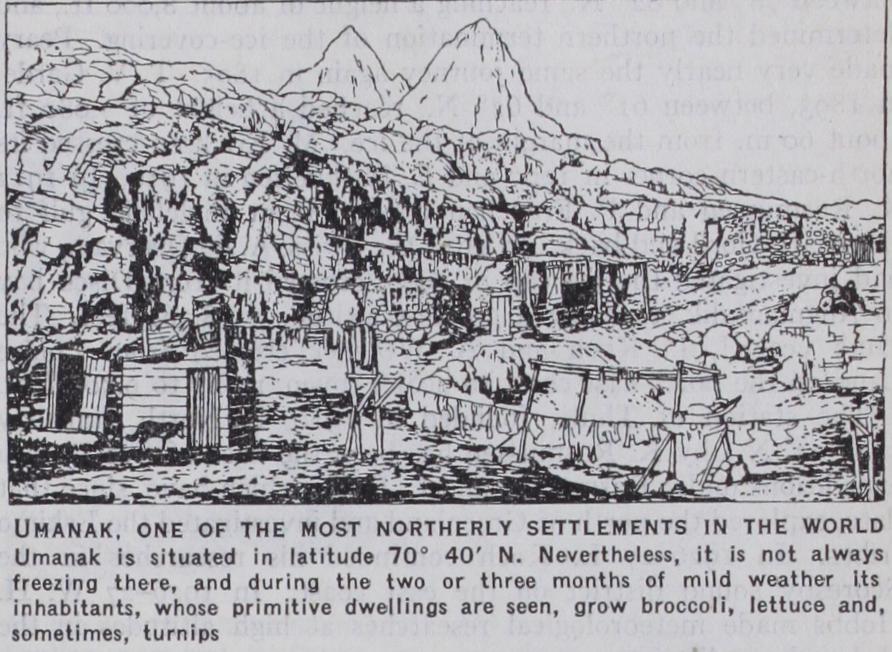
At Umanak (7o° 4o' N.) is the most northern garden in the world. Broccoli and radishes grow well, turnips (but not every year), lettuce and chervil succeed sometimes, but parsley cannot be reared. At Jacobshavn (69° 12' N.), only some 15 m. from the ice-sheet, gardening succeeds well; broccoli and lettuce grow ; spinach produces large leaves ; chervil, pepper-grass, leeks, parsley and turnips grow well; radishes are sown and gathered twice during the summer (June to August) . In the south, in the Juliane haab district, even flowering plants, such as aster, nemophilia and mignonette are cultivated, and broccoli, spinach, sorrel, chervil, parsley, rhubarb, turnips, lettuce, radishes grow well. Potatoes give fair results when they are taken good care of ; carrots grow to a thickness of i i in., while cabbage does poorly. Strawberries and cucumbers have been ripened in a forcing frame. In the "Kongespeil" (King's Mirror) of the i3th century it is stated that the old Norsemen tried in vain to raise barley.
The wild vegetation in the height of summer is, in favourable situations, profuse in individual plants, though scanty in species. There are no forests. In the north, where the lichen-covered or ice-worn rocks do not protrude, the ground is covered with a carpet of mosses, creeping dwarf willows, crowberries and similar plants, while the flowers most common are the andromeda, the yellow poppy, pedicularis, pyrola, etc., besides the "flowering" mosses; but in South Greenland there is something in the shape of bush, the dwarf birches even rising a few feet in very sheltered places, the willows may grow higher than a man, and the vege tation is less arctic and more abundant. The Eskimo probably migrated southward along the west coast during the period of the Norse colonies. No doubt they reached the east coast round Cape Farewell. Rasmussen has shown that a route by the north coast is almost impassable, owing to lack of hunting grounds. All west coast Eskimo have now some Danish blood and are called Greenlanders.
A Danish coloni in Greenland might seem to many not to be a cheerful place at best ; though in the long summer days they would certainly find some of those on the southern fjords com paratively pleasant. The fact is, however, that most people who have lived some time in Greenland always long to go back. There are generally in a coloni three or four Danish houses, built of wood and pitched over, in addition to storehouses and a blubber boiling establishment. The Danish residents may include, besides a coloni-bestyrer and his assistant, a snissionair or clergyman, at a few places also a doctor, and perhaps a carpenter and a school master. In addition there are generally from 20 to several hundred Eskimo, who live in huts built of stone and turf, each entered by a short tunnel. Lately, their houses in the colonis have also to some extent been built of imported wood. For ecclesiastical purposes Danish Greenland is reckoned in the province of the bishop of Zeeland. The Danish mission in Greenland has a yearly grant from the State. The Moravian mission, which used to work in Greenland, retired from the country in 1900. At Godthaab there is a seminary from which Greenlanders who wish to be ordained go to Copenhagen. All settlements have schools, gener ally under native teachers. There are two monthly newspapers in Eskimo. Wireless stations are working at Godthaab, Godhavn, Julianshaab and Angmagsalik. The trade of Greenland has de creased in modern times, and the Danish State has an annual deficit of about £30,000 on the administration of Greenland. This would be greater if the cryolite royalties did not bring in a large sum (f51,000 in 1926-27). The trade in cryolite is outside the State monopoly. In 1925 the mine produced 31,80o tons, of which 2 2,40o tons went to Copenhagen and the rest to the United States of America. The annual value of imports from Denmark, consisting of manufactured goods, foodstuffs, etc., is about f r 8o, 000. The chief articles of export, including seal oil, seal, fox, bird and bear skins, fish products and eiderdown, with some quantity of worked skins, were valued at f 7,80o in 1925. In addition, the exports of cryolite were valued at f455,000. Walrus tusks and walrus hides, which in the days of the old Norse settle ments were the chief articles of export, are now of little im portance. Proposals to modify the State monopoly in trade are being considered.
See also Arctic Manual and Instructions (1875) ; F. Nansen, The First Crossing of Greenland (1890) , and Erganzungshaf t, No. 105, to Petermann's Metteilungen (1892) ; A. R. Cartensen, Two Summers in Greenland (1890) ; R. E. Peary, Northward over the Great Ice (1898) ; E. von Drygski, Gronland Expedition der Gesellschaft f iir Erdkunde, 1891-93 (Berlin, 1897) ; E. Mikkelsen, Lost in the Arctic (1913) ; O. B. Boggild, "Gronland," in Handbuch der Regionalen Geologie IV. 2a, with bibl. of geology ; "Resultats scientifiques de l'expedition Suisse au Gronland, 1912-13," edit. by A. de Quervain, Mem. Soc. Helvetique, liii. (Zurich, 1920) ; K. Rasmussen, Greenland by the Polar Sea (1921) ; A. C. Seward, A Summer in Greenland (1922) ; D. B. Macmillan, Four Years in the White North (1925) ; W. H. Hobbs, The Glacial Anticyclones (New York, 1926), with full list of papers on ice and climate; and L. Koch, Geographical Journal (Jan. 1928) . See also bibliography of Arctic Region. (R. N. R. B.) History.—In the beginning of the loth century the Norwegian Gunnbjorn, son of Ulf Kraka, is reported to have found islands to the west of Iceland, and he may have seen the south-east coast of Greenland. In 982 the Norwegian, Eric the Red, sailed from Iceland to find Gunnbjorn's land, and he spent three years on its south-western coasts exploring the country. On his return to Ice land in 985 he called the land Greenland, in order to make people more willing to go there, and in 986 started again from Iceland with 25 ships, of which 14 reached Greenland, where a colony was founded on the south-west coast. Eric built his house at Brattalid, just north of the present Julianehaab. Other settlers followed and in a few years two colonies had been formed, one called Oster bygd, in the present district of Julianehaab, comprising later about 590 farms, and another called Vesterbygd, farther north, on the west coast, in the present district of Godthaab, comprising, later, about 90 farms. At the height of their prosperity the colonists numbered about 3,000. Numerous ruins indicate the location of these colonies. When the Norsemen came to Greenland they found various traces of Skraeling (the meaning of the word is un certain ; it means possibly elves or fairies) ; but the sagas do not report that they actually met natives. Somewhat later they met the Eskimo farther north, on the west coast, in the neighbourhood of Disko bay, where the Norsemen went to catch seals, walrus, etc. The Eskimo were probably migrating south at that time. Chris tianity was introduced by Leif Ericson about moo, and in 1126 Greenland got its own bishop, who resided at Gardar on Igaliko fjord. There were 12 churches, including a cathedral, a monas tery and a nunnery in Osterbygd, and four churches in Vester bygd. The last bishop died in 1540, but from 13 77 to that date the bishops did not reside in Greenland. Greenland was a repub lic until 1261, when the colonists swore allegiance to the king of Norway. At the dissolution of the union between Norway and Denmark, in 1814, neither Greenland, Iceland nor the Faroes were mentioned, and they were therefore retained by Denmark.
After the middle of the 14th century communications with Norway became infrequent. The trade was a Crown monopoly and was conducted by an annual ship (Knarren) . The growing dominance in Norway's shipping of the Hanseatic league, which had no interest in Greenland, brought the trade to an end. The last vessel from Greenland returned to Norway in 1410, but ves sels in the Icelandic fish trade probably visited Iceland till the end of that century. When J. Davis visited Greenland in 1585 there was no sign of the Norse colonists. Excavations in the Norse burial grounds in Greenland throw some light on the disappear ance of the colonists. Style and texture of clothes show Euro pean influences of the 15th century, but little or no trace 01 Eskimo culture. Skeletons show malformation, rickets and low stature, and include an undue proportion of infants and youths. There is clear evidence that the Norsemen perished either by ex cessive intermarriage among themselves or by adverse conditions of life, but there is no indication of absorption in the Eskimo race or of destruction by Eskimo onslaught. It was not until 1721 that the first of the modern settlements was formed, near Godthaab, by the Norwegian missionary, Hans Egede. Many of the 18th century colonists were convicts, but gradually the new colonies prospered, in spite of a devastating smallpox epidemic in In 1774 trade became a Government monopoly. From 1807 to 1814 communications with Europe were cut off owing to the war. A century later the World War again restricted shipping with Greenland, but not to the extent of causing real want. Until 1917 Denmark's sovereignty extended only over the west coast, be tween Cape Farewell and 74° 3o' N., and the one trading station of Angmagsalik in the east. In that year, however, it was extended to embrace the whole island, which led to a dispute with Norway regarding hunting and sealing rights on the east coast. (See ARCTIC REGIONS, Sovereignty.) In 192I, for the first time in history, the king of Denmark visited Greenland.