
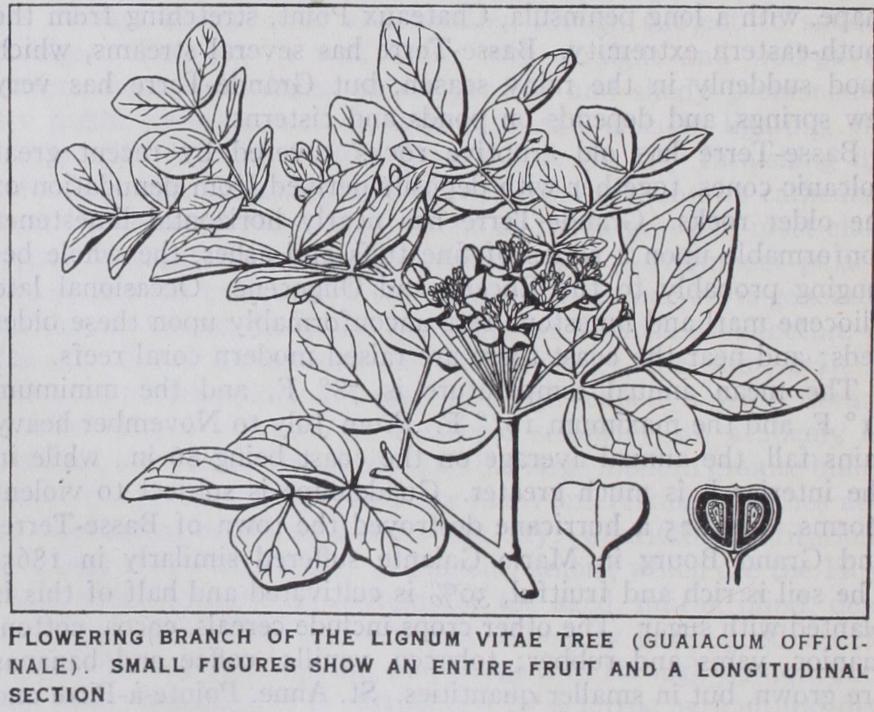
GUAIACUM (gwi'a-kum), a genus of trees of the order Zygophyllaceae. The guaiacum or lignum vitae tree G. officinale, is a native of the 'Vest Indies and the north coast of South Amer ica, where it attains a height of 2oft. to 3oft. Its branches are numerous, flexuous and knotted ; the leaves opposite and pinnate, with caducous stipules, and entire, glabrous, obovate or oval leaf lets, arranged in two or, more rarely, three pairs ; the flowers are in axillary clusters (cymes), and have five oval pubescent sepals, five distinct pale-blue petals three times the length of the sepals, 10 stamens, and a two-celled superior ovary. The fruit is about fin. long, with a leathery pericarp, and contains in each of its two cells a single seed (see fig. 1). G. sanctum grows in the Bahamas and Cuba, and at Key West in Florida. It is distin guished from G. officinale by its smaller and narrow leaflets, which are in four to five pairs, by its shorter and glabrous sepals, and five-celled and five-winged fruit. G. arboreurn, the guaiacum tree of Colombia, is found in the valley of the Magdalena up to altitudes 800 metres (2,625ft.) above sea-level, and reaches con siderable dimensions. Its wood is of a yellow colour merging into green, and has an almost powdery fracture ; the flowers are yellow and conspicuous ; and the fruit is dry and four-winged.
The lignum vitae of commerce, so named on account of its high repute as a medicinal agent in past times, is procured from G. officinale, and in smaller amount from G. sanctum. It is exported in large logs or blocks, generally divested of bark, and presents in transverse section very slightly marked concentric rings of growth, and scarcely any traces of pith; with the aid of a magnifying glass the medullary rays are seen to be equi distant and very numerous. The outer wood is pale yellow and devoid of resin ; the inner which is by far the larger proportion, is dark greenish-brown, contains in its pores 26% of resin, and has a specific gravity of 1.333, and therefore sinks in water. Owing to the diagonal and oblique arrangement of the successive layers of its fibres, the wood cannot be split; and on account of its hardness, density and durability it is much valued for the manu facture of ships' pulleys, rulers, skittle-balls, mallets etc.
Chips or turnings of the heartwood of G. officinale (lignum guaiaci) are employed in the preparation of the liquor sarsae composites concentrates of British pharmacy. They may be rec ognized by being either yellow or greenish-brown in colour, and by turning bluish-green when treated with nitric acid, or when heated with corrosive sublimate, and green with solution of chlo ride of lime. Guaiacum resin is obtained from the wood as a natural exudation; by heating billets about aft. in length, bored to permit of the outflow of the resin; or by boiling chips and raspings in water to which salt has been added to raise the temperature of ebullition. It occurs in rounded or oval tears, or in large brownish or greenish-brown masses, translucent at the edges; fuses at 85°C.; is brittle, and has a vitreous fracture, and a slightly balsamic odour, increased by pulverization and by heat ; and is at first tasteless when chewed, but produces subsequently a sense of heat in the throat. It is readily soluble in alcohol, ether, chloroform, creosote. oil of cloves and solutions of caustic alkalies; with glycerine it gives a clear solution, and with nitrous ether a bluish-green gelatinous mass. It is blued by various oxi dizing agents, e.g. ozone. The chief constituents are three distinct resins: guaiaconic acid, (70%), guaiac acid, which is closely allied to benzoic acid, and guaiaretic acid. Like all resins, these are insoluble in water, soluble in alkalies, but precipitated on neutralization of the alkaline solution.
Guaiacum wood was first introduced into Europe by the Span iards in 1508 but the first edition of the London Pharmacopoeia in which the resin is mentioned is that of 1677. Guaiacum resin is given medicinally in doses of 5-15 grains. Its important prepa rations in the British Pharmacopoeia are the mistura guaiaci (dose 2 Ioz.), the ammoniated tincture of guaiacum (dose-1 drachm), in which the resin is dissolved by means of ammonia, and the trochiscus or lozenge, containing three grains of the resin. This lozenge is undoubtedly of value when given early in cases of sore throat, especially of rheumatic origin. Guaiacum resin dif fers pharmacologically from other resins in being less irritant, so that it is absorbed from the bowel and exerts remote stimu lant actions, notably upon the skin and kidneys. The drug is useful both in acute and chronic sore throat, in chronic constipa tion and chronic gout and other forms of chronic arthritis.
The tincture of guaiacum is universally used as a test for the presence of blood, or rather of haemoglobin, in urine or other secretions. A single drop of the freshly-prepared tincture should be added to, say, an inch of urine in a test-tube. The resin is at once precipitated, yielding a milky fluid. If "ozonic ether" (an ethereal solution of hydrogen peroxide) be now poured gently into the test-tube, a deep blue coloration is produced along the line of contact if haemoglobin be present. The reaction is due to the oxidation of the resin by the peroxide of hydrogen—such oxidation occurring only if haemoglobin be present to act as an oxygen-carrier.