
GUATEMALA, the most populous and the second largest country of Central America. The name was formerly applied to the captain-generalcy of Spain which included not only the five Central American countries, extending southward to approxi mately the present northern border of the Republic of Panama, but also included, to the northward, most of the present Mexican State of Chiapas. Following the independence from Spain in 1821, and the separation of the Central American countries from the Mexican empire of Iturbide two years later, the name Guatemala was applied to the region formerly included in io of the 15 provinces; i.e., Chiapas was retained by Mexico and the provinces of Honduras, San Salvador, Nicaragua and Costa Rica became individual entities, recognized as such even through the various attempts to form a Central American Union out of the five countries. (See CENTRAL AMERICA, where, also, the early history of Guatemala is told.) The origin of the name, Guatemala, is certainly Indian, but its derivation and meaning are undetermined. Some students suggest that the original form was Quauhtematlan (which would indicate an Aztec rather than a Mayan origin, a thing most unlikely) meaning "land of the Eagle," and others hold its origin was Uhatezmala, meaning "Mountain vomiting water," referring to the so-called Volcano of Water, or "Agua" which destroyed Ciudad Vieja (q.v.), the first Spanish capital of the captain-generalcy.
The present republic of Guatemala lies between 42' and 17° 49' N., and 88° 1o' and 92° 3o' W. Its area is approximately sq.m., making it thus slightly smaller than Nicaragua, in claimed extent, although it is possible that the actual area of Guatemala is slightly larger (a monograph issued by the depart ment of commerce of the United States in 1927 puts Nicaragua's area as "some 45,00o sq.m.," and boundary disputes and incom plete surveys make all areas and most population figures extremely "approximate" in Central America). The population of Guatemala is put officially at 2,245,593, or about 49 inhabitants to the square mile; the country has a coast line of about 7o m. on the Carib bean and zoo m. on the Pacific shores. Its boundaries on the north and west, which touch Mexico, were fixed by treaty, finally on May 8, 1899, which set the Suchiate river, from the Pacific in land, as the start of an irregular line which runs generally north westward until it strikes the parallel of 17° 49' N., which it fol lows to the border of Belize or British Honduras. The eastern border, with Belize, follows the meridian of 89° 20' W., southward to the River Sarstoon, which it follows eastward to the Gulf of Honduras on the Caribbean sea ; this boundary was set by the treaty of July 9, The Gulf of Honduras, an arm of the Caribbean, forms the short shoreline of Guatemala on Atlantic waters. The boundary with Honduras on the east is still in dis pute, both countries claiming large areas within the generally accepted limits of the other.
Many efforts have been made to adjust this question, the last, in 1928, under the aegis of the United States, resulting in a temporary agreement. The south-eastern boundary with Honduras is generally accepted by the two countries, and the south-eastern line touching on El Salvador is accepted and marked, chiefly along natural lines.
(I) The Pacific coastal plains extend along the entire southern seaboard, with a mean breadth of 5o m., and link together the belts of similar territory in Salvador and the district of Soconusco in Chiapas, Mexico. This region is now being developed as a tropical agricultural section of considerable importance.
(2) The precipitous barrier of the Sierra Madre, which closes in the coastal plains on the north, is similarly prolonged into Salvador and Mexico. It is known near Guatemala city as the Sierra de las Nubes, and enters Mexico as the Sierra de Istatan. It forms the main watershed between the Pacific and Atlantic river systems. Its summit is not a well-defined crest, but is often rounded or flattened into a table-land. The direction of the great volcanic cones, which rise in an irregular line above it, is not identical with the main axis of the Sierra itself, except near the Mexican frontier, but has a more southerly trend, especially towards Salvador; here the base of many of the igneous peaks rests among the southern foothills of the range. It is, however, impossible to subdivide the Sierra Madre into a northern and a volcanic chain; for the volcanoes are isolated by stretches of com paratively low country; at least 13 considerable streams flow down between them, from the main watershed to the sea. The volcanic cones rise directly from the central heights of the Sierra Madre, above which they tower ; for in reality their bases are, as a rule, farther south, east of Tacana, which marks the Mexican frontier, and is variously estimated at 13,976 ft. and 13,900 ft., and if the higher estimate be correct is the loftiest peak in Central America. The principal volcanoes are—Tajamulco (13,517 ft.) ; Santa Maria (12,467 ft.) which has been in eruption since 1902, after centuries of quiescence, in which its slopes had been overgrown by dense forests; Atilan (11,719), overlooking the lake of that name; Acatenango (13,615), which disputes the claim of Tacana to be the highest mountain of Central America ; Fuego (i.e., "fire," variously estimated at 12,795 ft. and 52,582 ft.), which received its name from its activity at the time of the Spanish conquest; Agua (i.e., "water," 12,139 ft.) so named in 1S41 because it destroyed the former capital of Guatemala with a deluge of water from its flooded crater; and Pacaya (8,39o), a group of igneous peaks which were in eruption in 187o.
(3) The so-called plateaux which extend north of the Sierra Madre are in fact high valleys, rather than table-lands, enclosed by mountains. A better idea of this region is conveyed by the native name Altos or highlands, alhough the section so designated by the Guatemalans includes the northern declivity of the Sierra Madre. The mean elevation is greatest in the west (Altos of Quezaltenango) and least in the east (Altos of Guatemala). A few of the streams of the Pacific slope actually rise in the Altos, and force a way through the Sierra Madre at the bottom of deep ravines. One large river, the Chixoy, escapes northwards towards the Atlantic.
(4) The relief of the mountainous country which lies north of the Altos and drains into the Atlantic is varied by innumerable terraces, ridges and underfalls ; but its general configuration has been compared with the appearance of a "stormy sea breaking into parallel billows." The parallel ranges extend east and west with a slight southerly curve towards their centres. A range called here the Sierra de Chama, which, however, changes its name frequently from place to place, strikes eastward towards British Honduras, and is connected by low hills with the Cockscomb mountains; another similar range, the Sierra de Santa Cruz, continues east to Cape Cocoli between the Polochic and the Sarstoon rivers, and a third, the Sierra de las Minas or, in its eastern portion, Sierra del Mico, stretches between the Polochic and the Motagua. Be tween Honduras and Guatemala the temporarily accepted frontier is that along the Sierra de Merendon.
(5) The great plain of Peten, which comprises about one-third of the whole area of Guatemala, belongs geographically to the Yucatan peninsula, and consists of level or undulating country, covered with grass or forest. Its population numbers less than two per square mile, although many districts have a wonderfully fertile soil and abundance of water. The greater part of this region is uncultivated, and only utilized as pasture by the Indians, who form the majority of its inhabitants, and as a source of chicle, the basis of chewing gum. Peten was for centuries, however, the site of great cities of the later Maya empire and much of the important archaeological work now being done in Central America is going forward in this region. It is also the scene of petroleum prospecting.
Guatemala is well watered, not only on the eastern slopes (as is common along the American continents) but also on the Pacific slope and in the highlands. On the western side of the sierras the versant is short, and the streams, while very numerous, are conse quently small and rapid; but on the eastern side a number of the rivers attain a very considerable development. The Motagua, whose principal head stream is called the Rio Grande, has a course of about 25o m., and is navigable to within 90 m. of the capital, which is situated on one of its confluents, the Rio de las Vacas. It forms a delta on the south of the Gulf of Honduras. Of similar importance is the Polochic, which is about 18o m. in length, and navigable about 20 m. above the river-port of Teleman. Before reaching the Golfo Amatique it passes through the Golfo JJulce, or Lake Izabal, and the Golfete Dulce. A vast number of streams, among which are the Chixoy, the Guadalupe, and the Rio de la Pasion, unite to form the Usumacinta, which in its early stages passes along the Mexican frontier, and then flowing on through Chiapas and Tabasco, falls into the Bay of Campeche. The Chiapas follows a similar course.
There are several extensive lakes in Guatemala. The lake of Peten or Laguna de Flores, in the centre of the department of Peten, is an irregular basin about 27 m. long, with an extreme breadth of 13 miles. In an island in the western portion stands Flores, a town well known as the centre of the archaeological work now being carried on. On the shore of the lake is the stalac tite cave of Jabitsinal, of local celebrity; and in its depths, accord ing to the popular legend, may still be discerned the stone image of a horse that belonged to the conqueror, Hernando Cortes. The Golfo Dulce is, as its name implies, a fresh-water lake, although it is virtually an arm of the Caribbean; comparable on a smaller scale to Lake Maracaibo in Venezuela. It is about 36 m. long, and would be of considerable value as a harbour if the bar at the mouth of the Rio Dulce did not prevent the upward passage of seafaring vessels. As a contrast the lake of Atitlan is a beautiful land-locked basin encompassed with lofty mountains. About 9 m. south of the capital lies the Lake of Amwtitlan (q.v.) with the town of the same name. On the borders of Salvador and Guate mala there is the Lake of Guija, about 20 m. long and 12 broad, at a height of 2,100 ft. above the sea. It is connected by the river Ostuma with the Lake of Ayarza which lies about i,000 ft. higher, at the foot of the Sierra Madre.
The geology, fauna and flora of Guatemala are discussed in the article CENTRAL AMERICA. The bird-life of the country is remark ably rich; one bird of magnificent plumage, the quetzal (Trogon resplendens), has been chosen as the national emblem.
The average rainfall is heavy, especially on the Atlantic slope, where the prevailing winds are charged with moisture from the Gulf of Mexico or the Caribbean sea; at Tual, a high station on the Atlantic slope, it reaches 195 in.; in central Guatemala it is only 27 inches. Towards the Atlantic rain often occurs in the dry season, and there is a local saying near the Golfo Dulce that "it rains 13 months in the year." Fogs are not uncommon. In Guatemala, as in other parts of Central America, each of the three climatic zones, cold, temperate and hot, has its special char acteristics, described in the article on CENTRAL AMERICA.
The area of forest has not been seriously diminished except in the west, and still amounted to 2,000 sq.m. in 1925. Besides chicle, and a small quantity of wild rubber of the Castillao elastica, it yields many valuable dye-woods and cabinet-woods, such as cedar, mahogany and logwood. Fruits, grain and medicinal plants are obtained in abundance, especially where the soil is largely of vol canic origin, as in the Altos and Sierra Madre. Parts of the Peten district are equally fertile, but not greatly developed. The vege table products of Guatemala include coffee, cocoa, sugar-cane, bananas, oranges, vanilla, aloes, agave, ipecacur. nha, castor-oil, sarsaparilla, cinchona, tobacco, indigo, chicle, rubber and the wax plant.
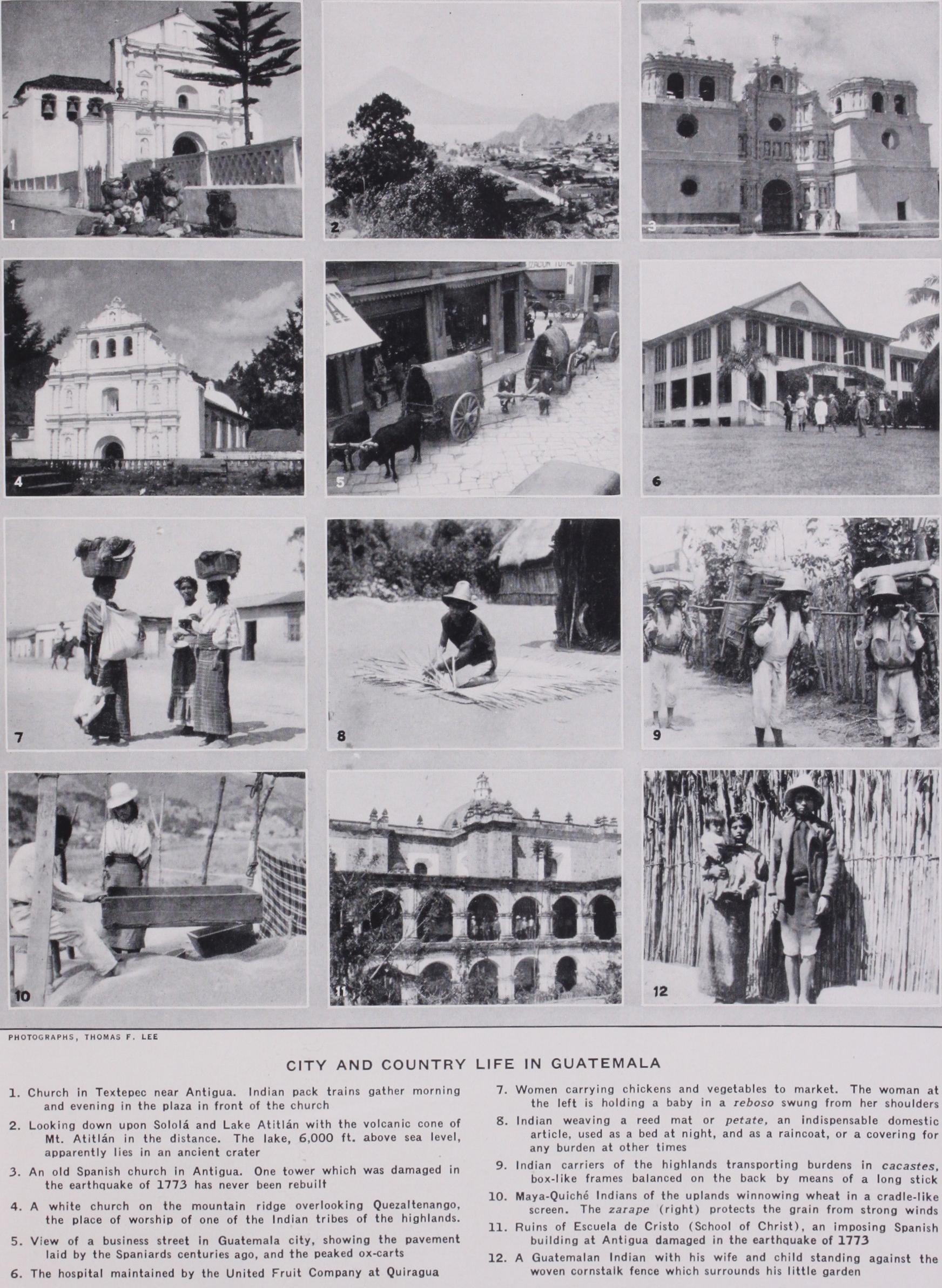
The Indian population of Guatemala is more nearly aboriginal in its habits and life than in any similar section of North or probably of South America. The existent tribes have been only sketchily studied, for the anthropology and ethnology of Central America are still almost untilled scientific soil, although it is known of course that the living Indians of Guatemala come, in general, from the Maya or from the yet older and less highly developed kindred Quiche strains (see MAYA) . The Indian coun try is in the highlands, the "Altos" above described. It is esti mated that at least i8 different Indian languages are spoken in Guatemala, and in the highland hinterland the tribes, with their distinctive dress, still rigorously maintained and distinguishing village from village as well as tribe from tribe, are sharply sep arated from one another in manners and language, Spanish being the only common tongue, and that unknown to thousands. The Governments of Guatemala, from the Spaniards down to to-day, have handled the Indians by converting the caciques, or tribal and village chieftains, into Government officials, and the control by the central Government of the Indian provinces is virtually feudal in form, the representative of the central authority still being a mili tary official, of varying rank, according to the importance of his post. The Indians, however, form the basis of the army, and many pure blooded Indians have risen high in military rank, the common soldier remaining Indian, however, with his loyalty rep resented by his affection for his immediate superiors, a trait which has been of considerable importance in time of threatened revo lution. The barefooted Indian soldier, with his canvas leggings binding his khaki uniform to his bare ankles, remains the basis of Guatemalan Government, so far as the preservation of public order is concerned; and his caciques—dignified Indian chieftains dressed in elaborately embroidered robes, with kilts and tartans of their village and with ornate staffs of office—are the repre sentative of an authority more absolute than that wielded by the white or mixed-blood officer who is nominally the political chief of the area.
The Indians differ but slightly in physical mien, being of dark copper skin, stocky build, with coarse, straight black hair, high cheekbones and low forehead, although the suggestion of the ori ental type comes in more often than in Mexico, and almost as much as in the Indians of the highlands of Bolivia and Peru, in South America. In their tribal life, the Indians are deeply loyal, but outwardly secretive. Nominally belonging to the Roman Catholic faith, they have many strange tribal dances, and the festivals of the church are made the occasion for rites often associated with images either on or quite outside the church altars; an immense folk-lore, with particular reference to witchcraft and disease, has been noted but only partially analysed by local and foreign students.
The Indian, forming the chief labour supply of the country (with the exception of the imported negroes who are almost en tirely confined to the Caribbean littoral) are handled in feudal fashion by the coffee planters and by the officials who must assist them. The abuses of earlier days, in the virtual slavery or peonage on the coffee plantations, have been somewhat ameliorated in recent years, but the wage is still miserably small, the system of debt indenture is widespread, with the Indians evading it by assuming varied Spanish names—their own are so difficult to pro nounce or at least to reduce to paper that the landlords encourage the exchange—or by disappearing from their highland villages when the picking season begins on the coffee plantations. A prac tice growing in use amongst the coffee planters is to purchase estates in the highlands, where the Indians are given free use of the tiny farming sections in the confined plains between the hills, their only obligation being a guarantee to come and work at the coffee picking at regular wages when the landlord calls upon them.
The chief centres of population are the capital, Guatemala city, with about 134,400 people; Antigua, 40,00o; Quezaltenango, 30, 000; Totonicapan, 28,000; Chiquimula, 25,00o; Coban, 27,000; Solola, 17,00o; Esquintla, 13,000; Hueheutenango, I2,000; Retal huleu, 7,000; Puerto Barrios, 2,500; Livingston, 2,500; San Jose, 1,50o; Champerico, 1,500. Most of these towns and cities are described under separate headings.
The executive power rests in the president, who is chosen for six years by popular vote. He appoints his cabinet of six secre taries of State, who are responsible officers, and may speak and vote in the national assembly. With the five members appointed by the assembly and four named by the president, the cabinet forms the council of State, a body with purely advisory functions, but often of great importance. The judiciary consists of a supreme court of five members, six courts of appeal of three members each, and 26 courts of first instance. Judges are chosen by direct popular vote and serve for a term of four years. The country, for purposes of administration, is divided into 23 departments, each presided over by a je f e politico or prefect appointed direct by the president. The municipalities are governed by alcades (or mayors) and councils chosen by direct vote of the people ; these have the power to assess and collect local revenues. The prefect, represent ing the central government, has the authority to amend the ordi nances and enactments of the councils of the towns in his depart ment. The police power is handled both by local constabulary in the towns and by the military, and is generally thoroughly effi cient and effective. There is some public care of the unfortunate but in general eleemosynary work is left to the religious denomi nations, chiefly Roman Catholic.
The archbishop of Guatemala is the primate of Central America and the church influence is very powerful. There are some Prot estant missionaries and mission schools. The Indians are theo retically Roman Catholics, but in some regions their religious prac tices are influenced by their not always coherent race memories of idolatrous conditions and practices, and some of the great Christian festivals bring out practices not entirely in accord with the strictest tenets of the church. On the other hand, much of the white population is notably and frankly religious, and while this is somewhat divided on political lines, and the church has at times been accused of opposing the prevailing liberal Government with serious consequences, the religious attitude of the people of the higher classes has not been greatly affected.
The foreign gold debt of Guatemala was in 1928 less than £2,000,000 sterling, chiefly held in England and Germany, and paying 4% ; the internal debt was approximately the same. The service on the foreign debt in 1926-27 was 242,704.99 quetzales.
Guatemala is well supplied with banks, the strongest, outside the new central bank of issue, being the six banks which formerly had the right of issue through their contracts with the Government mentioned above, namely, the Banco de Guatemala, International Bank of Guatemala, American Bank, Banco del Occidente, Banco Agricola Hipotecano and Banco Colombiano. Private banks in clude branches of the Anglo-South American Bank, the Notte bohm Banking Corporation, Pacific Bank and Trust Company, Schlubach Sapper and Co. and Rosenthal e Hijos.
Defence.—The Guatemalan army is theoretically made up of all the males of the white and mixed population, who are subject to call to arms from the age of 18 onward. Under the treaty of Feb. 7, 1923, with the other Central American countries, the army contains 5,200 officers and men, the officers being the product of the official military schools where excellent instruction and train ing are given, and the rank and file of the army largely made up of Indians. The effective strength of the army subject to call is 57,00o active and 30,000 reserve. The army budget in 1926-27 was Q2,191,711.62.
The telegraph lines of the Government cover the country ef fectively, and in addition there are three wireless stations, at Guatemala, Quezaltenango and Puerto Barrios. The telephone sys tem in Guatemala city is good, and there are long distance lines controlled by the fruit companies. The All America cables enter from the Pacific side, at San Jose, and are available to the country via the Government telegraph lines.
The highway development in Guatemala is still in its early stages, although the road from Guatemala to Antigua is open virtually all the year, as is the new overland highway, recently graded, which links Guatemala with San Salvador, the capital of the neighbouring republic of El Salvador. A highway from Retalhuleu to Quezaltenango and on to Solola is also passable most of the year, and there are many other highways, but there are no hard surfaced roads in Guatemala, and broken rock is used only where necessary. The beginnings that have been made indicate, however, an extensive interest, and the funds expended have been wisely and effectively invested. The growing importations of auto mobiles and their increasing use are having a direct effect on the public interest in road building.
General Jose Maria Reina Barrios was elected president in 1892, re-elected in 1897 and assassinated on Feb. 8, 1898. Succeeded by Vice-President Morales, the power passed, by election to Manuel Estrada Cabrera (1857-1924) in the fall of the same year. Estrada Cabrera ruled, continued in office by frequent re-elections, until April, 1920, when he was forced to resign in the face of a revolutionary movement which had spread to the national as sembly. Estrada Cabrera, as dictator of Guatemala, was respon sible for many improvements in the line of education, railways and industrial development, but was bitterly opposed by a large proportion of the substantial elements of the country. In 1906, his predecessor in the presidency, Gen. Manuel Barillas, invaded Guatemala, and soon Salvador, Costa Rica and Honduras were arrayed against Estrada Cabrera, with Nicaragua inactive but unfriendly. The situation was saved by the intervention of the United States and a subsequent meeting of representatives of the five republics in Washington, where the treaties of 1907 were drawn up.
The Unionist movement of 1920 became, in Guatemala, a move ment against Estrada Cabrera, and, as noted, he was forced to resign, after a brief but lively revolutionary campaign, confined solely to the capital. The national assembly, naming Carlos Her rera, a conservative and unionist, as first designate, he was ele vated to the presidency. A man of culture and wide experience, President Herrera began the rehabilitation of the country, and the restoration of the capital from the ruin following the earthquake of 1917-18. On Oct. io, 1921, he signed, with Honduras and Sal vador, the pact for the Central American Union.
On Dec. 7, 1921 the liberals overthrew Herrera and in March following Gen. Jose Maria Orellana was elected president. Under his able administration until his death in October 1926, and there after under that of his successor Gen. Lazaro Chacon, the country progressed in stability and peace. But on Dec. 16, 193o the latter was overthrown as a result of a coup d'etat, executed by Gen. Manuel Orellana. Unable to secure recognition from the United States in accordance with the treaty of 1923, Orellana was soon compelled to resign. And in February 1931 Gen. Jorge Ubico, of the Liberal-Progressive Party was elected president for a six year term. Guatemala with the rest of the world suffered from the economic depression, but her government managed to hold its position. In 1933 the long standing boundary dispute between her and El Salvador was finally settled by arbitration. BIBLIOGRAPHY.-C. W. Domville-Fife, Guatemala and the States of Central America (1913) ; A. Caille, Au Pays du Printemps Eternel (1954) ; Dana G. Munro, The Five Republics of Central America (1916) ; J. V. Mejia, Geografia Descriptiva de la Republica de Guate mala (1922) ; Wallace Thompson, Rainbow Countries of Central America (1926). Earlier authorities include Juarros, Compendio de la historia de Guatemala (trans. into English 1823) ; Karl Sapper, Grand zuge de Physikalischen Geographie von Guatemala (1894) ; A. C. and A. P. Maudslay's A Glimpse of Guatemala, and some Notes on the Ancient Monuments of Central America (1899) . Consult reports of the Pan-American Union (Government Printing Office), Washington, and H. M. Stationery Office, for current data on trade, etc. (W. THO.)