
GUN, a general term for a weapon, tubular in form, from which a projectile is discharged by means of an explosive. When applied to artillery (q.v.) the word is confined to those pieces of ordnance which have a direct as opposed to a high-angle fire, in which case the terms "howitzer" and "mortar" are used. (See ORDNANCE.) "Gun" as applied to firearms which are carried in the hand and fired from the shoulder, the old "hand gun," is now chiefly used of the sporting shot-gun, with which this article mainly deals ; in military usage this type of weapon, whether rifle, car bine, etc., is known collectively as "small arms." (See SMALL ARMS and PisToL.) The origin of the word, which in M.E. is gonne or gunne, is obscure.
Firearms are said to have been first used in European warfare in the 14th century. The hand gun, it is found, came into practical use in 1446 and was of very rude construction. It consisted of a simple iron or brass tube with a touch-hole at the top fixed in a straight stock of wood, the end of which passed under the right armpit when the "gonne" was about to be fired. A somewhat simi lar weapon was also used by the horse-soldier, with a ring at the end of the stock, by which it was suspended by a cord round the neck; a forked rest, fitted by a ring to the saddlebow, served to steady the gun. This rest, when not in use, hung down in front of the right leg. A match was made of cotton or hemp spun slack, and boiled in a strong solution of saltpetre or in the lees of wine. The touch-hole was first placed on the top of the barrel, but afterwards at the side, with a small pan underneath to hold the priming, and guarded by a cover moving on a pivot.
About 1540 the Spaniards constructed a larger and heavier firearm (matchlock), carrying a ball of Io to the pound, called a musket. This weapon was introduced into England before the middle of the 16th century, and soon came into general use throughout Europe. The snaphance was invented about this period in Germany, and from its comparative cheapness was much used in England, France and Holland. It held a flint instead of the pyrites of the wheel or firelock, which ignited the powder in the pan by striking on a piece of furrowed steel, when released by the trigger, and emitting sparks.
As a sporting weapon the gun may be said to date from the invention of the wheel-lock in the beginning of the 16th century, though firearms were used for sporting purposes in Italy, Spain, Germany, and to some extent in France, in the 15th century.
ward IV., by fixing a cock (Fr. serpentine) on the hand gun to hold the match, which was brought down to the priming by a trigger, whence the term matchlock. This weapon is still in use among the Chinese, Tatars, Sikhs, Persians and Turks. An im provement in the stock was also made during this period by forming it with a wide butt end to be placed against the right breast. Subsequently the stock was bent, a German invention, and the arm was called a hackbutt or hagbut, and the smaller variety of demihague. The arquebus (q.v.) and hackbutt were about a yard in length, including barrel and stock, and the demi Before that period the longbow in England and the crossbow on the Continent were the usual weapons of the chase. In Great Britain little use appears to have been made of firearms for game shooting until the latter half of the 17th century, and the arms then used for the purpose were entirely of foreign make.
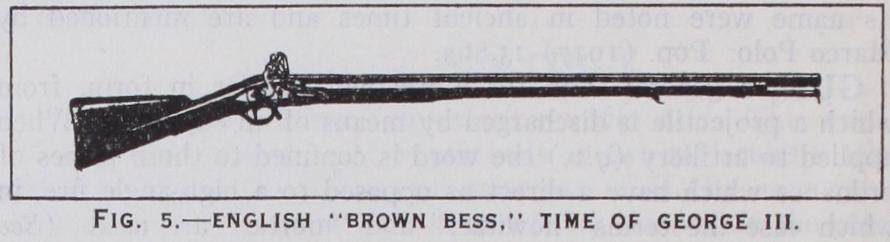
In 184o the Austrian army was supplied with the percussion musket, and in 1842 a new model percussion musket with a block or back-sight for 15o yd. was issued to the British army, 11 lb. 6 oz. in weight, 4 ft. 64 in. in length without bayonet, 6 ft. with bayonet and with a barrel 3 ft. 3 in. in length, firing a bullet of 144 to the lb. with 44 drs. of powder. This musket was larger in bore than that of France, Belgium, Russia and Austria, and thus had the advantage of being able to fire their balls, while the Eng lish balls could not be fired from their barrels. But the greater weight and momentum of the English ball was counteracted by the excess of windage. This percussion musket of 1842, the latest development of the renowned Brown Bess, continued in use in the British army until partially superseded in 1851 by the Minie rifle, and altogether by the Enfield rifle in 1855. For further informa tion as to the history and development of military, target and sporting rifles see SMALL ARMS, DEVELOPMENT OF.
About 1836, C. Lefaucheux, a Paris gunsmith, improved the old Pauly system of breech-loading, but its breech action was a crude mechanism, with single grip worked by a bottom lever. The double grip for the barrels was the subsequent invention of a Birmingham gunmaker. The central-fire cartridge, practically as now in use, was introduced into England in 1861 by Daw. It is said to have been the invention of Pottet, of Paris, improved upon by Schneider, and gave rise to considerable litigation in respect of its patent rights. Daw, who controlled the English patents, was the only exhibitor of central-fire guns and cartridges at the International Exhibition of 1862. In his system the barrels work on a hinge joint, the bottom lever withdraws the holding down bolt ; the cartridge is of the modern type, the cap being detonated by a striker passing through the standing breech to the inner face. The cartridge-case is withdrawn by a sliding extractor fitted to the breech ends of the barrels. Daw was subsequently defeated in his control of the patents by Eley Bros., owing to the patent not having been kept in force in France. The modern breech-loading gun has been gradually and steadily improved since 186o. Westley Richards adopted and improved Matthews' top-lever mechanism. About 1866 the rebounding lock was intro duced, and improved in 1869. The treble wedge-fast mechanism for holding down the barrels was originated by W. W. Greener in 1865, and perfected in 1873. A very important improvement was the introduction of the hammerless gun, in which the mechanism for firing is placed entirely within the gun. This was made possible by the introduction of the central-fire cartridge. In 1862 Daw, and in 1866 Green, introduced hammerless guns in which the cocking was effected by the under lever. These guns did not attain popularity. In 1871 T. Murcott patented a hammerless gun, the first to obtain distinct success. This also was a lever-cocking gun. About the same time Needham introduced the principle of utiliz ing the weight of the barrels to assist in cocking. In 1875 Anson and Deeley utilized the fore-end attached to the barrels to cock the locks. From this date hammerless guns became really popular. Subsequently minor improvements were made by many other gun makers, including alternative movements introduced by Purdey and Rogers. Improvements were also introduced by Westley Richards, Purdey and others, including cocking by means of the mainspring. In 1874 J. Needham introduced the ejector mecha nism, by which each empty cartridge-case is separately and auto matically thrown out of the gun when the breech is opened, the necessary force being provided by the mainspring of the lock. W. W. Greener and some other gun-makers have since introduced minor modifications and improvements of this mechanism. Next in turn came Perks and other inventors, who separated the ejector mechanism from the lock work. This very decided improvement is universal to-day. A later innovation in the modern breech loader is the single trigger mechanism introduced by some of the leading English gun-makers, by which both barrels can be fired in succession by a single trigger. This improvement enables both barrels to be rapidly fired without altering the grip of the right hand, but deprives the shooter of the power of selecting his barrel.
Repeating or magazine shot-guns on the principle of the re peating rifle with a magazine below the single firing barrel, are also made by some American and Continental gun-makers, but as yet have not come into general use, being comparatively cumber some and not well balanced. The difficulty of a shifting balance as each cartridge is fired has also yet to be overcome. Several varieties of a combination rifle and shot-gun are also made.
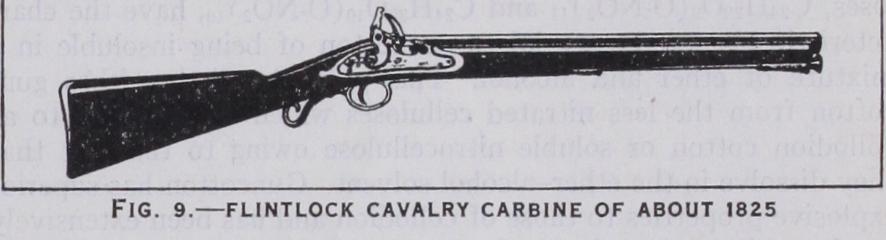
The chief purposes for which modern shot-guns are required are game-shooting, trap-shooting at pigeons and wild-fowling. The game gun may be any bore from 32 to io gauge. The usual stand ard bore is 12 gauge unless it be for a boy, when it is 20 gauge. The usual weight of the 12-bore double-barrelled game gun is from 6 to 7 lb. with barrels 3o in. long, there, however, being a present tendency to barrels of a shorter length. These barrels are made of steel, as being a stronger and more homogeneous material than the barrels formerly produced, which were mostly of Damascus pattern, a mixture of iron and steel. Steel barrels, drilled from the solid block, were originally produced by Whitworth. To-day the makers of steel for this purpose are many. The standard charge for the 12-bore is 42 grains of smokeless powder and 1 oz. to 1 Ath oz. of shot. Powder of a lighter gravimetric density is occasionally employed, when the weight of the charge is reduced to 33 grains. This charge of powder corresponds to the 3 drams of black powder formerly used. The ordinary game gun should have a killing circle of 3o in. at 3o yd. with the first barrel and at 4o yd. with the second. Improved materials and methods of manufacture, and what is known as "choke" boring of the bar rels, have enabled modern gun-makers to regulate the shooting of guns to a nicety. Choke-boring is the constriction of the diam eter of the barrel near the muzzle, and was known in America in the early part of the 19th century. In 1875 Pape of Newcastle was awarded a prize for the invention of choke-boring, there being no other claimant. The methods of choke-boring have since been varied and improved by the leading English gun-makers. The pigeon gun is usually heavier than the game gun and more choked. It generally weighs from 7 to 8 lb. Its weight, by club rules, is frequently restricted to 71 lb. and its bore to 12 gauge. The standard wild-fowling gun is a double 8-bore with 3o-in. barrels weighing 15 lb. and firing a charge of 7 drams of powder and 2 to 3 oz. of shot. These guns are also made in both smaller and larger varieties, including a single barrel 4-bore, which is the largest gun that can be used from the shoulder, and single barrel punt guns of is-in. bore, weighing ioo lb. While no conspicuous advance in improved gun-mechanism and invention has been made during recent years, the materials and methods of manufacture, and the quality and exactitude of the gun-maker's work, have continued gradually and steadily to improve. English, and par ticularly London-made, guns stand pre-eminent all over the world. (H. S.-K.)