
THE GRAIN MARKET Recent developments in grain trading have tended to reduce the volume of business transacted on the large exchanges of London and Liverpool. At Liverpool, "futures" trade in wheat is still active, but efforts to develop a similar market in London have met with only a modified degree of success. London was formerly pre-eminent, in the c.i.f. business by reason of the large surplus supplies which the United Kingdom imported, the financial facili ties available in London, together with well-placed ports of call in the South of England and Ireland to which laden ships could be sent to await orders. Among the causes of reduction are the smaller imports made by continental countries and the efforts of exporters to sell direct to the importers; the formation of pools and official selling agencies in Canada, Australia, Argentina and the United States which seek to obtain high prices for growers by cutting out merchants and brokers—where possible the pools sell full cargoes direct to millers; the formation of millers' combines with the object of buying large quantities direct from shippers, both brokers and merchants being ignored in these operations.
World exports of wheat nearly doubled between 'goo and 1928 but with the inauguration of the self-sufficiency era, trade subse quently contracted. The period 1929-39, in fact, makes depress ing reading. It was a period of low prices, world over-production and general economic deterioration. The importing countries of Europe, without exception, brought into operation measures to re duce the inflow of foreign wheat or to exclude it entirely. Na tional development of wheat growing in Europe cut down the world trade in wheat and flour by some 20 to 3o million qrs. per annum. In the seasons 1936-39, not one country in Europe im ported as much foreign wheat or flour as in the peak or "pre depression" period of 1925-29. However, most authorities be lieve that, with the return of more stable political conditions, Europe will reverse its policy and call a halt to uneconomic production at home. There is an abundance of additional land in Canada, Argentina and Australia to enable shippers to sell still larger quantities, and there are millions of potential buyers and consumers in Asia and Africa, but they have yet to acquire a taste for wheaten bread and sufficient money to pay for it. Altera tions in the sources of supply have been many and varied within the memory of the oldest traders. Baltic ports were once important shippers, but they were pushed out of the trade by South Russia and the Eastern states of America, then came California and India, and finally the great inland States of America, the vast prairies of Canada, the fertile plains of Argentina and the vast spaces of Australia, measured in millions of square miles.
The predominance of North America in the grain markets of the world is an outstanding fact, and it is not too much to say that the wheat quotations of Chicago and Winnipeg are those most regarded as deciding the course of the world's grain trade from day to day; the importance of Buenos Aires quotations has also steadily increased as Argentine crops have become greater and trade in River Plate produce has steadily expanded.
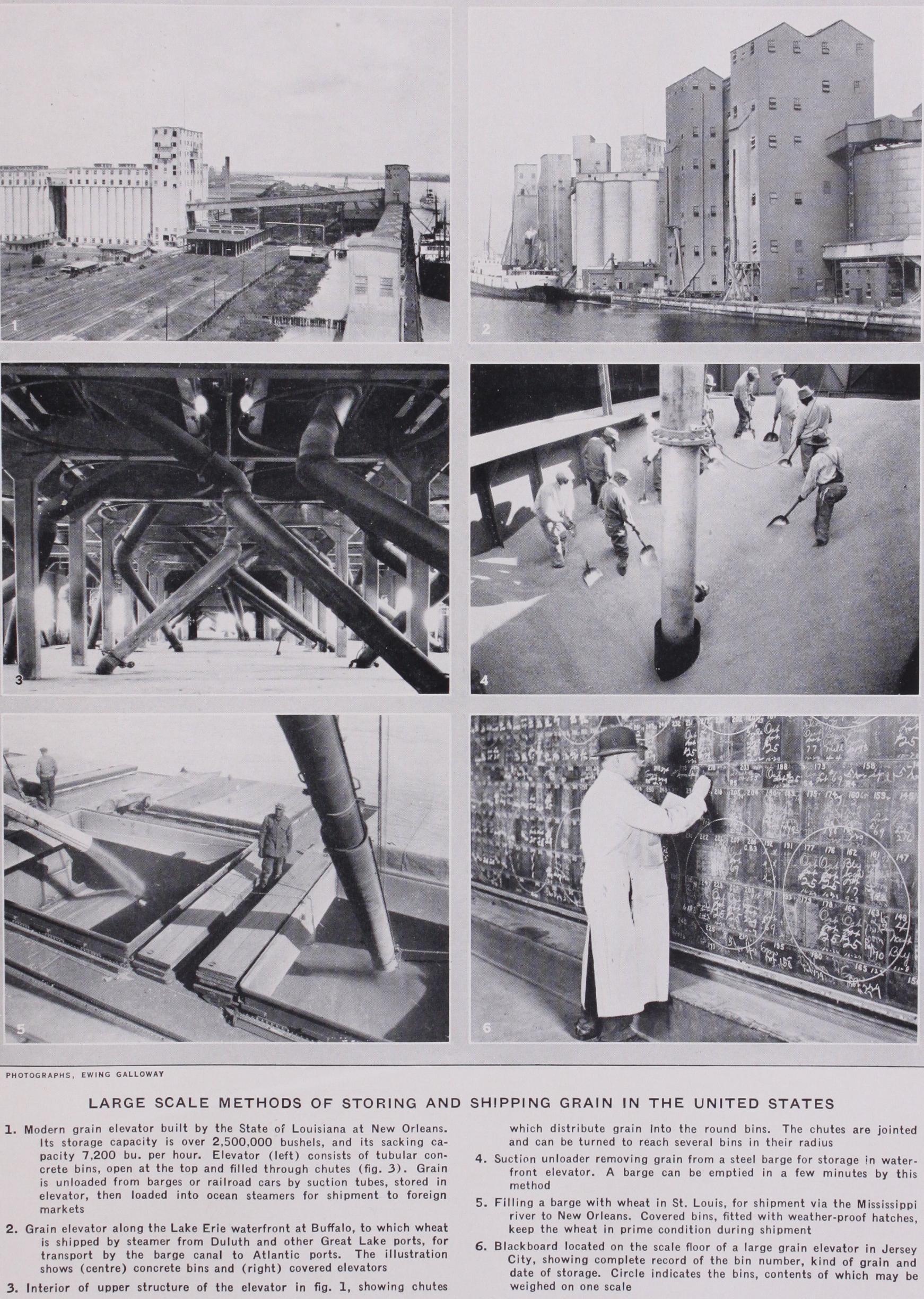
The practice of grading wheat and other grain has spread from North America to other countries, but lacking the complete ele vator systems, these cannot deal with all their crops on the basis of grades. Argentina will probably be the next country to adopt the grading certificate.
By means of one or other of these exchanges the farmer can, if he chooses to do so, sell his crop of wheat whenever the price suits him, months before it is ready for the reaper, and thus prac tically eliminate any risk of falling prices. The miller who has purchased a cargo of wheat can sell an equal quantity in the form of contracts for future delivery. Naturally he will not find this course desirable unless there is an apparent profit between the price paid for his cargo, and that obtainable for future delivery of wheat. The miller has to buy wheat for his mill, and if he makes contracts for future delivery his next enterprise is to sell the flour to be manufactured later, and, as he achieves this, to buy in his wheat contracts. He thus makes four transactions in place of the simple purchase of wheat abroad and the sale of flour at home.
The wheats tenderable against the Liverpool future delivery (Graded Wheat) contract are Canadian Spring wheat ; American Red wheat and Spring wheat ; Soft Winter wheat and Hard Win ter wheat, Argentine wheat (northern type and southern type) and Australian wheat ; but no wheat is tenderable which is unsuit able for general milling purposes.
Maize growers have grumbled at the. prices obtained but they have continued to ship. In the case of Argentina the quantities exported have steadily grown until the trade is now on a vast scale, and moreover it appears likely to increase. Argentina in deed, is regarded as the main source of supply, but in years of poor crops, the higher international price invariably encourages the United States to export. There is no country in the world that grows as much maize as the United States. The British Empire does not figure prominently as a maize exporter. The African supplies are uncertain, the Canadian climate is not suitable, and .Australia finds the international price too low. India can consume all the home crop in a normal year. As maize contains a larger per centage of moisture than wheat, it is more likely to spoil if shipped soon after harvest, or during the germinating season.
The units for maize sales on the international market are a quarter of 48olb. or a metric ton of I,000 kilos (2,2o4.61b.). American maize is sold on grade, the certificate of the U.S. grader being final. Argentine maize is sold as fair average quality and shippers guarantee full outturn on arrival; of course, the quality and condition must be right to conform to the description "fair average." South African and Kenya maize are also graded by the Government and sales are made on the basis of the official inspec tion certificate. The unit for "futures" (forward deliveries) and spot sales in Liverpool is 1 oolb. ; in America the bushel of 561b. is the legal unit. In South Africa and East Africa the bag of 2oolb. is always employed for statistics and sales.
On the British markets the supplies of home grown and foreign barley used to be about equal in quantity, so that brewers and maltsters could select the desired quality from either source, but times have changed, and in more recent years native types have predominated. Agricultural legislation has favoured the barley grower who, commencing with the season 1939-40, is entitled to a guaranteed average price, the difference between the guaranteed and the open market price being made good by payments obtained by a levy on home-brewed beer, malt, etc. The suitability of barley for malting is one of the technical studies of the grain trade and a really accurate judgment on a particular sample is not an easy matter. Of the feeding barley trade in Great Britain, Bristol is the chief centre. Sales are always made per 400lb. and the contracts expressly stipulate that imported barley shall not contain more than a fixed percentage of foreign matter, e.g., 3% or 5%. It was found necessary many years ago to fix definitely the amount of foreign matter tolerated, because it seemed the Russian peasant was trying to ship the family acres to importing countries and charge them as barley.
The higher qualities of malting and distilling barleys are mostly sold per 4481b., the lower qualities per 400lb., but this rule is not adhered to strictly, for so-called Chilian Forage is sold per 4481b. and on the other hand some good Asia Minor sorts are sold per 400lb.
The contract terms for the sale of Argentine and North Ameri can oats are the same as for other grain.
Sales on the international market are now all made per quarter of 32o1b., or metric tons of 2,204•61 lb. ; previous to the war of 1914-18 the size of the quarter varied, some qualities being always sold at 3o41b. and some at 32o1b. British oats are sold per cwt. of II21b. or per quarter of 3cwt., the former being the only legal unit. The unit in North America is a bushel of 321b., so that io bushels make one quarter of 32o1b.
The British trade in oats is chiefly in home grown grain; of the country's ordinary requirements over 8o% is produced in the British Isles, and a very large proportion is used locally for dairy ing or other cattle food and horse provender. British oats growers are subsidized, and a prohibitive tariff has been placed on foreign grown oats.
Rye is sold on British markets per quarter of 48o1b. and on the Continent the units are the quintal (2 20.461b.) and the metric ton of ten quintals. In North America rye is graded officially in the same way as other grain and is sold per bushel of 56 pounds.