
GYROPLANE, an aeroplane in which the wings are free to rotate about an approximately vertical axis. No driving power is supplied to them mechanically, their rotation being dependent on the forward motion of the whole machine. The type was originated in Spain between 1919 and 1924 by Sr de la Cierva. In his machine (the "Autogiro") an essential feature is the hinging of each of the wings about an axis perpendicular to the spindle about which they all rotate. They are prevented from collapsing upward by centrifugal force, but they have a flapping motion, of a frequency equal to that of the rotation (I oo to 13o per min.), resulting in equalisation of the lift of the advancing and retreat ing wings, thus balancing the machine laterally. The speed of the wing tips, due to their rotation, is about twice the forward speed of the machine.
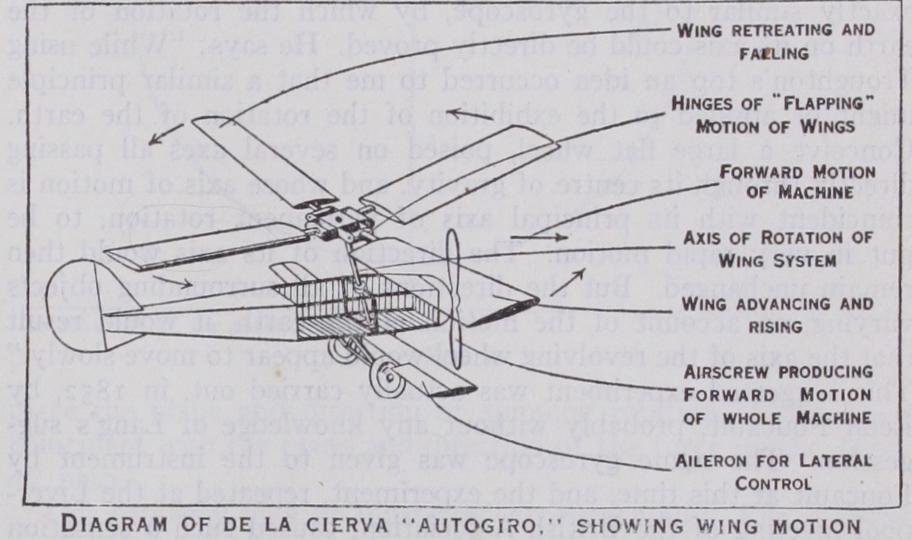
Although the "Autogiro" cannot hover, it is capable of a very low minimum flying speed, some 3om. per hour (equivalent to that of a conventional aeroplane with a wing area equal to the circle described by the wing tips) and there appears to be no "stall" as usually understood. It can glide safely at so steep an angle that it appears to the eye to be descending vertically. On touching the ground it stops after a few yards, and can thus land safely in a very small space. The essential risk of flight in normal aeroplanes is absent, and it is this particular feature which may be expected to justify the confidence of the inventor in its safety for the future.
In speed and useful load the "Autogiro" appears to be some what inferior to a normal aeroplane. In taking off it is still de pendent on initial rotation of the wings by external means, even though only a short run on the ground is needed before they at tain sufficient speed for flight. Enclosed or "cabin" models of the '"autogiro" have been manufactured and speed of the craft has been increased considerably, although these features have not made it a serious competitor of the aeroplane in transport opera tions. (See also Aeroplane; Helicopter; and Journal Royal Aero nautical Society, Jan. 1926 and June 1927.)
