
HAM. The thigh and hind leg of a pig is termed the gammon, but when cut from the carcase and separately cured it is termed the ham. As in the case of bacon (q.v.) there are different methods of curing, but the variety of methods by which hams are cured is much larger. When home curing of bacon and hams in farm houses was common every housewife had her own special recipe for pickling, curing and, generally, smoking hams. Now that the operation is done commercially on a large scale there is general uniformity of system. One or two special methods of curing have established a trade in a particular kind and quality of ham. Among them are the York ham in England, the Brandenburg ham in Germany, and the peach-fed ham in America.
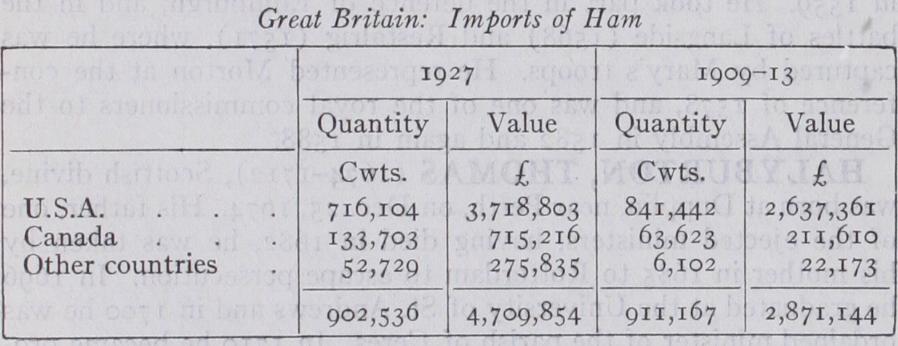
No statistics are available of the production of hams but the quantity and value imported into Great Britain and Northern Ireland are ascertainable from the trade accounts. Practically the whole of the imports come from Canada and the United States. The following were the imports in 1927, the pre-war average being added for comparison: It is noteworthy that while the importation of hams into Great Britain is less that in 19°9-13 that of bacon has increased by about 4 million cwt. The reduction has been especially marked since 1923 when I4 million cwt. of hams were imported. It appears probable that there has been an increase in British home production, but no statistical evidence can be cited in proof of this fact. (R. H. R.) United States.—In the United States the term "ham" is applied to the fresh or cured thigh of the hog. The hams are cut from the rest of the side, trimmed and cured in a pickle made of salt, sugar and a nitrate or nitrite. After pickling and soaking, the ham is smoked with fumes from hard-wood or from sawdust. Hams also are sold and consumed to some extent in the fresh state.
Production.—The production of ham in the United States runs into millions of pounds annually. An average hog will yield approximately 13% of its live weight in ham. On this basis, the production of fresh and cured hams produced commercially and in retail establishments and on farms in 1938 is estimated as 1,825, 000,000 pounds.
Exports of Ham.—Exports of ham and bacon from the United States during the period from 191 o to 1913 ranged from approxi mately 150,000,000 lb. to 200,000,00o pounds. In 1938, exports of hams and shoulders totalled 52,216,000 lb., valued at approxi mately $9,863,000. During the World War, exports of hams greatly increased. During one year they reached the total of ap proximately three quarters of a billion pounds. Most of the hams exported from the United States are sent to the United Kingdom. A few are shipped to the Netherlands, France and Belgium and also to Central and South American countries.
Marketing.—After smoking, the ham is chilled and then wrapped in a grease-proof paper, then in an absorbent paper, and finally in an attractively coloured and printed parchment paper covering for sale in the retail meat shop. Some hams are sold unwrapped but practically all hams are branded on the skin side with a trademark.
As is the case with bacon, both fresh and cured hams are traded in extensively on the Chicago Board of Trade and also are sold by one packer to another. Most trading is done in carload lots. The processing and marketing of hams is handled at many points in much the same way as bacon (q.v.).
The practice of skinning hams at the point of production is growing in the United States. Skinning involves removal of the skin and sometimes portions of the fat from the upper part of the ham.
Uses and Food Value of Ham.—Ham is one of the most popular dishes in the American dietary. This undoubtedly is due to the fact that it is very palatable and that it may be prepared easily in a variety of ways. The whole or half ham and the butt and shank may be baked or boiled; slices may be broiled or fried. It is also used extensively as a sandwich meat. From nutritional and other standpoints, ham offers some rather obvious reasons for being popular. Fresh meats must be consumed within a short space of time ; cured meats can be kept in good condition for great lengths of time. Again, ham offers a pleasing contrast in flavour to fresh meats.
Besides the points just enumerated, there is the additional virtue that ham is one of the products of a very economical meat producing animal. The hog is one of the most economical of all food-producing animals when measured in terms of the yield received from a given outlay of feed consumed by the animal. Ham is one of the most nutritious of meat foods. It furnishes large quantities of the highest quality protein. Proteins differ in their value as food for human beings according to the kind and amount of the various smaller chemical compounds, known as amino acids, of which they are constituted. As a rule, animal proteins are superior to vegetable proteins in this respect. The flesh of meat-producing animals—and this includes ham—is one of the best sources of this protein.
Readily available energy is also supplied by ham. The amount depends upon the fatness of the ham and upon the relative amount of this fat eaten. For example, lean ham may furnish about 1,200 calories and fat ham may furnish as much as 2,60o calories per pound of substance eaten. Ham is a good source of many of the mineral elements needed for adequate nutrition. Many of these mineral elements are furnished in adequate amounts in any usual diet. Those most apt to be deficient are, in the relative order of their importance : calcium, iron, iodine and phosphorus. Ham, along with muscle meats in general, is a good source of iron and phosphorus. The iodine content will depend upon whether the hog has been fed on crops grown on land that has not had its store of iodine depleted. The supply of calcium in ham is rather small.
As a source of the vitamins, ham qualifies for a place on the menu. Its content of vitamin A may be quite low, but it also may be high if the animal from which it came has been fed on feeds rich in this vitamin. According to the work of investigators in the U.S. Department of Agriculture, lean pork is an important source of vitamin B and compares rather favourably with such excellent vitamin foods as liver and kidney. Even when the pork is cured, smoked and cooked its content of this vitamin is high. Ham, therefore, is a good source of vitamin B.
Since ham is not eaten unless it is well cooked, it can not be counted as a source of vitamin C. However, it is rich in both the pellagra-preventing vitamin (G) and the vitamin needed for the no. mal functioning of the reproductive process in animals (vitamin E). (W. HA.; X.)