
HARVARD UNIVERSITY, the oldest and one of the foremost of American educational institutions, situated chiefly in Cambridge, Mass., but also in Boston and other places. In 1636 the general court of the Colony voted f400 towards "a schoale or colledge," which in the next year was ordered to be at "Newetowne." In memory of the English university where many (probably some 7o) of the leading men of the Colony had been educated, the township was named Cambridge in 1638. In the same year John Harvard (1607-38), an immigrant Puritan minis ter to America, a bachelor and master of arts of Emmanuel college, Cambridge, dying in Charlestown, Mass., bequeathed to the wilder ness seminary f 780 (half his estate) and 26o books; and the college, until then unorganized, was named Harvard college (1639) in his honour.
The history of Harvard is unbroken from 164o, and its first commencement was held in 1642. The spirit of the founders is beautifully expressed in the words taken from New England's First Fruits (1643) and carved on the college gates : "After God had carried us safe to New-England, and wee had builded our houses, provided necessaries for our livelihood, rear'd convenient places for Gods worship and settled the Civill Government ; One of the next things we longed for, and looked after was to advance Learning and perpetuate it to Posterity; dreading to leave an illiterate Ministry to the Churches, when our present Ministers shall lie in the Dust." The charter of 1650 dedicated the college to "the advancement of all good literature, arts, and sciences," and "the education of the English and Indian youth . . . in knowledge and godlynes." The second building (1654) on the college grounds was called the "Indian College." In it was set up the college press, which since 1638 had been in the president's house, and here, it is believed, was printed the translation of the Bible (1661-63) by John Eliot into the language of the natives, with his primer, catechisms, grammars, tracts, etc. A fair number of Indians were students, but only one, Caleb Cheeshahteaumuck, took a bachelor's degree (1665). By generous aid received from abroad for this special object, the college was greatly helped in its infancy.
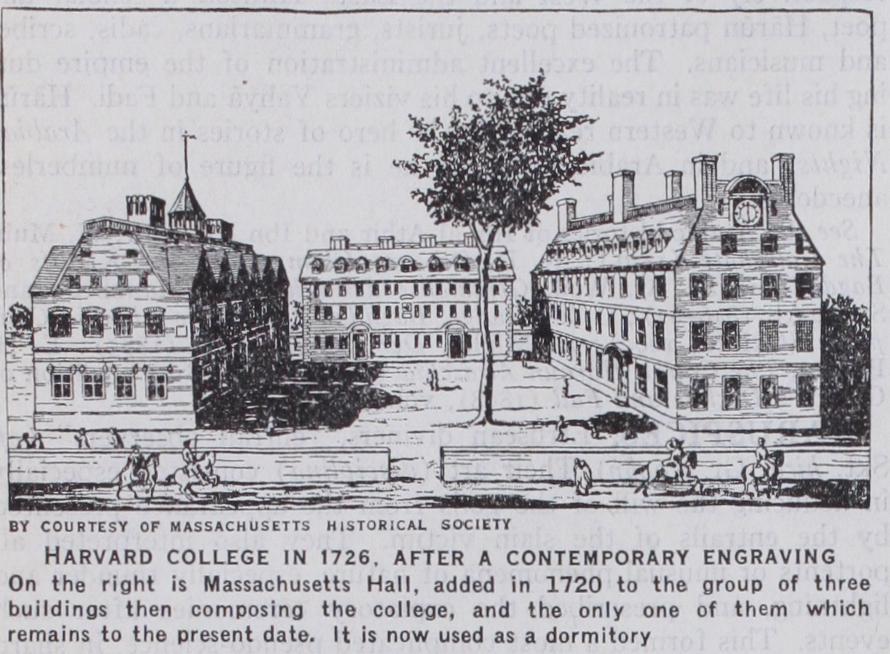
The charter of 1650 has been in the main, and uninterruptedly since 1707, the fundamental source of authority in administration. It created a self-perpetuating corporation consisting of the presi dent, the treasurer and five fellows, who formally initiate ad ministrative measures, control the college funds, and appoint offi cers of instruction and government, subject, however, to confirma tion by the board of overseers (established in 1642), which has a revisory power over all acts of the corporation. Circumstances gradually necessitated ordinary government by the resident teachers; and to-day the various faculties, elaborately organized, exercise immediate government and discipline over all the stu dents. The board of overseers was at first jointly representative of State and Church. The former, as founder and patron, long regarded Harvard as a State institution; but the controversies and embarrassments incident to legislative action proved preju dicial to the best interests of the college, and an act of 1865 severed the connection with the State. Financial aid and practical dependence had ceased some time earlier ; indeed, from the very beginning, and with steadily increasing preponderance, Harvard has been sustained and fostered by private munificence. The last direct subsidy from the State terminated in 1824, although State aid was afterwards given to the Agassiz museum, later united with the university.
The church was naturally sponsor for the early college. The changing composition of its board of overseers marked its libera tion first from clerical and later from political control; since 1865 the board has been chosen by the alumni who therefore really control the university. When in the first half of the 17th century the unity of Puritanism, in religion and in politics, gave way to a variety of intense sectarianisms, this, as also the incoming of Anglican churchmen, made the old faith of the college insecure. The conservatives, who clung to pristine and undiluted Calvinism, sought to entrench themselves in the board of overseers. The history of the college from about 1673 to 1725 was exceedingly troubled. One episode in the struggle was the foundation of Yale college by the conservatives of New England as a truer "school of the prophets" after they had failed to secure control of the government of Harvard. In 1792 the first layman was chosen to the corporation; in i 8o5 a Unitarian became professor of theology ; in 1843 the board of overseers was opened to clergy men of all denominations ; in 1886 attendance on prayers ceased to be compulsory. Thus Harvard, in response to changing con ditions, grew away from the ideas of its founders.
Harvard, her alumni and her faculty had been very closely connected with American letters, not only in the colonial period, when the Mathers, Samuel Sewall and Thomas Prince were im portant names, and in the revolutionary and early national epoch with the Adamses, Fisher Ames and Robert Treat Paine, but especially in the second third of the 19th century, when the great New England movements of Unitarianism and Transcendentalism were led by Harvard graduates. In 1805 Henry Ware was elected the first anti-Trinitarian to be Hollis professor of divinity, and this marked Harvard's close connection with Unitarianism, in the later history of which nearly all the leaders were Harvard graduates. Of the "Transcendentalists," Emerson, Francis Henry Hedge, Clarke, Conyers Francis, Parker, Thoreau and Christopher Pearse Cranch were Harvard graduates. Loagf ellow's professorship at Harvard in 1836--54 identified him with it ; Oliver Wendell Holmes was professor of anatomy and physiology at Harvard in 1847-82; and Lowell, a Harvard alumnus, was Longfellow's successor in 1855-86 as professor of the French and Spanish languages and literatures. Ticknor and Charles Eliot Norton, in literary criti cism, are other important names. The historians Sparks, Bancroft, Hildreth, Palfrey, Prescott, Motley, Parkman and Fiske were graduates of Harvard, as were the orators Edward Everett, Charles Sumner and Wendell Phillips.
In organization and scope of effort Harvard became, especially after 1869, under the direction of President Charles W. Eliot, in the highest sense a university; but the "college" proper, whose end is the liberal culture of undergraduates, continues to be the centre of university life, as it is the embodiment of university traditions. The medical school (in Boston) dates from 1782, the law school from 1817, the divinity school (though instruction in theology was of course given from the foundation of the college) from 1819,, and the dental school (in Boston) from 1867. The Bussey insti tution (at Jamaica Plain) was established in 1871 as an under graduate school of agriculture, and reorganized in 1908 for ad vanced instruction and research in subjects relating to agriculture and horticulture. The Graduate School of Arts and Sciences dates from 1872, and the Graduate School of Business Administration from 1908. The latter is situated just across the Charles river from the college and is housed in a series of suitable buildings erected in 1926-27 through the generous gift of $6,000,000.00 from Mr. George F. Baker of New York. The Lawrence scientific school, established in 1847, was practically abolished in 1907-08 but was re-established later as the Harvard engineering school, and comprises departments of study in mechanical, electrical, civil, sanitary, municipal and mining engineering, in sanitary and in dustrial chemistry and in metallurgy. There are also schools of public health, of architecture, of landscape architecture, and the Graduate School of Education to which alone of the various departments women are admitted. The university institutions include the botanic garden (1807) and the (Asa) Gray herbarium (1864) ; the Arnold arboretum (1872) at Jamaica Plain for the study of arboriculture, forestry and dendrology; the university museum, founded in 1859 by Louis Agassiz as a museum of com parative zoology, greatly developed by his son, Alexander Agassiz, and transferred to the university in 1876, though under an inde pendent faculty; the Peabody museum of American archaeology and ethnology, founded in 1866 by George Peabody ; the Fogg art museum (1895) ; the Semitic museum (1889) ; the Germanic museum (1902), containing rich gifts from Kaiser Wilhelm II., the Swiss Government and individuals and societies of Germanic lands; the astronomical observatory (1843, location 42° 22' 48" N. lat., 71° 8' W. long.), which long maintained a station near Arequipa, Peru, but removed in 1927 to a point near Bloem fontain, South Africa; besides a number of other museums and laboratories. A permanent summer engineering camp is main tained at Squam lake, New Hampshire. In Petersham, Mass., is the Harvard Forest, about 2,000ac. of hilly wooded country; this forest was given to the university in 1907, and is an important part of the equipment of the division of forestry.
The Harvard library is the largest university library in the world, and is of exceptional value. In 1936 it numbered, in cluding the various special and departmental libraries, books and pamphlets. Some of its collections are of great value from associations or special richness. There are department libraries connected with the law school, the Arnold arboretum, the Gray herbarium, the Bussey institution, the astronomical ob servatory, the meteorological observatory, the Peabody museum, the museum of comparative zoology and the schools of theology, medicine, dentistry, engineering, business administration, archi tecture, landscape architecture and education. In 1878 the library published the first of a valuable series of Bibliographical Contri butions. Other publications of the university include, for example, the Harvard Oriental Series (started 1891), Harvard Studies in Classical Philology (1890), Harvard Theological Review (19o7), Harvard Law Review (1889), Harvard Historical Studies (1897), Harvard Economic Studies (1906), Harvard Psychological Studies (1903) , Harvard Engineering Journal (1902), the Bulletin (1874) of the Bussey institution, the Archaeological and Ethnological Papers (1888) of the Peabody museum, and the Bulletin (1863), Contributions and Memoirs (1865) of the museum of comparative zoology. The Harvard Alumni Bulletin, a weekly magazine, is pub lished with the intention of keeping the graduates informed on all matters of current interest connected with the university.
In 1936-37 there were 1,977 officers of instruction and 10,870 students (1,059 in 1869), the latter including 3,735 in the college, in the graduate and professional schools, 464 in graduate medical courses and 2,141 in the summer school of Arts and Sciences and also of Education. The whole number of degrees con ferred in 1935 in all the different departments was 2,069. The average age of the students at entrance, only 14 years so late as 1820, had risen in 1890 to 19 years, making possible the transi tion to a regime of great liberty of life and studies with positive improvement to the morale of the student body. A strong devel opment toward the university ideal marked the last half of the 19th century, especially in the widening of courses, the better ment of instruction and the progress in university freedom. The elimination of the last vestiges of sectarianism and churchly dis cipline, a lessening of oversight of conduct, a lopping off of various outgrown colonial customs, a complete reconstruction of pro fessional standards and methods, the development of a great graduate school in arts and sciences based on and organically con nected with the undergraduate college, a marked improvement in the college standard of scholarship, the allowance of great free dom to students in the shaping of their college course (the "elective" system), and very remarkable material prosperity marked the administration (1869-19o9) of President Eliot.
In the co-ordination in the curricula of American colleges of the elements of professional training and liberal culture Harvard has been bold in experiment and innovation. She took a leading part in the movement that transformed university education, and her influence upon secondary education in America has been great. Her entrance requirements to the college and to the schools of medicine, law, dentistry and divinity have been higher than those of other American universities. A bachelor's degree is requisite for entrance to the professional schools (except that of dentistry), and the master's degree (since 1872) is given to students only for graduate work in residence, and rarely to other persons as an hon orary degree. In scholarship and in the growth of academic free dom Germany gave the quickening impulse. This influence began with George Ticknor and Edward Everett, who were trained in Germany, and was continued by several eminent German scholars, some driven into exile for their liberalism, who became professors in the second half of the 19th century, and above all by the many members of the faculty later trained in German universities.
The ideas of recognizing special students and introducing the elective system were suggested in 1824, attaining establishment even for freshmen by 1885, the movement characterizing partic ularly the years 1865-85. The basis of the elective system is free dom in choice of studies within liberal limits. This freedom was modified in 1910 by requiring each student to choose enough courses in one field to enable him to gain considerable knowledge of that subject, and by distributing a certain number of courses among other fundamental subjects so as to secure a more well rounded education. At the same time the "degree with distinc tion" was established for high attainment in general, coupled with distinguished success in the subject to which the student had given most attention. Beginning with 1916, general final examina tions on the student's field of concentration were introduced for all students in the departments of history, government and eco nomics; the plan was later extended to almost all departments.
In the years following 1916 a system of tutors was developed to direct the private reading of the students. The tutor meets his men individually each week and advises as to their private study; he is in no sense a coach. The results thus far show that the tu torial system is of great educational value. In 1931 the "House Plan," made possible by large gifts by Mr. Edward S. Harkness, went into operation. Under this plan the three upper classes live in "Houses", each holding about 30o students, with tutors and a head-master. In 1935 there were seven houses, each con taining students so selected as to be representative of the college as a whole. It is believed that in this way any advantage that a small college may have is united with those of a large college.
The material equipment of Harvard is very rich. The total in vestments were valued June 3o, 1936, at $134,601,999.05. For the fiscal year ended on that day, the total income of the university, excluding gifts to capital account and gifts for immediate use given in that year, was $9,689,331.56. Gifts in the year were for capital account $5,188,074.91; for immediate use, In the year (1934-35) the amount distributed in scholarships, fel lowships, prizes, loans and other aids to students was $703,010.91. Among the university buildings are residence halls, dining halls, libraries, laboratories, museums, a theatre for public ceremonies, a chapel, an infirmary, gymnasiums, boathouses and a concrete stadium capable of seating 54,00o spectators.