HAVANA or HABANA, capital and commercial metropolis of the Republic of Cuba, the largest city of the West Indies and one of the most progressive tropical cities in the New World, lies on the northern coast of the island of Cuba, toward the western end, at 23° 9' N. lat. and 82° 2 2' W. long. The population was
in 1899, the year following independence, and 542,522 in 1931. Havana is the seat of the Federal executive, of the national Congress and of the Supreme Court of the nation. It boasts one of the finest natural harbours of the Caribbean region, completely protected and accessible to ships of virtually any draught. In recent years the city has undergone a wide-spread change to modernity, the narrow harbour entrance as well as the outer shore have been flanked by a broad avenue, important streets have been cut through the older city, and the narrow centre, for some years unimaginably congested with motor traffic, has been made more easily accessible to the outer suburbs and the newer sections.
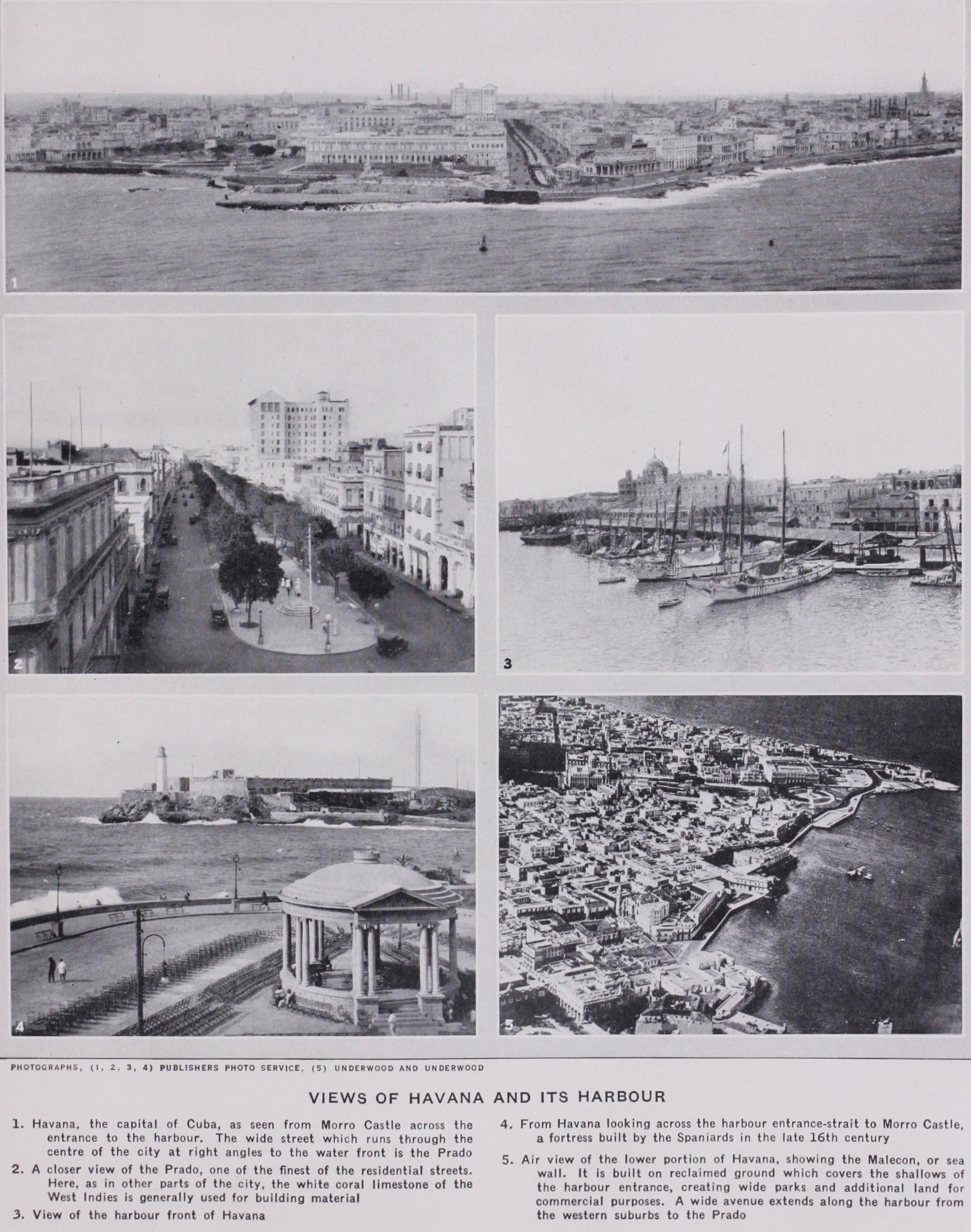
Havana occupies a peninsula west of the harbour, Morro castle, a landmark and powerful fortress of the Spanish colonial days, occupying the opposite point of the narrow harbour entrance. This entrance strait, some 25o metres wide and 1,400 metres long, leads to the inner harbour, which lies east and south of the city, whose water front in the older sections is lined with wharves and docks, to which ocean-plying ships tie up and unload. There are three distinct arms of the inner bay, called, respectively, Marimalena or Regla bay, Guanabacoa bay and the Bay of Atares. About three-quarters of the imports and a large portion of the exports of the island pass through Havana, and shipping from every country of the world centres there. It is now the terminus of the train ferry from the United States carrying loaded cars of freight to and from Key West. The passage of this train ferry occupies six hours from the United States port to the Cuban, and a large proportion of the perishable freight between the two countries travels by this unique route; a similar train ferry is to connect Havana and New Orleans. Havana is also the terminus of the air-mail and passenger planes from the United States and an important station in the air-mail connection from the United States south-eastward to Haiti, Santo Domingo, Porto Rico and the lesser Antilles and, west and south, via Yucatan and Central America, to the Panama Canal Zone.
The aspect of Havana from the sea is striking and picturesque. The suburbs, with beautiful residences and country clubs, lie along the seacoast, and at the entrance of the harbour, the Morro, with its picturesque lighthouse rises to the left, while on the right the city, built of the white coral limestone of the West Indies, rises on either side of the superb avenue, properly called the Paseo de Marti, but commonly known by its old Span ish name of the Prado. The lower Prado is lined with residences, but the so-called Upper Prado leads to the Parque Central on one side of which has been built the pretentious and costly new Legis lative Palace, begun by President Jose Miguel Gomez about 1910 and finished under President Gerardo Machado in 1929.
From well out toward the western suburbs, the Malecon, or sea wall, a wide avenue which skirts the sea and city, has furnished a colourful foreground which now is extended along inside the harbour, on reclaimed ground which covers the shallows of the harbour entrance, and creates wide parks and valuable commercial lands. The Malecon merges at the Prado into the new Avenida del Puerto, which with a width varying from 15 to 37 metres, connects this outer drive to the old, narrow streets of the business section. This new entrance to the old business streets of O'Reilly, Obispo (Pi y Margall) etc., has wiped out much of the old down-town congestion. Most of the old streets of Havana, laid out to furnish shade along their narrow drives and walks and to carry only a few dozen old fashioned Cuban coaches (quitrines or volantas) now carry the hundreds of automobiles in one direction only, giving a more ordered control of the traffic problem.
Many new public buildings are being built along the Malecon and the Avenida del Puerto, including the handsome Capitania, or office of the captain of the port and the new section has also a number of fine parks, notably the Parque del Maine, with its handsome monument dedicated to the American battleship "Maine," which was blown up in Havana harbour on Feb. 15, 1898. Another recent and important public building is the Presidential palace, the residence of the chief executive, at the head of the Avenida de las Misiones, a wide new thoroughfare; this avenue leads from Avenida del Puerto inland, and is designed to be lined for its short length with the embassies and legations of foreign Governments.
Of the older landmarks, one of the most important is the old palace of the Spanish governors, now the office of the Ayuntamiento or city government ; this fine old pile stands on the site of the original parish church, on the eastern side of the Plaza de Armas, the old centre of the colonial city. The palace was erected in 1773-92 and remodelled in 1835 and 1851. It was the scene of the surrender by the Spaniards of the sovereignty of the island to the United States at the close of the Spanish-American War and the scene, too, of the transfer of its sovereignty from the United States to the first president of Cuba, Tomas Estrada Palma, on May 2o, 1902.
The most precious of the old historical landmarks, however, is the ancient stronghold, La Fuerza, or more properly, El Castillo de la Real Fuerza, begun in 1565 and completed in 1583, standing on the site of the yet older fortress built by order of Hernando de Soto in 1538, but destroyed by the French pirate Jacques de Sores. The present fortress was from 1584 until the middle of the i8th century the home of the governors general and the citadel and refuge of the populace in times of danger. Crowning the old watch-tower of La Fuerza is a weather vane formed in the shape of a woman, called "La Habana" or "The Havana," the origin of a local adage that "Many have visited Havana who have not seen The Havana." Another old building is that used by the senate, of elaborate i8th century Spanish baroque architecture, recently restored. The old city also contains the post office (the church of San Francisco), begun in 1575 and rebuilt in 17 31-37. Also the old municipal jail, a typical Spanish fortress on the Prado, and the Castillo del Principe, now the penitentiary. In this section also is the national library, the Maestranza, formerly the navy yard and the headquarters of the artillery. The old city abounds, also, in ancient private residences, many of them now in the hands of the Government or patriotic societies, which preserve and have restored them with appreciative care.
Many of the present public buildings were formerly churches, and indeed churches of the colonial epoch are still amongst the most interesting and carefully preserved relics of the older days. The convent of Santa Clara, built in 1644, was in 1928 bought by the Government at a substantial price and converted into the ministry of public works ; in the large patio of this old building are still preserved the first houses and streets built in Havana, as they were enclosed in the old church and monastery by its builders in the 17th century. The cathedral is the most note worthy, architecturally, of the city's churches; it was originally the Jesuit church, erected between 1656 and 1724, although the interior decorations date only from 179o-182o. One of the tombs of Columbus is marked here ; the remains of the discoverer were removed, according to certain claimants, from Santo Domingo in 1796, and lay here until carried to Spain in 1898. (See COLUM BUS, also SANTO DOMINGO, for the Dominicans claim that Co lumbus's bones still lie in their ancient cathedral.) Other fine old churches of Havana, like Santo Domingo (1578), Santa Catalina (170d), San Agustin (1618), La Merced (1744), San Felipe (1693) and Belen (1704), have suffered from the ravages of time and have gone or will go soon, to make way for new busi ness structures.
Havana has been famous since the days of the Spaniards for its parks and drives. The harbour's edge on the east is traversed in part by the old Paseo or Alameda de Paula, originally laid out in 1772, and by the new Avenida del Puerto, the latter a portion of the elaborate modern reconstruc tion of Havana (including the opening of the Avenida de las Misiones and the beautification of the Prado), designed and carried out under Dr. Carlos Miguel de Cespedes, while minister of public works under President Gerardo Machado. The Malecun or sea wall drive, now extended around the harbour entrance as the Avenida del Puerto, traverses the edge of the city along the sea for several miles, a beautiful drive and promenade. The Prado, rechristened the Paseo de Marti in honour of the "Apostle of Cuban independence," follows the line of the old city wall, past the Parque Central to the Plaza de la Fraternidad, formerly Parque de Colon or Campo de Marte. The Prado is lined with handsome homes and clubs. It curves in its course and furnishes a highway into the heart of the old city, although its formal climax is the Parque de Colon, where stand handsome monuments to Jose Marti and other Cubans notable in history and science. This park is surrounded by handsome offices, hotels and clubs, among them the more elaborate and costly Centro Asturiano one of the two large Spanish clubs, the other being the Casino Espanol, 6o,000 members. In this section are most of the half-dozen very modern and handsomely equipped hotels that make Havana an important winter resort.
From Plaza de la Fraternidad, the Avenida de Simon Bolivar, formerly Calzada de la Reina, reaches the Paseo de Carlos III. and the Paseo de Tacon, passing westward through the city to the botanical gardens and the Quinta de los Molinos to the old citadel of El Principe, begun in 1774 and finished 20 years later. Los Molinos was once the summer palace of the Spanish governors general and now adjoins the gardens of the university, whose fine modern buildings were dedicated by their use for the Sixth Pan American Conference in 1928. Near El Principe is the Colon cemetery, with many historic monuments and handsome mausole ums. Another famous promenade and drive is the Avenida de Menocal, at the west end of the new city; the Cerro, in the south west, is a handsome residence quarter, with many elaborate homes.
Suburban growth in Havana has been rapid and extensive, the whole territory now tributary to the capital, thanks to good roads and automobile traffic, covering a large area. On the south and west the city is surrounded by a range of hills, with the con spicuous fortifications of Castillo del Principe on the west. Lower down on the hills are the suburbs of Venado, Jesus del Monte and Luyana; besides these Puentes Grandes, old Marianao and Guanabacoa are healthy and populous suburbs ; along the sea coast, baths excavated in the coral rock mark clubs and resorts; such baths make swimmers safe from sharks.
As Havana was, and is, the chief centre of political and commercial life of Cuba, so its charities and educational facilities are the most complete in the island. Ancient foundations compete with modern institutions, in the former category, the Casa de Beneficencia y Maternidad (charity and maternity hospital), dating from 1794, while the Club Astu riano, one of the richest of the modern Spanish clubs, has its own modern sanitarium in the midst of the city. The university is the most important and its buildings the most modern of the edu cational facilities of the capital, but there are fine secondary schools, a fairly complete system of primary education, virtually all of it built since independence, and some notable Roman Catholic schools. Libraries are improving. The Sociedad Econo mica de los Amigos del Pais, founded in 1792, has one of nearly 50,00o vol., and the National library, dating only from 1901, over 100,000, including donations from historical sources.
The newspapers of Havana are modern, progressive and nu merous. The Diario de La Marina is the oldest, having been founded in 1838. El Mundo is a powerful younger rival in the morning field, while the evening papers, though less formal than the morning press, are influential and enjoy wide circulation.
Havana has grown steadily since its foundation, boasting 51,307 people in 1 7 91; 96,304 in 181 1 ;
in 1817; 184,508 in 1841; 235,981 in 1899, the year fol lowing independence; 360,517 in
in
in 1931. In 1929 it was estimated to have together with the suburbs and tributary territory close to a million. The
census, made by the U.S. administration, showed 25% of the population foreign (2o% being Spanish), a figure which probably continues, as there is a heavy immigration from Spain each year besides the temporary workers who come annually to Cuba (via Havana) for the sugar cutting, and return home to Spain (and Italy) when it is done.
The workers' residence portion of the city is congested, and be fore the American occupation, health conditions were notoriously bad and deaths from epidemics, including periodic scourges of yellow fever, rose to high figures. One of the worst of the yellow fever epidemics broke out in 1900, immediately following the War of Independence, and concomitant with a heavy immigration from Spain. Stringent sanitary regulations failed to stop the epidemic, and the efforts of the American army surgeons to locate the method of transmission of yellow fever led directly to the dis covery of the part played by the stegomyia mosquito; Maj. Walter Reed, of the U.S. army, gave his life through voluntary in fection with yellow fever through a mosquito bite to prove the theory. Maj. William C. Gorgas (q.v.), later the sanitary officer who cleaned up the Panama Canal Zone, led the fight that prac tically exterminated the mosquitoes of Havana and ended yellow fever epidemics. Havana is now one of the most carefully pro tected ports in the world, so far as sanitary measures are con cerned, and its death rate has long since been reduced to normal proportions. Recent changes in the water system, with additions of new reservoirs, has brought the excellent water from the hills into the capital and the fetid Havana of the colonial period is now a memory only.
Havana is the terminus of the chief rail ways of the island, every community of the republic seeking com munication with the capital. It is also the focus of the important new Central highway, extending the length of the island, with Havana as the radiating centre of the two branches east and west; the highway was begun in 1927, to be completed in 193o, of solid concrete base, concrete bridges and surfaced with asphalt corn position. Havana also has the most complete steamship service with the outside world, being a principal stop for passenger liners to and from the Panama Canal and the Caribbean region, and in touch with United States and European ports by direct lines. Cable, telephone and radio link it to the outside world.
Havana was founded in 1514 by Diego Velasquez in an unhealthy site now occupied by the town of Batabano, but was early removed to its present site and rapidly assumed an in creasing importance in the Spanish colonies of the New World. In 1634 its important strategic position was recognized by a royal decree declaring it to be the "Llave del Nuevo Mundo y Ante mural de las Indias Occidentales." (Key to the New World and Bulwark of the West Indies), and the arms of the town to-day carry the symbolic key and its two fortresses. The town has been the object of numerous attacks by English, French and Dutch pirates. In 1537 it was sacked and burned, in 1555 it was plundered by French buccaneers and in 1586 Sir Francis Drake threatened it; but in 1589 Philip II. of Spain ordered the erection of the Punta and the Morro, the ancient defences, and the resi dence of the governor of the island was removed from Santiago de Cuba to Havana, which gained the rank of a city in 1592. It is estimated that the population of the city was about 3,00o by
but had doubled by 1655, when many Spaniards fled there from Jamaica after the capture of that island by the English. During the 17th century Havana became the port of rendezvous of the east-bound fleets of Spanish galleons and was thus the object of many attacks by the English, Dutch and French. The port was blockaded four times by the Dutch in the first half of the 17th century and in 1671 the city walls were begun, being completed in 1702. The European wars of the 17th and i8th centuries were marked by various incidents in local history. After the end of the Spanish War of Succession (1713) came a period of com parative prosperity in slave-trading and general commerce. The creation, in 174o, of a monopolistic trading-company was an event of importance in the history of the island. English squadrons threatened the city several times in the first half of the i8th century, but it was not until 1762 that an investment, made by Admiral Sir George Pocock and the earl of Albermarle, was suc cessful. The siege lasted from June to August and was attended by heavy losses on both sides. The British commanders wrung great sums from the church and the city as prize of war and price of good order. By the treaty of Feb. 1o, 1763, at the close of the Seven Years' War, Havana was restored to Spain in ex change for the Floridas. The English turned over the control of the city on July 6. Their occupation greatly stimulated com merce, and from it dates the modern history of the city and of the island. The gradual removal of obstacles from the commerce of the island from 1766 to 1818 particularly benefited Havana. At the end of the i8th century the city was one of the seven or eight great commercial centres of the world, and in the first quar ter of the 19th century was a rival, in population and in trade, of Rio Janeiro, Buenos Aires and New York. In 1789 a bishopric was created at Havana suffragan to the archbishopric at Santi ago. From the end of the i8th century Havana, as the centre of government, was the centre of movement and interest. During the administration of Miguel Tacon Havana was improved by many important public works; his name is frequent in the nomen clature of the city.
In general, the history of Havana under the Spaniards, and since independence, has been the history of Cuba. Various pirate raids, the slave traffic in the i8th and i9th centuries, filibuster ing expeditions in the 19th century, and the war (ushered in by the blowing up of the U.S. battleship "Maine" in Havana harbour, Feb. 15, 1898) between Spain and the United States in 1898-99, all had direct bearing on the history of Havana and the city suffered and triumphed with them. These are noted in the article on Cuba.
Havana, like other cities of the West Indies, has suffered from the hurricanes that scourge that region, the most violent being those of 1768, 1810 and 1846, while in 1907 and again in 1926, Havana suffered severely from notable hurricanes.
is little descriptive data in book form in EngBibliography.-There is little descriptive data in book form in Eng- lish, and the most important references are those under the article on Cuba (q.v.). In Spanish, there are some valuable works, including the following: J. M. de la Torre, Lo que fuimos y to que somos, o la Habana antigun y moderna (Havana, 1857) ; P. J. Guiteras, Historia de la conquista de la Habana, 1762 (Philadelphia, 1856) ; J. de la Pezuela, Sitio y rendition de la Habana en 1762 (Madrid, 1859) ; A. Bachiller y Morales, Monogra f la Kist orica (Habana, 1883) , minutely covering the English occupation (the best account) of 1762-63 ; Maria de las Mercedes, comtesse de Merlin, La Habana (Paris, 1844) . (W. Tim.)
