
HAWAII (hah-wi'i; native hah-vah'e-e), HAWAIIAN (N. SANDWICH ISLANDS, capital Honolulu (q.v.), geographi cally a chain of islands near the centre of the north Pacific ocean, 1,578 m. from E.S.E. to W.N.W., between 18° 55' and 28° 25' N. and 154° 48' and 178° 25' W. Politically, as a Territory of the United States, it consists of the islands ceded by the Republic of Hawaii to the United States in 1898 and made a Territory by Congress in 1900, and hence excludes the small coral island, Mid way, which was acquired by the United States in 1859 and has been used since 1902 as a cable station, and includes two small un inhabited coral islands not in the chain, Johnston (or Cornwallis) and Palmyra.
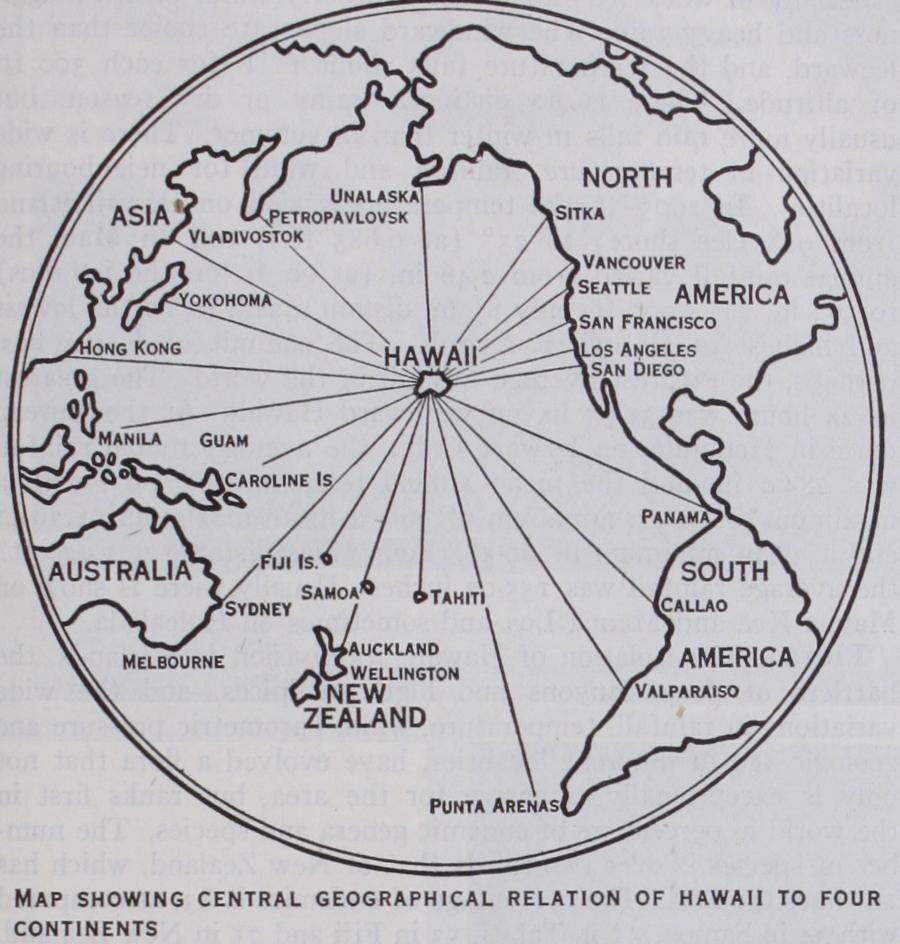
Hawaii, comprising both volcanic and coral islands built up from depths of 15,000 to 18,000 ft., is the northernmost of the central Pacific island groups. It has the largest area (6,412 sq.m.), and greatest altitude (13,825 ft.). It is also the most isolated of important land areas. The nearest important groups to the south are Samoa, 2,263, and Tahiti, 2,390 nautical miles. To the north, Unalaska in the Aleutian islands is 2,106, and to the west, Guam is 3,337 miles. The distances in nautical miles from Honolulu to principal ports of the Pacific are: San Francisco, 2,ioo; Los Angeles, 2,226; Seattle, 2,409; Sitka, 2,395; Yokohama, 3,445; Sydney, 4,424; Panama, 4,665; Manila, 4,778; Hongkong, 4,961; Valparaiso, 5,916. Cape Horn is 6,488 miles. The large, high, inhabited islands, Hawaii (4,03o sq.m.), Maui (728), Molokai (260), Lanai (141), Kahoolawe (45), Oahu (604), Kauai (555) and Niihau (72), together with their nearby small uninhabited islands, form the east-south-east fourth or about 375 m. of • the chain, extending to 2 2 ° 14' N. and i6o° 15' W. The islands of the remainder of the chain are so small that their total area is only 6 sq.m., and yet they afford a rich field for the naturalist. Those in the west half of this part of the chain are coral (mostly sand) islands; those in the other half, forming a transition link with the large inhabited islands, are lava-rock. The islands of the entire chain apparently were formed beginning at the westerly and finishing at the easterly end, where there are still active volcanoes.
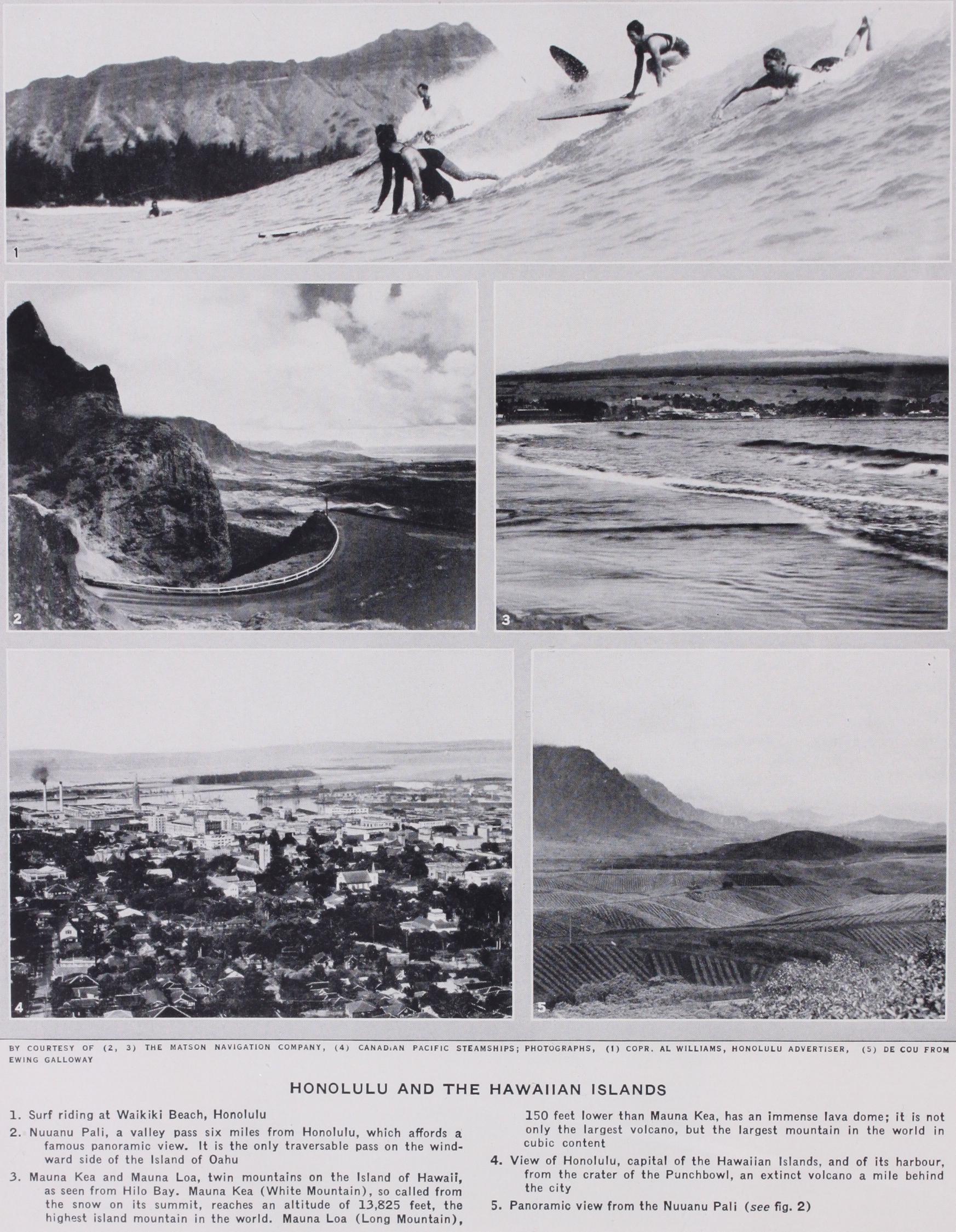
The Kohala mountain or range (5,505 ft.), the oldest, its wind ward side deeply eroded, its top a water sponge, its leeward side dry, with the higher slopes covered with cinder cones, forms the north angle of the island. Next, south-easterly, is Mauna Kea ("White Mountain," so-called from the snow on its summit) . There are glacial markings on its upper windward slopes. At 13,000 ft. there is a small lake, which often freezes over, and nearby are extensive quarries of fine-grained, compact greyish stone, of which the Hawaiians of old made their best adzes and other implements. The crater has disappeared, blown up in an explosive eruption, or covered by reddish cinder cones, which in great numbers dot the summit and upper slopes. This is not only the highest mountain of the group but the highest island mountain in the world (13,784 feet). In a real sense it is also the highest of all mountains in the world, for, although many others are higher above sea-level, this starts from a great plain 18,00o ft. below sea-level and is built up from that as a single mountain, rising within a distance of 5o m., to a height of nearly 32,00o feet.
South-westerly from Mauna Kea is Hualalai (8,269 ft.), whose summit, like that of Mauna Kea, has no great crater and is cov ered with cinder cones, but, unlike Mauna Kea, has many small pit craters. Its only flow in historic times was in 1801. Further south is Mauna Loa, "Long Mountain," twin of and Ioo ft. lower than Mauna Kea. Except for the cinder cones of the latter it would be higher. It is an immense lava dome, not only the largest volcano, but the largest mountain in the world in cubic content ; it discharges more lava than any other volcano. On the summit is an elongated pit crater, Mokuaweoweo (3.7 sq.m.), with vertical walls soo to 600 ft. high, from which radiate black and brown lava flows of bygone ages. While at times, especially preceding eruptions, the summit crater is exceedingly active, no flow has originated there in historic 'times. All historic flows, ex cept submarine, have burst from the sides at elevations of 7,000 to 13,00o ft., usually on two lines running north-east and south west respectively from the summit. The principal flows of the last century were in (33 m. long, i m. wide in places), 1868, 1877 (submarine), ; 1907-16-19-26, and 1935-36, when the flow was bombed to divert its course.
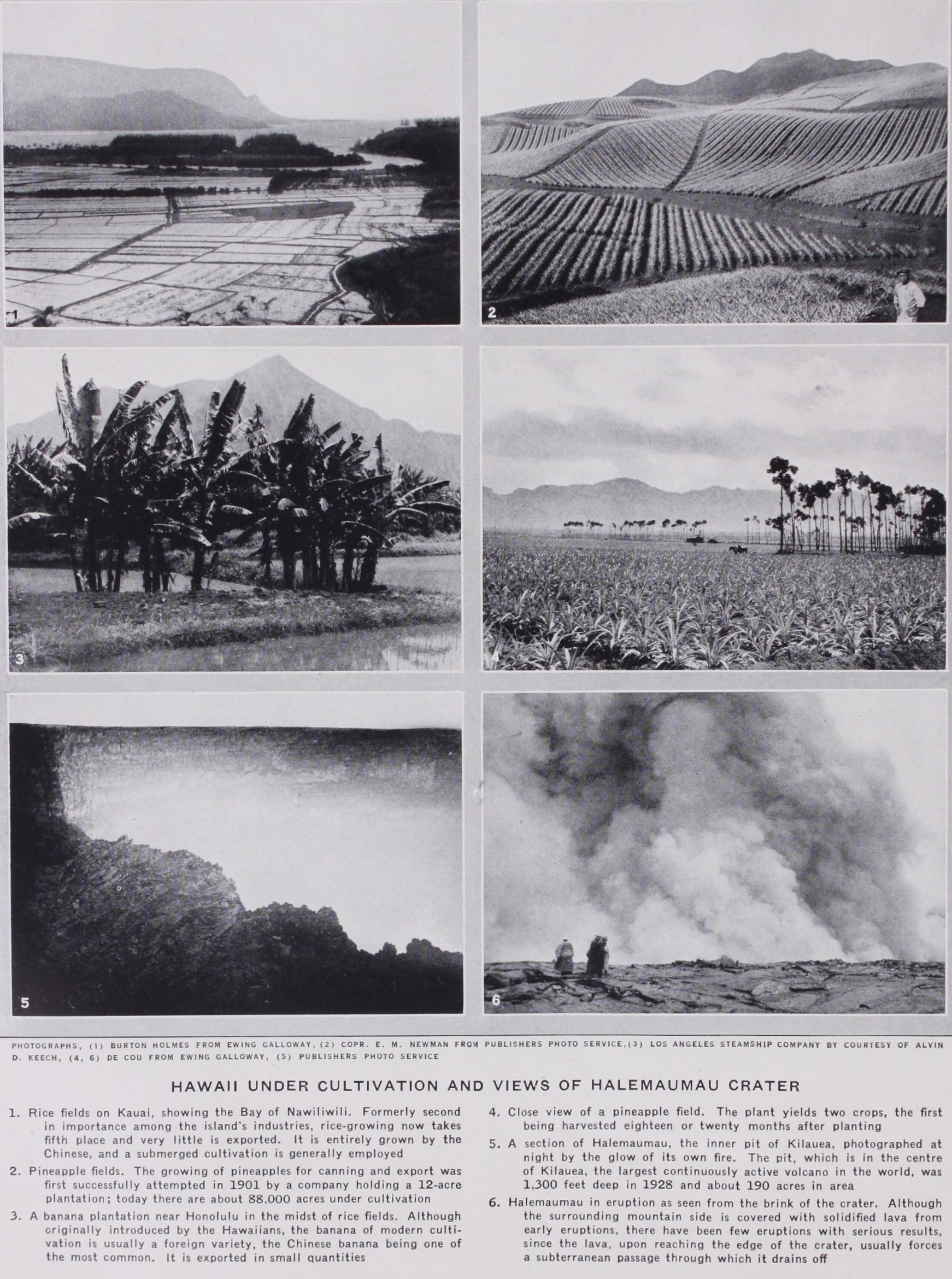
Lastly and easternmost, is Kilauea, with the largest and most spectacular of all active craters, an oval pit 4.14 sq.m. in area, with walls now soo ft. high—i,000 ft. a century ago. It is hardly a distinct mountain, for, although an independent volcano and older than Mauna Loa, it is merely a hole in the side of the latter at an elevation of 4,090 ft.; it is reached by motor in an hour, over 3o m. of concrete road through tropical forests from Hilo. Except for occasional flows over the floor of the main pit, visible activity has, for several decades, been confined to an oval inner pit, Halemaumau, 3,00o by 3,50o ft., and 1,3oo ft. deep in 1936. Operating in cycles, the lava rises until it overflows and breaks through some subterranean passage and drains out, only to begin the cycle again. During the i9th century and the early years of the 2oth the only flows of size outside the crater, and some distance from it, were those of 1823-40-68 and 1920-21, but small quantities of lava have erupted nearer in 1832-68, 1922 and 1923. Just before the last drop-out, in 1924, the lake of boiling molten lava covered about 5o ac., and when the lava fills the present enlarged caldera it will cover about 190 acres.
Only two explosive eruptions have occurred in historic times, those of Kilauea in 1790 and 1924, the earlier of which destroyed a division of a Hawaiian army. Earthquakes have been numerous and tidal waves occasional on the east coast of Hawaii island, but have done little damage, except in 1868, when, at the time of the lava flow of that year, a landslide i by 3 m., the so-called "mud flow," killed 31 persons; a tidal wave swept away several small villages, killing 46 persons, many houses were levelled, great cracks opened and the coast subsided some feet. All historic flows of Mauna Loa and Kilauea have been in regions of few or no habitations. That of 1826 covered the small village of Hoo puloa without loss of life. The lavas are of two kinds, pahoehoe, of smooth but wrinkled, shiny surface, and aa, exceedingly broken and jagged. Since 1911 a volcanic observatory has been main tained at Kilauea, and in 1916 the National Government created the Hawaii National park consisting of the Kilauea and Mauna Loa sections (245 sq.m. together) on Hawaii, and the Haleakala section (26 sq.m.) on Maui, to which was added in 1927 a strip (72 sq.m) connecting the first two sections. In the Kilauea sec tion, visited by 6o,000 persons annually, besides the active vol cano. there is much of interest, such as numerous other pit craters, sulphur banks, pumice beds, lava tubes, tree molds, lava trees, lava spatters in trees, stalactites, Pele's hair (Pele being the Hawaiian goddess of volcanoes), tropical forests and birds and sulphur-steam baths.
Hundreds of species have been introduced into the islands since their discovery by Europeans and about 25 were introduced anciently by the Hawaiians. Among the ancient introductions are the coco-nut, breadfruit; ohia ai or mountain apple (.Iambosa malaccensis) ; taro (Colocassia antiquorum, roots used for making a paste, poi, the principal food of the Hawaiians) ; sweet-potato; yam ; banana ; pia or arrowroot (Tacca pinnati fida) ; sugar cane; gourd ; awa and ti (Piper methysticum and Cordyline terminalis), roots used for making drinks, and leaves of ti, for wrappers, plates, etc. ; olona (Touchardia lati f olia, yielding exceedingly strong and durable fibre for fish nets, etc.) ; wauke (Brous sonetia pa pyri f era) , fibre used for making kapa or paper cloth; kukui or candle-nut (Aleurites moluccana), useful for candles, oil, dyes, paint, gum, food and medicine; snilo (Thespesia popul nea) and kou (Cordia subcordata), now almost extinct, and kamani (Callophyllum inophyllum), all three yielding beautiful wood valued for making calabashes and other dishes ; and hau (Paritionn tiliaceum), useful for making outriggers and rope and training over arbours for shade, noni (Morinda citrifolia), useful for dyes and perhaps ginger. Among the more common later in troductions are the avocado or alligator pear, mango, pineapple, orange and other citrons fruits, papaya, guava, coffee, grape, fig, poha or cape gooseberry, litchi, mulberry, tamarind, date, passion fruits, eugenias, cherimoya, custard apple and the Queensland nut.
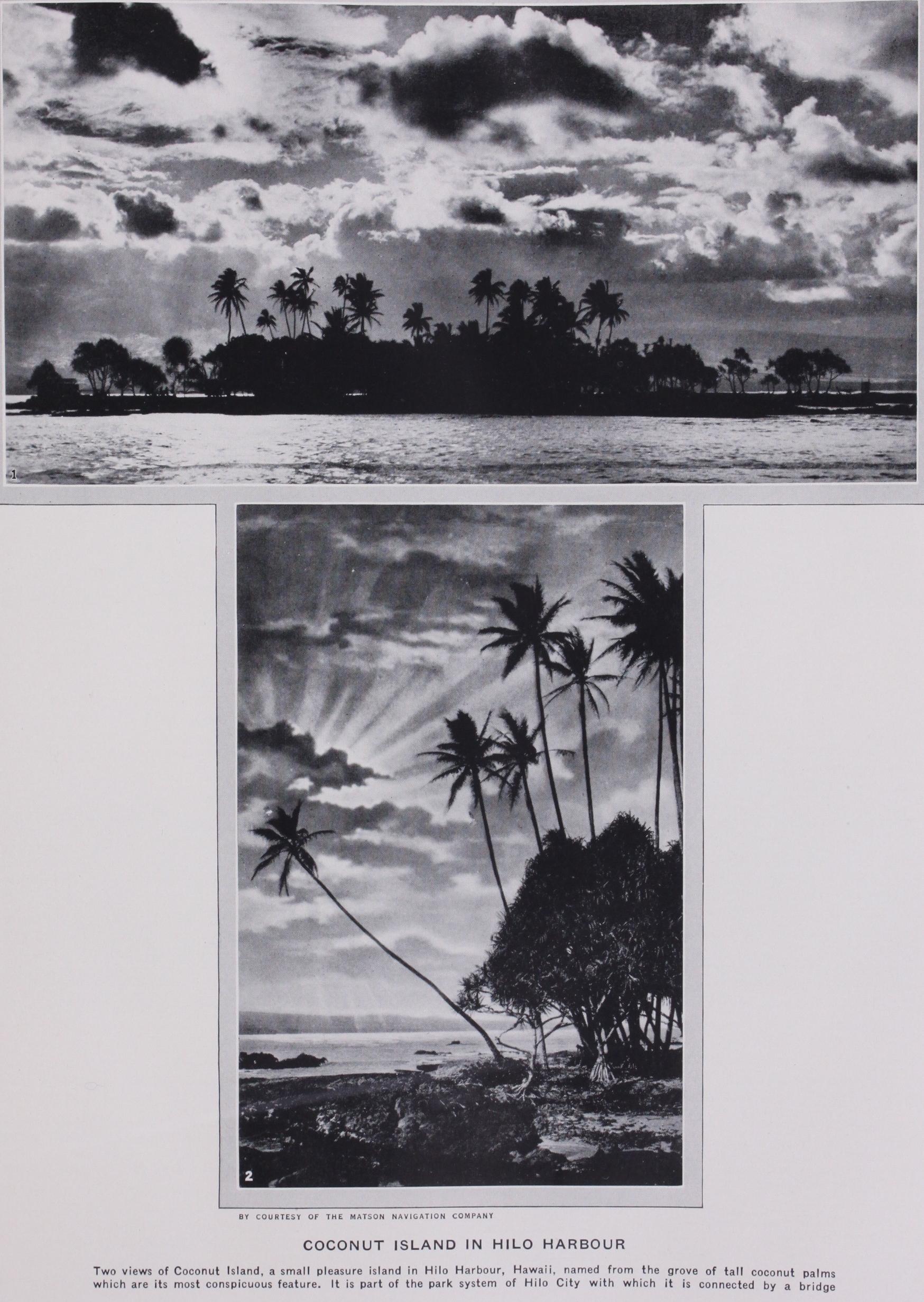
There were about 125 species of birds, resident and migrant, of which, perhaps, a score are now extinct. On the inhabited islands the native birds are disappointingly few, as their habitats are mostly in the forests and on the heights. A striking example of bird evolution is found in the song-bird family (Drepanididae) with 6o species, all peculiar to Hawaii. Most prized for feather work were the yellow feathers of the now-extinct mamo (Dre panis pacifica) and nearly-extinct oo (Moho nobilis) ; the vermil ion, of the iiwi (Vestiaria coccinea) ; and the crimson, of the apapani (Himatione sanguinea). Very common are the brown elepaio (Chasiempis sandwicensis) ; the green-and-yellow amakihi (Chlorodrepanis spp.) ; and the ou (Psittirostra psittacea), the best Hawaiian songster. A wild goose, nene (Bernicia sandwicen sis), confines itself to dry areas. The birds most commonly seen on the lower and more open areas are exotics. Chickens were anciently introduced by the natives, and the later introductions include, besides various domestic fowls, the skylark, Chinese thrush, mynah, turtle dove, pigeon, linnet, blue-cheeked parrot, rice bird, English sparrow, pheasant, quail and California partridge.
The only native land reptiles are seven species of small skinks and geckos, commonly called lizards. There are no snakes, and the frogs and toads are introductions. Although there are several thousand species of indigenous insects, mostly endemic, they are not troublesome or destructive. The noxious forms are mostly introductions, such as the sugar-cane leaf-hopper and borer, rice borer, Mediterranean fruit fly, melon fly, Japanese beetle, horn fly, cutworms, army worms, termites, fleas and mosquitoes. Per haps no animal group has contributed more light on the subject of evolution than the 500 species of land and fresh-water shells of Hawaii, especially the beautiful tree shells (Achatinellidae). The exceptionally rich marine animal life includes more than 65o species of fish, many of which are fantastic in shape and colour. Among introduced fishes are trout, carp, black bass, catfish, goldfish and top minnows.
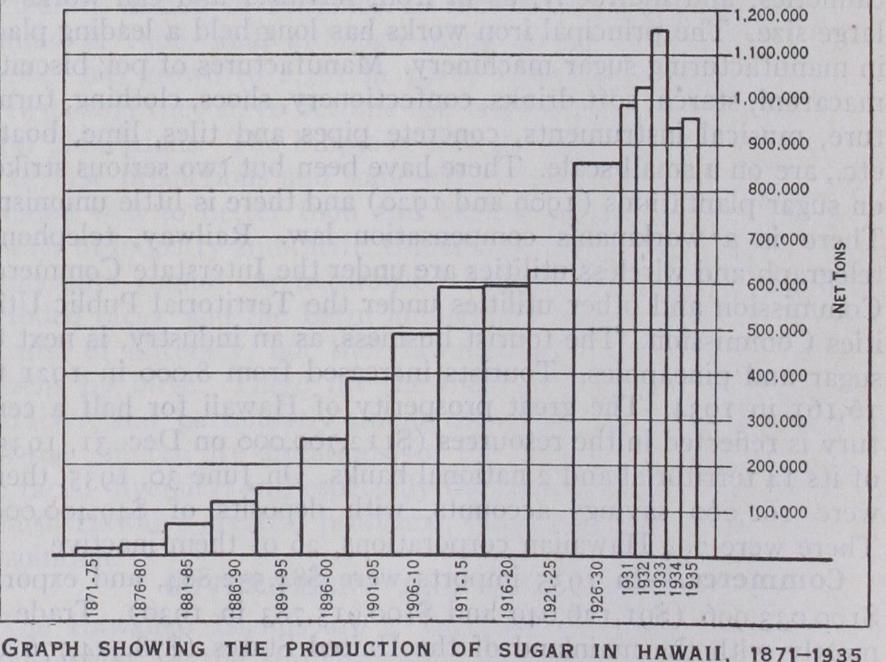
The chief product of the islands has long been sugar. Small quantities were produced from 1802 to 1835, when the indus try really began, and yet the output had increased to only 13,036 short tons by 1876, when there was great impetus from the reciprocity treaty with the United States. It increased to 229,414 tons by 1898, the year of annexation, 517,090 in 1910 and 962,000 in 1935. For 25 years acreage and number of em ployees have remained fairly constant, but better methods have greatly increased the outpi't. The sugar and pineapple industries, especially have profited from scientific methods as applied through the sugar planters', pineapple planters' and U.S.A. experiment stations, University of Hawaii and Territorial Bureau of Agri culture and Forestry. The yield per acre averages 74 tons of sugar on irrigated and 5 tons on unirrigated land, with a maximum of 18 tons. The cane, however, requires from 14 to 3o months to grow and only a little over half the area (126,00o ac.), is harvested each year. Two or three crops at different stages grow at the same time. About half the area is irrigated—by conduits from mountain streams and pumping from artesian and surface wells. The irrigation system of one plantation cost nearly $6,000, 000. Before a field is harvested it is set on fire to burn off the leaves. Conveyance to the mills is by railway, flumes and over head trolley. The centrifugal drying process for sugar was in vented in Hawaii in 1851. All but one plantation ships sugar raw, mostly to their co-operative refinery in California. Corporations own the mills and raise most of the cane. Of the 45,000 or so unskilled employees about work by contract and are pro vided with living quarters, gardens, medical attendance and other advantages without cost.
The pineapple industry, a growth of this century, is second only to sugar in importance. The export of all companies has increased from 1,893 cases in 1903, to 9,000,000 (225,000,00o cans) in 1934. The area cultivated is about 88,000 acres. This industry, unlike sugar, had to create its market.
The live stock, coffee and rice industries have successively occupied second place. There are numerous ranches and dairies, many with thoroughbred stock—cattle, sheep, horses, hogs and poultry. The coffee industry, one of the oldest, is taking on new life. The coffee is of superior quality, known as "Kona" from the district on western Hawaii where most of it is raised. Rice is a waning industry. The banana industry is steady, though not large. Other industries which are still small or have had their day, but some of which have possibilities, are silk, cotton. tobacco_ rubber, vanilla, sisal, potato, wheat, flour, macadamia nut, etc. While Hawaii exports and imports a larger percentage of what it produces and consumes than most countries, there is neverthe less much subsistence farming, and several industries, such as live stock, fish, fruit and vegetable, figure largely in local trade. Little lumber is produced. Practically the only mineral products are building stone, lime and salt. Much has been done since 1850, and especially since 1895, to promote homesteading of public lands, not altogether successfully; but since 192o a new policy has been pursued, with greater success, under which permanent improvements are made in advance by the Government, settlers are selected with reference to their qualifications, long-time loans at low rates are made and instruction is given by specialists. Although Hawaii is essentially an agricultural country, the principal industries are such as require much manufacturing directly, as in sugar, pineapple, rice, coffee and fish mills and canneries, and indirectly, as in iron, fertilizer and can works of large size. The principal iron works has long held a leading place in manufacturing sugar machinery. Manufactures of poi, biscuits, macaroni, starch, soft drinks, confectionery, shoes, clothing, furni ture, musical instruments, concrete pipes and tiles, lime, boats, etc., are on a small scale. There have been but two serious strikes on sugar plantations (1909 and 1920) and there is little unionism. There is a workman's compensation law. Railway, telephone, telegraph and wireless utilities are under the Interstate Commerce Commission and other utilities under the Territorial Public Util ities Commission. The tourist business, as an industry, is next to sugar and pineapples. Tourists increased from 8.000 in 1921 to 16,161 in 1934. The great prosperity of Hawaii for half a cen tury is reflected in the resources ($112,700,000 on Dec. 31, of its 14 territorial and 2 national banks. On June 30, 1935, there were 162,00o savings accounts, with deposits of $49,400,000. There were 794 Hawaiian corporations, 26 of them inactive.
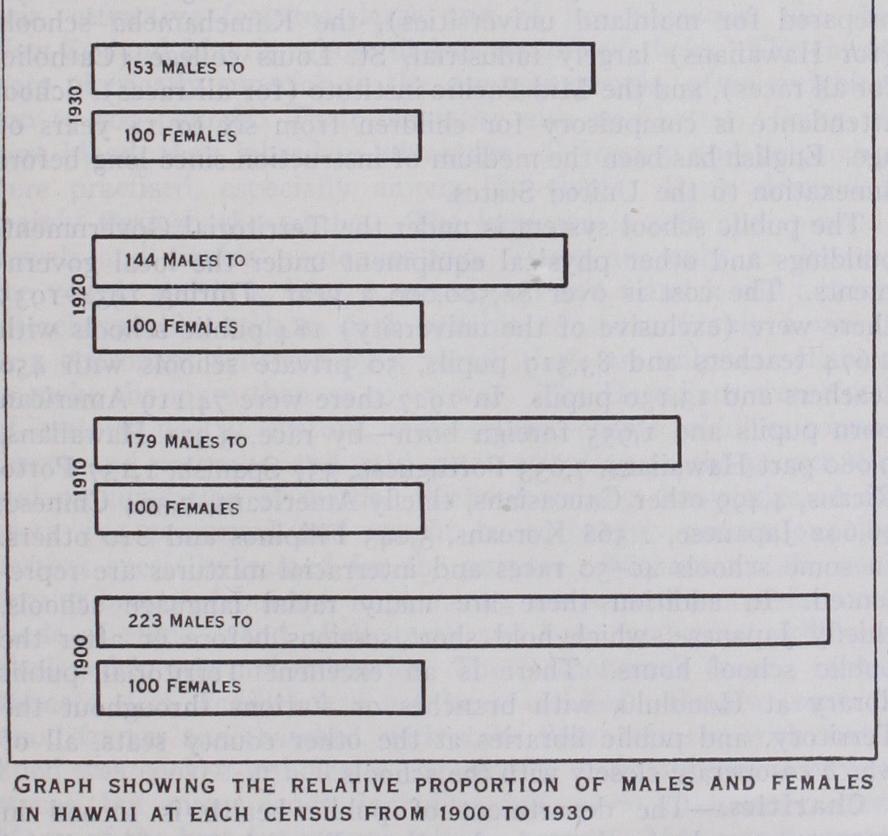
In 1927, 217,618 (65.27%) were U.S.A. citizens and 115,802 were not (including Filipino immigrants who were neither citizens nor aliens but owed allegiance to the United States). Native-born constituted 41 • i % in 1900, 51.1 % in 1910, (including the newly-arrived Filipinos) in 192o, and 81.4% in 1930. Males fell from 69.1% in 190o to 64. 1 % in 1910, and to 59 • I % in 19 20, in cluding Filipinos, but rose again to 60.5 % in 1930. Increase of population except of Americans and Filipinos, is now mainly through births. Departures of most others exceed arrivals. In 1932 the birth-rate was 28.19 and the death-rate 9.76 per i,000. The birth-rate was highest among Asiatic-Hawaiians, followed by Caucasian-Hawaiians and the Japanese, and lowest among Ameri cans and Northern Europeans. The death rate was highest among Hawaiians followed by Caucasian-Hawaiians, Filipinos, Asiatic Hawaiians, Koreans, Japanese, Spanish, and lowest among Ameri cans and northern Europeans. Illiteracy in 193o was 15.1 %, as compared with 18.9% in 1920. Percentage of illiteracy by races was: Filipino, 38.5; Puerto Rican, 3 2 .o ; Korean, 17.6; Spanish, 16.4; Chinese, 15.7; Japanese, 12.7; Portuguese, 9.7 ; Hawaiian, 3.4 ; Asiatic-Hawaiian, 0.9 ; Caucasian-Hawaiian, o.6 ; other Cau casian, 0•3. There is a strong tendency toward racial intermarriage. It is difficult to classify by races because of the mingling.
Attention was then directed chiefly to the Latins, particularly the Portuguese. Consequent upon the pressing demand for labour occasioned by the Reciprocity Treaty and after investigation of the relative merits of immigrants from many countries, I o, 798 Portuguese were brought from Madeira and the Azores in 1878-90 and 337 in 1899. They proved to be industrious, thrifty and law abiding. They brought their families and most of them remained and multiplied. In 1906-13, 5,196 more were introduced, many from Portugal. Simultaneously 7,695 Spanish were brought from Malaga, but most of these have left, and, although many Portu guese also have left, those in the Territory had increased to 28,417 by 1927. In 1898, 255 Italians were introduced and in 19oo–oi about 5,00o Porto Ricans. Most of the latter remained and, contrary to first indications, the majority have developed well and increased to 6,572. About ioo negroes and their families (190 i) and about 50o Hindus (I 9o8r I I) were introduced, most of whom soon left. Aside from the Portuguese,—the Chinese, Japanese, Koreans and Filipinos have constituted the bulk of the labour immigrants. The Chinese came first (1,632 in 185 2-67) ; then, opposition having developed, 148 Japanese were introduced in 1868, but, the Japanese Government objecting, no more were brought in and the Chinese continued to come (2,819 in 1868-7 7 ) when, in 1878, the immigration of Portuguese began, but not to the exclusion of the Chinese, who continued to come unassisted in large numbers (20,791 in 1878-85). The Chinese became so numerous that restrictive measures were applied in 1883 and attention was again turned to Japan. Chinese immigration almost ceased, the total for 1886-99 having been only 6,129, of whom 5,241 came in 189 , just before the Federal Chinese exclusion laws were extended to Hawaii upon annexation. Japanese came in large numbers, at first assisted and then unassisted, 65,034 during of whom 19,908 came the last year, fearing that such immigration also might be inhibited. Many went from Hawaii to the mainland, the arrivals having been 96,092 and the departures, to the mainland and Japan, 92,221 during I 9oo–I 5, but after the "Gentlemen's Agreement" of 1907 between the United States and Japan the arrivals were largely women, which resulted in rapid increase through births. Opposition on the mainland led to Japanese exclusion in 1924. The Chinese immigrant population resident in the islands decreased from 25,762 in 190o to 21,674 in I 910, but the total of both immigrant and Hawaiian-born Chinese increased, through excess of births over deaths and de partures, to 23, 507 in 191 o and 27,179 in 1930. The Japanese increased from 61,115 in 190o to 79,675 in 1910, 109,274 in 1920 and 139,631 in 1930. Koreans to the number of 7,859 came in 1903-05, but there were only 4,533 in 1910 and 4,95o in 1920; since then they have increased through births to 6,461 in 1930.
Finally, largely because of the enactment of Federal laws pro hibiting assisted immigration from foreign countries, the sugar companies turned to Filipinos as the only available source, be ginning in 1906, and, although many go to the mainland, the number has grown to 2,361 in 1910, 2I,o31 in 192o and 63,052 in 1930, and they have become the largest racial element on the sugar plantations. The Filipinos, like the Porto Ricans, contrary to adverse predictions and some early disappointments, have re sponded well to better food and health conditions and training in ways of industry and thrift. Under the Federal laws the oriental immigrants cannot be naturalized because they belong to the excluded races, and the Latin immigrants usually cannot qualify because of illiteracy, but the Hawaiian-born children of all are citizens by birth. These for the most part display ability and character, and, particularly among the orientals, both the parents and the children are ambitious for the latter's education. While the racial diversity, and especially the large number of Japanese, furnish Hawaii's greatest problems, they appear to be in process of solution.
The Hawaiian Islands are a Territory, an integral part, not a possession, of the United States, governed under an Organic Act, effective from June 14, 1900. The Federal officers are a delegate to Congress, elected for two years, who may introduce bills and debate but not vote, two judges of a Federal district court and a U.S.A. attorney and marshal, appointed for six years by the president with the consent of the Federal Senate, and vari ous officials of the Treasury, Post-office, Agriculture, Commerce and Interior departments. The Territorial legislature, which meets biennially, consists of a senate of 15 members elected, seven or eight at each biennial election, for four years, and a house of representatives of 3o members elected for two years. The presi dent, with the consent of the Federal Senate, appoints for four years the the secretary, who acts as governor in the absence or disability of the latter, the chief justice and two asso ciate justices of the supreme court and the eight judges of the five circuit courts. The governor, with the consent of the Terri torial senate, appoints for four years, and with like consent may remove, the attorney-general, treasurer, auditor, commissioner of public lands, superintendent of public works, superintendent of public instruction, surveyor, high sheriff, and, for various terms, all members of boards and commissions, among which are those of health, harbours, public instruction, public utilities, agriculture and forestry, fish and game, farm loan, pension, uni versity regents, registration of voters and inspectors of election.
Hawaii, having previously been an independent sovereignty, is the most highly organized Territory created by Congress and the only one to which has been given the administration and revenue of its public lands. The chief justice appoints for two years one or more district magistrates for each of the 27 district courts. Certain designated circuit judges serve also as judges of the land court (Torrens), the court of domestic relations and the juvenile courts. Equity and law are kept distinct but with sim plified procedures. Appeals may be taken from the Federal dis trict court and, when a Federal question or a value in excess of $5,000 is involved, from the Territorial supreme court to the Federal circuit court of appeals of the ninth circuit. Local governments were first created in 1905. These are (1936) the city and county of Honolulu, comprising the island of Oahu and all small islands not included in any other county and hence extending 1,350 m. W. and I,Ioo m. S. of Honolulu, the city and county seat ; county of Hawaii, comprising the island of that name, county seat at Hilo ; county of Maui, comprising the islands of Maui, Molokai (except the leper settlement), Lanai and Kahoolawe, county seat at Wailuku; county of Kauai, com prising the islands of Kauai and Niihau, county seat at Lihue; county of Kalawao, comprising the leper settlement. Each in cludes also the small islands within 3 m. of the shores of the larger ones. Each, except Kalawao, which is only an inchoate county under the board of health, has a board of supervisors, sheriff, clerk, auditor, attorney and treasurer elected for two years. Honolulu has also a mayor. Territorial and local officers and the Federal judges, attorney and marshal must, in general, be citizens of the United States and have resided in the Territory one to three years next preceding election or appointment.
The qualifications of voters are citizenship, residence of a year in the Territory and three months in the district, age of 21 years, ability to speak, read and write the English or Hawaiian language, and registration, which is permanent except that if one fails to vote at any election his name is struck out and he must reregister in order to vote. Absent seamen may vote, but those in the army or navy may not. Except Kauai supervisors and the Kalawao sheriff, all Territorial and local elective officers are elected at large or from multi-member districts. Direct primaries have been in operation since 1913 and woman suffrage since 1920. The political parties are the Republican and Democratic, the former preponderating. Citizenship by birth and naturalization are governed by the Federal Constitution and laws. During the gen eral election of 1930 the registered voters numbered 52,149, as follows: Hawaiian and part-Hawaiian, 19,858; Caucasian, 19,225 (11,114 Anglo-Saxon and 8,1i I Latin, mostly Portuguese) ; Ori ental, 11,419 (7,057 Japanese, 4,402 Chinese). Over 85% of those who registered voted.
The educational system includes all grades from kindergarten to university, as well as a normal school and schools for the physically defective, feeble-minded and juvenile delinquents and evening classes. Much attention is given to agricultural, trade and industrial vocational work (including part-time schools), home economics and medical, dental and nutritional needs. The university (about i,000 students) maintains an aquarium and marine biological laboratory, conducts extension work and renders important service in industrial experimental and research work. Prominent among private schools are Oahu college (I,000 stu dents) founded in 1841 (where most of the Anglo-Saxons are prepared for mainland universities), the Kamehameha schools (for Hawaiians) largely industrial, St. Louis college (Catholic, for all races), and the Mid-Pacific institute (for all races). School attendance is compulsory for children from six to 14 years of age. English has been the medium of instruction since long before annexation to the United States.
The public school system is under the Territorial Government, buildings and other physical equipment under the local govern ments. The cost is over $8,500,000 a year. During 1934-1935 there were (exclusive of the university) 184 public schools with 2,674 teachers and 83,319 pupils, 50 private schools with 450 teachers and 13,130 pupils. In 1927 there were 74,119 American born pupils and 1,955 foreign born—by race, 3,971 Hawaiians, 9,08o part-Hawaiians, 7,633 Portuguese, 337 Spanish, 1,137 Porto Ricans, 4,499 other Caucasians, chiefly Americans, 7,304 Chinese, 36,692 Japanese, 1,568 Koreans, 3,043 Filipinos and 810 others. In some schools 4o-5o races and interracial mixtures are repre sented. In addition there are many racial language schools. chiefly Japanese, which hold short sessions before or after the public school hours. There is an excellent Territorial public library at Honolulu, with branches or stations throughout the Territory, and public libraries at the other county seats, all of which co-operate closely with the schools.
Feudalism grew up much as it did in mediaeval Europe and from much the same causes. The unit of land, the ahupuaa, usually extended from the shore to the mountain top, with rights in the adjoining sea waters, so that the occupants had the means of supplying all their wants—the sea for fish, the littoral for coconuts, the valley for taro, their principal food, the lower slopes for sweet potatoes, yams and bananas and the mountain for wood. The next subdivision was the ili, either subservient to the ahupuaa or independent. Within these. were small areas, kuleanas, occupied by the common people, who also had certain rights of fishery, water and mountain products. Besides open sea fisheries, there were stone-walled fishponds, some now a thousand years old, built semi-circularly from the shore. Taro was raised in terraces flooded by conduits from streams. Elabo rate systems of water rights were evolved. A conqueror or a successor king often redistributed the lands.
The Hawaiians were a brown race, with straight or wavy black hair, attractive features, large and of fine physique, like the New Zealand Maoris, whose dialect resembled theirs. The chiefs were physically superior to the common people, often weighing 30o to 500 pounds. Their mentality also was better. Being of pure blood, they inbred to advantage. Polygamy and polyandry were practised, especially among the chiefs. Rank descended mainly through the mother. The language is soft and musical, vowels and liquids predominating. There are only 12 letters, the vowels and h, k, 1, m, n, p and w, 1 and r and k and t being interchangeable, as each syllable consists of only a vowel or a consonant followed by a vowel, there are only 4o syllables to make the more than 20,000 words. The Hawaiians were fond of oratory, poetry, history, story-telling, chants, riddles, conun drums and proverbs, and paid much attention to the proper use and pronunciation of words. Without writing, knowledge of all sorts was preserved and taught to successive generations by persons specially trained for the purpose. Without metals, pot tery or beasts of burden, implements, weapons and utensils were made of stone, wood, shell, teeth and bone, and great skill was displayed in arts and industries. The feather-work (capes, robes, helmets, leis, kahilis) has not been excelled. Houses were of wood frames and thatched, with stone floors covered with mats. Food was cooked in holes in the ground, imus, by means of hot stones, but many foods, including fish, were often eaten raw. Many of the best foods were tabu to women. Men usually wore only a inalu or girdle and women a skirt of kapa or paper cloth or leaves or fibre, though both sometimes wore mantles thrown over the shoulders. Canoes were outrigger or double, sometimes ft. long. They have hardly been surpassed as sailors, fish ermen or swimmers. They were skilful navigators, knowing stars, winds and currents. Their year began on Nov. 20 and consisted of 12 lunar months with occasionally an intercalary month. They had remarkable knowledge of animals and plants and were great warriors, using spears, javelins, clubs and slings, but no shields or bows, the latter being small and used only for shooting rats and mice for sport.
They excelled in athletics, in which there were frequent con tests, even between champions of different islands, in surf boarding on the crests of waves, swimming, wrestling, boxing, spear-throwing (at each other), coasting down permanently pre pared courses standing on narrow sleds, bowling, foot-racing, etc. Surfing has now become a favourite sport for others as well as Hawaiians. They gambled much and made narcotic and fermented drinks of the awa and ti roots, but not distilled liquours. They were fond of music, vocal and instrumental, and had percussion, string and wind instruments, including a nose flute but no mouth flute. The ukulele is of Portuguese origin, developed and popularized by the Hawaiians. Their dances were largely the notorious hula of many varieties, the better forms of which have latterly become popular with others. They loved flowers, which they wore much in leis or wreaths about necks and hats. This has become customary with the whites, especially on arrivals and departures of steamers and on May day. They tattooed little. Their proverbially courteous, generous, hospitable spirit has affected the remainder of the population.
There were four principal gods, Kane, Kanaloa, Ku and Lono, and innumerable lesser gods and tutelar deities. Animals, plants, places, professions, families, all objects and forces had their gods or spirits. Temples of stone and idols of wood abounded and hardly anything was undertaken without religious ceremonies. On important occasions there were human sacrifices. There was a vague belief in a future state. Priests and sorcerers were potent. There were "cities of refuge" to which one might flee and be safe. Cannibalism was unknown but infanticide prevalent. The political and religious systems were closely interwoven.
During the last period before the discovery, although there were occasional bright intervals under highminded kings, and notwithstanding that there was so much that was praiseworthy, in general, the nobility and priesthood became more and more aristocratic and tyrannical, the common people more and more degraded ; destruction of life was frightful ; property was inse cure; there was little encouragement for industry; the laws, chief among which were the intricate and oppressive tabus, bore heavily upon the masses, especially the women, and their admin istration became largely a matter of arbitrariness and favouritism.
Benign foreign influences were exerted by such voyagers as Vancouver , Cleveland (1803) and Kotzebue (1816), and such residents as John Young and Isaac Davis, captured (179o) boatswain and mate, and Don Francisco de Paula Marin, immigrant (in 1791) from Andalusia, who introduced useful plants and animals and inculcated higher ideals. But baleful foreign influences were exerted by numerous Botany bay con victs, pirates, buccaneers, beachcombers, adventurers and others, who introduced the art of distillation, fire arms, venereal dis eases and vices of all kinds.
Kamehameha treated foreigners well but combated their vices. Indulging a little at first, he later abstained from the use of liquors and ordered the destruction of distilleries. Having un successfully sought to obtain teachers of Christianity, he ad hered to the Hawaiian religion and enforced strict observance of it, but with lessening severity. The .last human sacrifices were in 1807. However, foreign influences undermined faith in the old religious systems, and shortly after his death (May 8, 1819), these were abolished (about Nov. 1, 1819) under the leadership of his favourite queen, Kaahumanu, and his queen of highest rank, Keopuolani—not, however, without a bloody battle (Dec. 20, 1819) between the progressives and conservatives. Thus, union under a single Government, the establishment of peace and order, and the dissolution of the old politico-religious bonds, pre pared the way for new social forces.
Interest culminated in the "Great Revival" of a decade later, which added a fifth of the population. The first convert (1823) was Keopuolani, head queen of Kamehameha, mother of the next two kings and highest chief by blood in the nation. Indeed the chiefs, especially the females, led in embracing and supporting the new religion and learning. Kaahumanu, Kamehameha's favourite queen, was converted in 1825 and was thereafter known as the "New Kaahumanu," as strong for good as she had theretofore been haughty and cruel, and of the ten who joined the church in 1826, nine were chiefs, including Kalanimoku, known as the "Iron Cable." Kaahumanu and Kalanimoku were the strongest characters in the nation.
The first score or so of years after the arrival of the mis sionaries was a crucial period, not so much because of the in herent difficulties of civilizing and christianizing a barbarous and pagan race as because of the opposition of whites. This oppo sition came not only from the beachcombers and grog-shop keepers, but, more dangerously, from British, French and Ameri can consuls and naval officers. They opposed the laws against licentiousness and drunkenness, slandered the missionaries, made unjust claims against the Government, insisted that they were not subject to Hawaiian laws, attacked with arms the homes of missionaries and chiefs, aimed at the overthrow of the Govern ment; the British consul claimed that the islands had become British territory.
Hence, after vain attempts to secure from New England teach ers of the science of government, the missionaries were induced to detach one of their number, W. Richards. He rendered notable service to the Government as did two other missionaries, G. P. Judd and R. Armstrong, similarly detached later. After hearing a course of lectures on government (1839) delivered to the king, chiefs and leading commoners, the king promulgated the Declara tion of Rights, called Hawaii's magna charta, June 7, 1839, the Edict of Toleration, June 17, 1839, and the first Constitution, Oct. 8, 1840. The first compilation of laws was published in 1842. The Catholics began their cathedral in 1840, and ever since, through churches and schools, have done much good work. Contrary to the usual course of history, in Hawaii democratiza tion evolved from the top downward rather than from the bot tom upward.
But troubles with foreigners were not at an end. French naval officers in i839, 1842, 1849 and 1851 made unjust demands, the first and third times accompanied by force. A British naval officer took possession in 1843 and held it until the flag was re stored by higher authority. After the ceremonies, the king, ad dressing his people on the means of preserving independence, used the expression "Ua man ke ea o ka aina i ka pono" ("The life of the land is perpetuated by righteousness"), which has since been Hawaii's official motto. Diplomatic missions secured recognition of independence from the United States in 1842 and England and France in Further troubles with foreigners, and especially the outrageous French demands of 1849 and 1851, led to other diplomatic mis sions, and in the latter year a secret proclamation putting the islands under the protection of the United States. The French, having learned this, retracted and the United States declined the protectorate, but, as a result of further troubles and dangers, within and without, including threatened filibustering from Cali fornia, and the "manifest destiny" sentiment awakened in the United States by the acquisition of the Oregon Territory and California, negotiations were opened in 1854 for annexation to the United States but were terminated by the death of the king. The troublesome foreign representatives were removed and fairer treaties entered into. Mormon missionaries first came in 185o, and that church now has a large membership and a magnificent temple and is doing good work.
New Codes.—Encouragement of immigration began in 1852 and has continued ever since. A small-pox epidemic in 1853 numbered its victims in thousands. Meanwhile, after the adoption of the crude Constitution of 184o, every effort was made to organize and perfect the Government. An able lawyer, John Ricord, was appointed attorney-general in 1844 and made a famous report to the legislature of 1845, as a result of which he was requested to draft comprehensive organic acts, which were enacted in 1846-47. W. L. Lee was appointed chief justice in 1846. He was chief drafter of the penal code of 185o, the more modern Constitution of 1852 and chief compiler of the civil code of 1859. Action was taken in 1845 and subsequent years by which the old feudal tenures were changed to allodial, and the interests of Government, Crown, chiefs and common people were severed and all claims adjudicated by a board of which Lee was chairman. R. C. Wyllie, a Scot, was minister of foreign affairs 1845-65. For able and untiring service, Lee, Wyllie and Ricord are among the outstanding personages in Hawaiian history. A tower of strength was Kekuanaoa (father of Kamehamehas IV. and V.), governor and judge of Oahu. The long and fruitful reign of the liberal-minded Kamehameha III. ended on Dec. 15, 18S4. Hawaii had become a civilized and christianized country with constitutional Government, highly creditable legislative, executive and judicial branches, personal and property rights secure, allodial tenures, modern industries, the respect of other nations and independence assured.
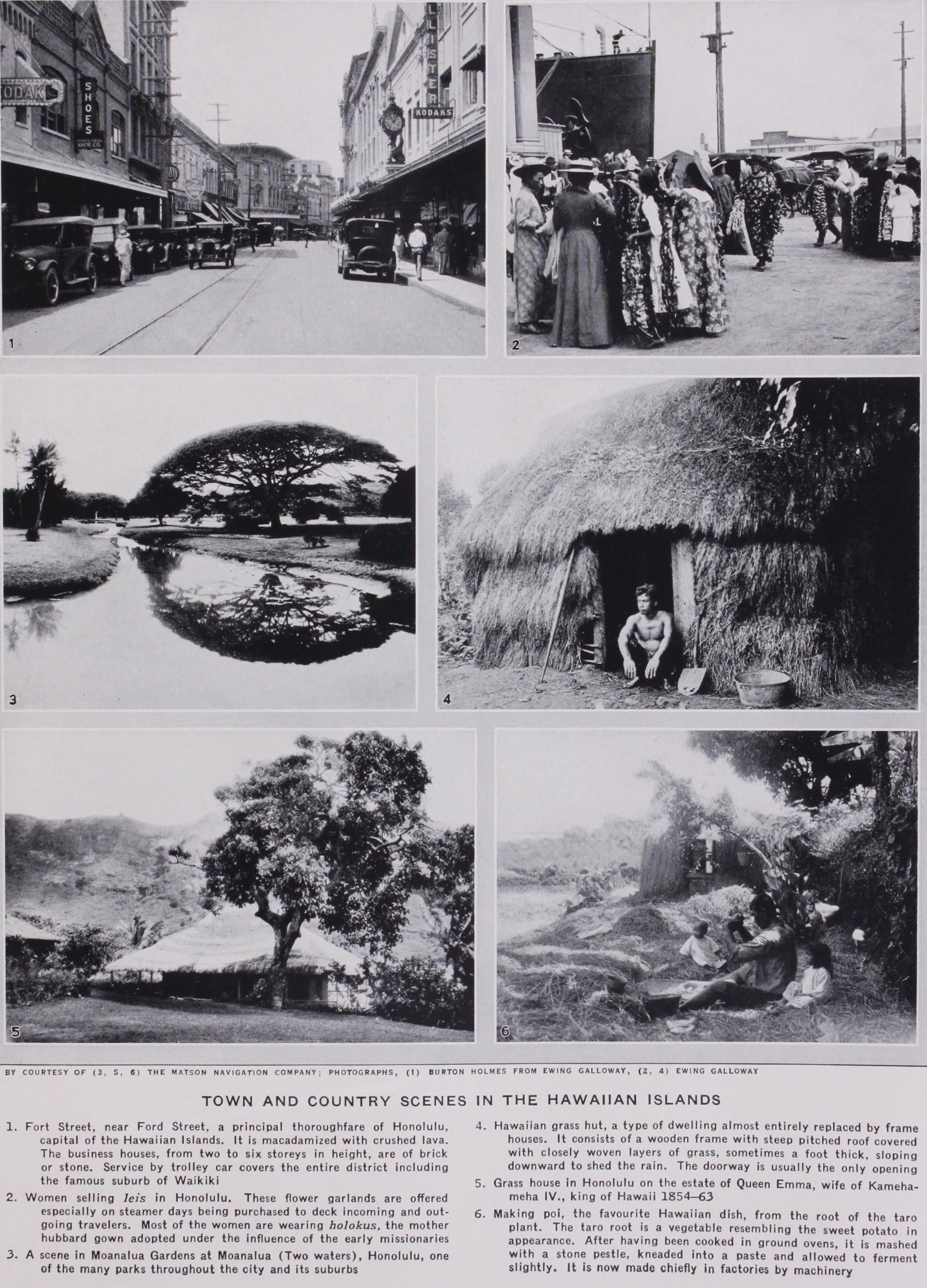
The next two kings, high-minded, educated and travelled, Kamehameha IV. (1854-63) and V. (1863-72), feeling that the Government had become democratized too rapidly and that American interests were becoming too preponderant, were slightly reactionary and pro-British. The former and his consort, Queen Emma, are remembered for their founding of the Queen's hospital (186o) and the inauguration (1862) of the Episcopal Church, which, especially since annexation, has prospered. The American Board, which had sponsored the missionaries, deeming Hawaii qualified to graduate (the first nation to do so) from the field of Christian missions, withdrew in 1863 and transferred its work to the Hawaiian Board. Kamehameha V., after calling and dis missing a Constitutional Convention, himself promulgated a new Constitution (1864), which changed that of 1852 less than had been feared.
With his death ended the beneficent Kamehameha dynasty, and after the brief reign (1873-74) of the liberal, popular, pro American Lunalilo, elected against Kalakaua, came the decidedly reactionary reign (18 7 4-91) of the latter, elected as pro-American against Queen Emma as pro-British. The principal forces for good, the chiefs and missionaries, had largely died off. At first Kalakaua ruled fairly well and was largely instrumental in bring ing about the Reciprocity treaty with the United States (1876), which produced far-reaching results. Efforts had been made from time to time since 1848 to effect such a treaty, partly for the economic benefits and partly as an alternative to annexation. The treaty was terminable after seven years on one year's notice, and agitation having arisen in the United States for such termination, an extension for seven years and until one year's notice was ob tained in 1887 but only by giving the United States the exclusive right to enter Pearl harbour and maintain a naval coaling and repair station there—a right which was not exercised.
Reaction and Annexation.—There was ever-increasing en deavour by the king to restore the ancient order with its heathen customs and ideas of absolutism and Divine right, accompanied by extravagance, corruption, personal interference in politics and fomentation of race feeling, until the second generation of mis sionaries and their associates, including many patriotic Hawaiians, finding it impossible to stem the tide by ordinary means, rose in peaceful revolution, but with ample force in the background, and compelled the king to promulgate (1887) a new Constitution providing for responsible ministerial government and other guar antees. The struggle continued, however, not only until the end of that reign (1891), during which there was an armed insurrec tion (1889) by the reactionaries, but even more hotly during the following reign of the king's sister, Liliuokalani. She had some superior qualities as a poet and musical composer and was inter ested in welfare work; however, it was deemed necessary to de pose her (Jan. 17, 1893) and set up a Provisional Government. Annexation to the United States was to be sought.
This failed for the time being and a republic, with probably the most advanced Constitution ever adopted, was established, July 4, 1894. It continued, disturbed only by an unsuccessful in surrection in 1895, until annexation was accepted by Joint Reso lution of Congress in 1898. There has since been general pros perity and progress on the islands, although of late years serious friction has developed between the natives and military and naval men stationed there. The Massie incident in 1931 and the case of two army aviators set upon and beaten in 1933 were symptoms of a bad situation. In the hope of strengthening the local govern ment against such disorders, President Roosevelt asked authority to appoint a governor without regard to his previous residence, but the senate failed to approve the suggestion. The Territory remained Republican in 1936.
(W. F. Fa.)