
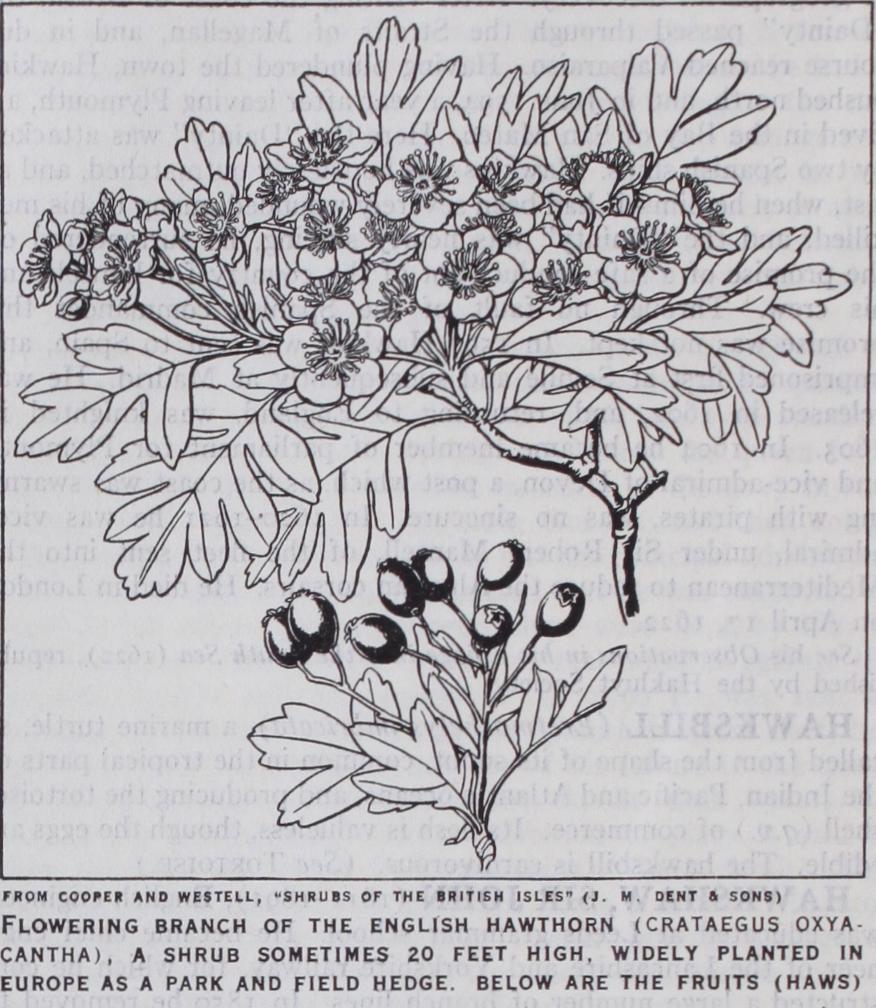
HAWTHORN, the common name for Crataegus, in botany, a genus of shrubs or small trees belonging to the family Rosa ceae, native of the north temperate regions, especially America. It is represented in the British Isles by the hawthorn, white-thorn or may, C. Oxyacantha, a small, round-headed, much-branched tree, 10 to 20 ft. high, the branches often ending in single sharp spines. The leaves, which are deeply cut, are 1 to 2 in. long and very variable in shape. The flowers are sweet-scented, in flat topped clusters, and to a in. in diameter, with five spreading white petals alternating with five persistent green sepals, a large number of stamens with pinkish-brown anthers, and one to three carpels sunk in the cup-shaped floral axis. The fruit, or haw, as in the apple, consists of the swollen floral axis, which is usually scarlet, and forms a fleshy envelope surrounding the hard stone.
The common hawthorn is a native of Europe as far north as 6o° in Sweden, and of North Africa, western Asia and Siberia, and has been naturalized in North America and Australia. It thrives best in dry soils, and in height varies from 4 or 5 to 12, 15 or, in exceptional cases, as much as between 20 and 3o ft. Haw thorn has been for many centuries a favourite park and hedge plant in Europe, and numerous varieties have been developed by cultivation; these differ in the form of the leaf, the white, pink or red, single or double flowers, and the yellow, orange or red fruit. In England the hawthorn, owing to its hardiness and close ness of growth, has been employed for enclosure of land since the Roman occupation, but for ordinary field edges it is believed it was not generally in use till about the end of the i 7th century. James I. of Scotland, in his Quair, ii. 14 (early 15th century), mentions the "hawthorn hedges knet" of Windsor Castle. The first hawthorn hedges in Scotland are said to have been planted by soldiers of Cromwell at Inch Buckling Brae in East Lothian and Finlarig in Perthshire. Annual pruning, to which the hawthorn is particularly amenable, is necessary if the hedge is to maintain its compactness and sturdiness. When the lower part shows a ten dency to go bare the strong stems may be "plashed," i.e., split, bent over and pegged to the ground so that new growths may start. The wood of the hawthorn is white in colour, with a yellow ish tinge. Its great hardness, however, renders it valuable for the manufacture of various articles, such as the cogs of mill-wheels, flails and mallets, and handles of hammers and for engraving. The custom of employing the flowering branches for decorative purposes on the 1st of May is of very early origin; but since the alteration in the calendar the tree has rarely been in full bloom in England before the second week of that month. Branches of the Glastonbury thorn, C. Oxyacantha, var. praecox, which flowers both in Dec. and in spring, were formerly highly valued in England, on account of the legend that the tree was originally the staff of Joseph of Arimathea.
The number of species in the genus is from 7o to loo accord ing to the view taken as to whether or not some of the forms, especially of those occurring in the United States, represent dis tinct species. C. coccinea, a native of Canada and the eastern United States, with bright scarlet fruits, was introduced into English gardens towards the end of the 17th century. C. Crus Galli, with a somewhat similar distribution and introduced about the same time, is a very decorative species with showy, bright red fruit, often remaining on the branches till spring, and leaves assuming a brilliant scarlet and orange in the autumn ; numerous varieties are in cultivation. C. Pyracantha, known in gardens as pyracantha, is evergreen and has white flowers, appearing in May, and fine scarlet fruits of the size of a pea which remain on the tree nearly all the winter. It is a native of south Europe and was introduced into Britain early in the 17th century.