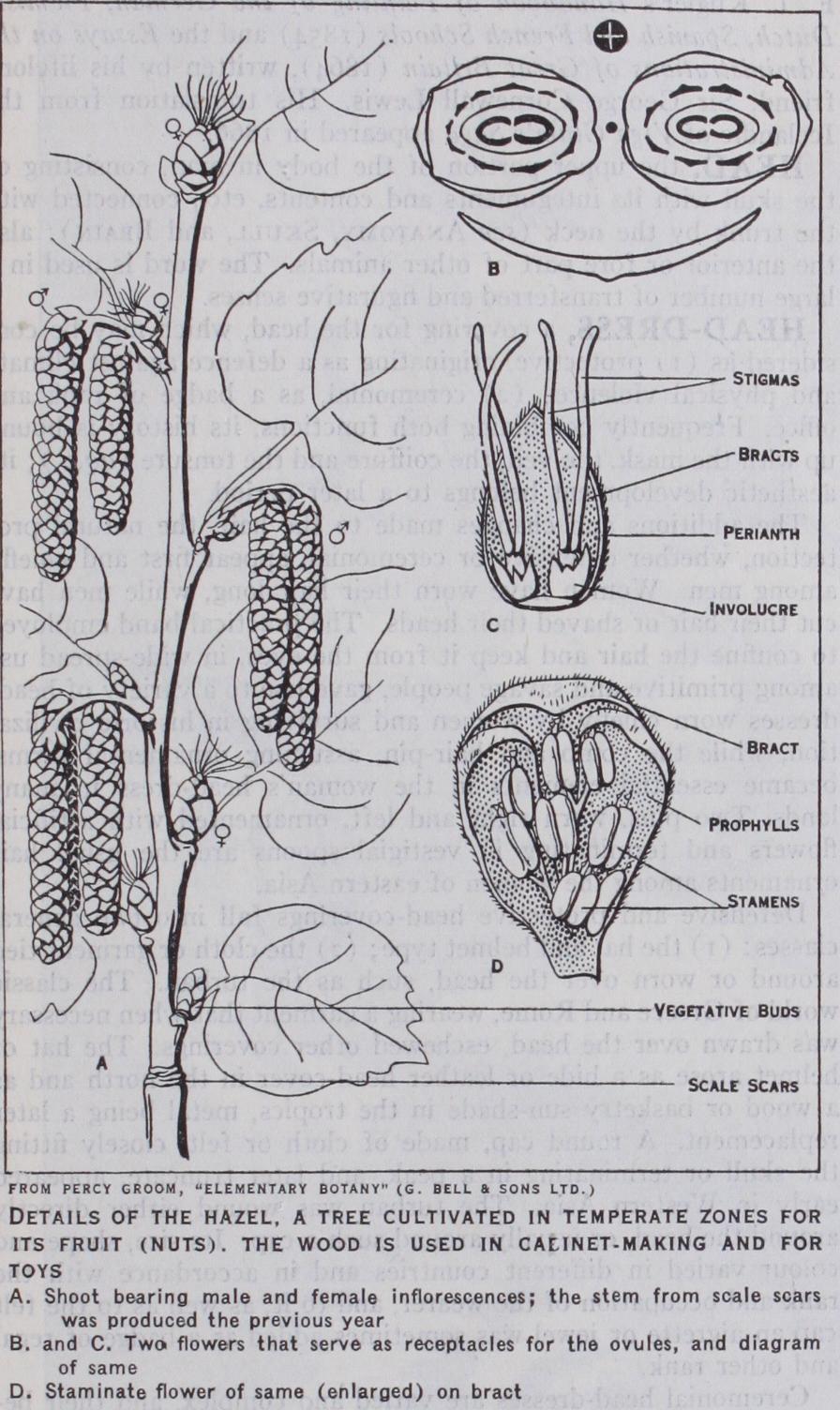
HAZEL, botanically Corylus, a genus of shrubs or low trees of the family Betulaceae. The common Old World hazel, Corylus avellana (fig. 1), occurs throughout Europe, in North Africa and in central and Russian Asia, except the northernmost parts. It is commonly found in hedges and coppices, and as an undergrowth in woods, and reaches a height of some 12 ft.; occasionally it may attain to 3o ft. The bark of the older stems is of a bright brown, mottled with grey, that of the young twigs is ash-coloured, and glandular and hairy. The leaves are alternate, from 2 to 4 in. in length, downy below, roundish heart-shaped, pointed and shortly stalked. In the variety C. purpurea, the leaves, as also the pellicle of the kernel and the husk of the nut, are purple, and in C. heterophylla they are thickly clothed with hairs. The flowers are monoecious, and appear in Great Britain in Feb. and March, before the leaves. The cylindrical drooping yellow male catkins (fig. 1A) are 1 to 2-i in. long and occur 2 to 4 in a raceme; when in unusual numbers they may be terminal in position. The female flowers are small, sub-globose and sessile, resembling leaf-buds, and have protruding crimson stigmas; the minute inner bracts, by their enlargement, form the palmately lobed and cut involucre or husk of the nut. The ovary is not visible till nearly midsum mer, and is not fully developed before autumn. The nuts have a length of from to a in,, and grow in clusters; The wood of the hazel is whitish-red, close in texture and pliant, and has been used in cabinet-making, and for toys and turned articles. Curiously veined veneers are obtained from the roots; and the root-shoots are largely employed in the making of crates, coal-corves or bas kets, hurdles and bands, whip-handles and other objects.
The filbert, among the numerous varieties of Corylus avellana, is extensively cultivated, especially in Kent, for the sake of its nuts, which are readily distinguished from cob-nuts by their ample involucre and greater length. It may be propagated by suckers and layers, by grafting and by sowing.
In North America there are three native hazels, all with edible nuts somewhat smaller than those of the common hazel of Europe. The best known is the American hazel (C. americana), 3 ft. to 8 ft. high, with broadly oval pointed leaves, found in thickets from Maine to Ontario and Saskatchewan and southward to Florida and Kansas. The beaked hazel (C. rostrata), similar in size and as pect, but with the husk (involucre) enclosing the nut prolonged into a tubular beak, is found from Nova Scotia to British Colum bia and southward to Georgia, Kansas and Oregon. The California hazel (C. calif ornica), usually a shrub but sometimes a small tree 3o ft. high, occurs in forests from British Columbia to central California. (See FILBERT.)