
HEAD-DRESS, a covering for the head, which may be con sidered as (I ) protective, originating as a defence against climate and physical violence ; ceremonial, as a badge of rank and office. Frequently combining both functions, its history is bound up with the mask, the veil, the coiffure and the tonsure (qq.v.) ; its aesthetic development belongs to a later period.
The additions and changes made to the hair, the natural pro tection, whether defensive or ceremonial, appear first and chiefly among men. Women have worn their hair long, while men have cut their hair or shaved their heads. The practical band employed to confine the hair and keep it from the eyes, in wide-spread use among primitive and savage people, gave rise to a variety of head dresses worn chiefly by women and surviving in historic civiliza tion, while the comb and hair-pin, assuming ornamental forms, became essential elements in the woman's head-dress in many lands. Two pins, worn right and left, ornamented with artificial flowers and terminating in vestigial spoons are the usual hair ornaments among the women of eastern Asia.
Defensive and protective head-coverings fall into two general classes : the hat and helmet type ; the cloth or garment tied around or worn over the head, such as the turban. The classic world of Greece and Rome, wearing a garment that when necessary was drawn over the head, eschewed other coverings. The hat or helmet arose as a hide or leather head-cover in the north and as a wood or basketry sun-shade in the tropics, metal being a later replacement. A round cap, made of cloth or felt, closely fitting the skull or terminating in a peak, and later truncate, appeared early in Western Asia. The turban was wound either directly around the head, or usually around such a cap. Its size, shape and colour varied in different countries and in accordance with the rank and occupation of the wearer, and to it, as well as to the felt cap an aigrette or jewel was sometimes added as a badge of regal and other rank.
Ceremonial head-dresses are varied and complex, and their be ginnings may be traced to primitive conditions. Like the mask, they were assumed frequently to identify the wearer with a divinity or to perpetuate the tradition of a divine ancestor. Chi nese imperial head-dresses bear the symbols of the sun and moon. The pointed crown may be regarded as a solar emblem. The custom of shaving the head was common at the initiation of a warrior or priest, but a head ornament or cap was commonly a badge of rank and its prerogatives jealously guarded. In China and Japan a straight, standing knot was left on the top of the head to which the imperial cap was attached by a transverse pin. The North American Indian warrior shaved his head, leaving a medial crest, or wore a similar crest made of the hair of the moose in which a tablet bearing the symbol of a bird was embedded. This object, tied to the so-called scalp lock, serves to explain the feathers fastened to his hair as well as his feather head-dresses. The peacock feather badge of the Chinese Manchu dynasty had a similar mechanism. The feathers of the Plains Indian war bon nets, assumed to symbolize exploits, may be regarded as a com posite and cumulative expression of the bird on the tablet. The horns of these war bonnets are those of the buffalo. A miniature netted shield and two feathered darts, emblems of the Twin Way Gods, are of wide-spread recurrence in the head-dress of the Indian warrior. The aboriginal head-dresses of the Indian tribes of the North American continent may be regarded as emanations from ancient Mexico, where elaborate head-dresses of feathers were worn by the priests and warriors who personated the gods.
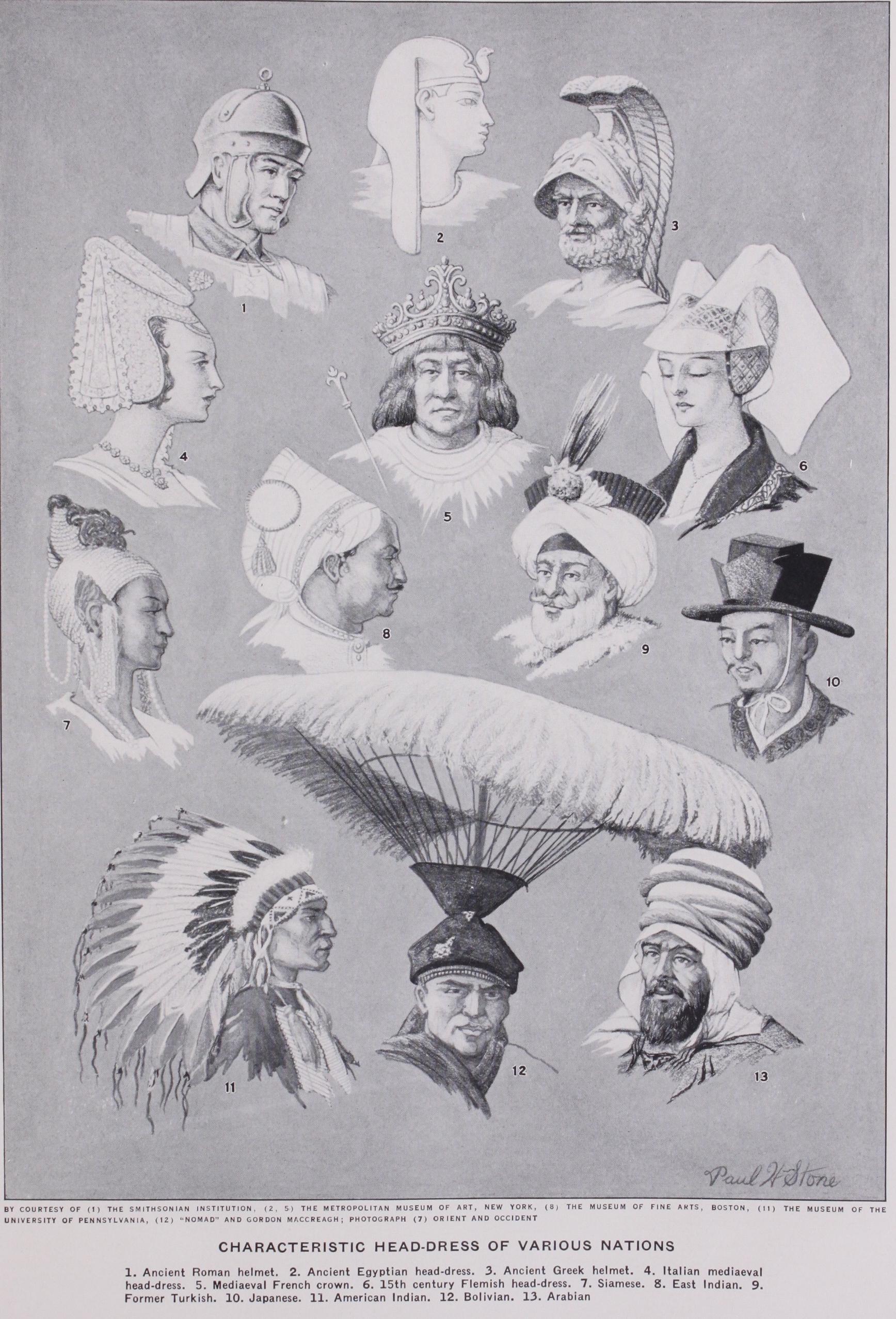
The military head-dress of historic Europe was in the main de fensive, but the bear skin shako and lofty plumed hat of the i8th century were intended to increase the apparent height of the wearer and impress the enemy. Ecclesiastic head-dresses both East and West had secular origins.
The ceremonial crowns and head-dresses of women were bor rowed and imitated from those of their consorts, whose rank they shared. The peasant wedding-crowns of central Europe are remi niscent. Flowers, natural and artificial, were their common and widely used hair ornaments, but the rule that women should not appear in church uncovered led to the universal use of the women's head-cloth or kerchief in Catholic Europe. The sun bonnet is a combination of this cloth with a band, by which it was tied over the head.
The head-dress of fashion for both men and women reached its highest development in Europe in the 18th century. Its simplifi cation due to the general adoption of short hair has resulted in the employment of the felt hat now generally worn by women in Europe and America. (See also DRESS; COSTUME DESIGN.) BIBLIOGRAPHY.—J. Braun, S. J., Die Liturgische Gewandung (FreiBibliography.—J. Braun, S. J., Die Liturgische Gewandung (Frei- burg, 19o7) ; Zelia Nuttall, Standard or Head-dress? (1888) ; M. Viollet-le-Duc, Dictionnaire raisonne du mobilier francais (Paris, 1872). (S. Cu.)