
HELIGOLAND BIGHT. On Aug. 28, 1914, a sweep by the British light naval forces into the Heligoland Bight brought about the first serious contact between the opposing naval forces during the World War. The action began at daylight, developed into a series of confused fights, in misty weather upon a glassy smooth sea, and lasted until 1.3o P.M., when, the sweep having been completed, Vice-Admiral Sir David Beatty withdrew his forces. The day ended to the distinct advantage of the British, who had one cruiser ("Arethusa") and three destroyers damaged with a total casualty list of 35 killed and 4o wounded. The Ger mans lost 1,242 officers and men, killed, wounded, and prisoners; three cruisers ("Mainz," "Coln," and "Ariadne") and one de stroyer (V. 187) were sunk ; one cruiser ("Frauenlob") was badly crippled, and there was unreported damage to other cruisers and torpedo craft.
From the first days of the war a watching patrol, maintained by British submarines off the entrance to the German ports, had obtained an accurate knowledge of the routine movements of the German patrols. Against these patrols the sweep was planned, to be carried out by light forces, upon a day when the German heavy ships would be tide-bound until afternoon, inside the Jade river bar. In the original plan of the operation, Comm. Roger Keyes, commanding the submarine flotilla (eight submarines of the "D" and "E" class and the destroyers "Lurcher" and "Firedrake") was to place an inner line of three submarines close to Heligoland, with orders to remain submerged until after a certain hour. An outer line of three submarines was stationed 4om. to the west ward, instructed to try and draw the enemy destroyers to sea. Two other submarines were to watch the entrance to the Ems river.
The destroyer force, under Comm. Reginald Tyrwhitt, con sisted of the "Arethusa" with the 3rd flotilla (16 t.b.d's) and the "Fearless" (Capt. Blunt) with the 1st flotilla (15 t.b.d's). The battle-cruisers "Invincible" (Rear-Admiral Sir Archibald Moore) and "New Zealand" were to act in support and were to meet the destroyer force to the south-6ast of the Dogger Bank on the eve ning of the 27th. Whilst the submarines were taking up their positions the cruisers and destroyers were to steer for a point 75m. N.N.W. from Heligoland, so as to arrive there by daylight on the 28th. The flotillas were then to sweep south and west through the Bight to cut off the German destroyers on their return from their nightly patrol. The two battle-cruisers would be in support to seaward and, away to the west, off the Terschilling light, an armoured cruiser force under Rear-Admiral Christian was held in reserve.
Such was the original plan. It was modified at the last moment on account of the diversion at Ostende. A brigade of Royal Ma rines was landing at that place on the 26th, under cover of the ships of the channel squadron, and a countermove by the Ger man high sea fleet seemed likely. Therefore, support from the grand fleet was arranged and Admiral Jellicoe sent Vice-Admiral. Beatty south in command of a force consisting of the battle-cruis ers "Lion," "Queen Mary," and "Princess Royal" and Comm. Goodenough's squadron of six light cruisers ("Southampton," "Falmouth," "Birmingham," "Nottingham," "Lowestoft," and "Liverpool"). Beatty joined the "Invincible" off the Dogger Bank on the evening of the 27th and Goodenough's cruisers were sent on towards the destroyers' daylight position. Unfortunately, a wireless message, informing Tyrwhitt and Keyes of the change of plan, miscarried and neither commodore was aware of the pres ence of the northern forces until after the operation had com menced.
At about 3.3o A.M. Goodenough's cruisers came into contact with Tyrwhitt's destroyers and were at first mistaken for an enemy: recognition signals, however, averted the danger of an attack and at 4.o A.M. Tyrwhitt, with his destroyers, began his run to the south. Goodenough's six cruises s were , eight miles astern of him, and 3om. away on his starboard quarter was Beatty with five battle-cruisers. Keyes, in the "Lurcher," had stationed his submarines, but was still unaware of the presence of the cruis ers, a fact which, as will be seen later, complicated the situation during the forenoon, when, owing to the mist, the course of events was by no means clear. Meanwhile, intercepted wireless signals had warned the Germans that a considerable force was approach ing the Bight and they altered their normal dispositions. Their patrol force was ordered to retire before the British destroyers and to try and entice them into the Bight, where the light cruisers would be ready to cut them off. Thus, at daylight, the position was an interesting one, the destroyer forces being each intent upon leading its opponent into the arms of its supporting cruisers.
The morning broke dull and overcast, with a smooth sea. To seaward the horizon was clear, but inshore it was misty, with the visibility never exceeding three to four miles and sometimes much less. At 4.45 A.M. E.7 fired a torpedo at one of the German outer patrol (G. 194), and this brought the German 5th flotilla out from Heligoland to hunt the submarine. At this time Tyrwhitt, in the "Arethusa," with the 3rd flotilla, was steering S.S.E. into the Bight, followed by "Fearless" with the 1st flotilla. Shortly before 7.0 A.M. a German t.b.d. was sighted on the port bow, about 31m. off, and "Laurel," with the 4th division, was sent in chase (see fig. 1) . The enemy turned S.E. and "Laurel" soon sighted ten more destroyers; shots were exchanged at long range as the Ger mans made off towards Heligoland. Tyrwhitt turned to the east ward to support his chasing division and, just before 8 A.M., the "Stettin" came in sight to the N.E. Her arrival was opportune, for the German destroyer "V.1" had been hit and was dropping astern. A few minutes later "Frauenlob" was seen to the eastward and "Arethusa" for a short time came under a heavy fire from both German cruisers. "Stettin," which had not yet got steam for full speed, on sighting "Fearless" with her flotilla, turned away and disappeared into the mist. "Frauenlob" turned to the south-west ward, and "Arethusa," turning to a converging course, a sharp fight ensued. "Arethusa," which had been commissioned only the day before, suffered heavily. She came under the fire of the forts of Heligoland and by 8.2o A.M. had only one 6in. gun remaining in action; but she continued her fight with "Frauenlob." At 8.25 A.M. the latter, heavily hit on her forebridge, broke off the action and retired. She reached Wilhelmshaven at noon with 5o killed and wounded on board. A tramp steamer, attempting to cross the bows of "Arethusa," was turned back by the British destroy ers, who also chased and smashed up the torpedo boats D.8 and T. 33. After "Frauenlob" had retired S.E. Tyrwhitt turned W. He had, at 8.13 A.M., made the signal "Course W4S" (the course for the sweep), but delayed turning himself until he had finished with "Frauenlob." "Fearless," having lost sight of "Stettin," turned to the new course and recalled the chasing destroyers. The first phase thus closed at 8.3o A.M. with the British flotillas steer ing to the westward as planned, "Fearless" being about six m. to the north of "Arethusa." The mist had now thickened, and soon after turning, "Fearless" sighted a destroyer coming in from seaward. At first she was mistaken for the "Lurcher," but soon identified as an enemy. "Goshawk" with the 5th and "Ferret" with the 3rd divisions were sent in chase. The enemy was "V.187," the leader of the German flotillas, and she attempted to escape to the southward. At 8.o A.M. Goodenough had detached "Nottingham" and "Lowestoft" to Tyrwhitt's assistance and "V.187," sighting these two cruisers ahead at '8.38 A.M., was turned back by their 6in. guns into the arms of "Fearless" and eight destroyers. She was soon reduced to a wreck and she sank at 9.1 o A.M. "Fearless," leaving the de stroyers to deal with "V.187," rejoined Tyrwhitt and together they resumed the westerly course by 9.o A.M.
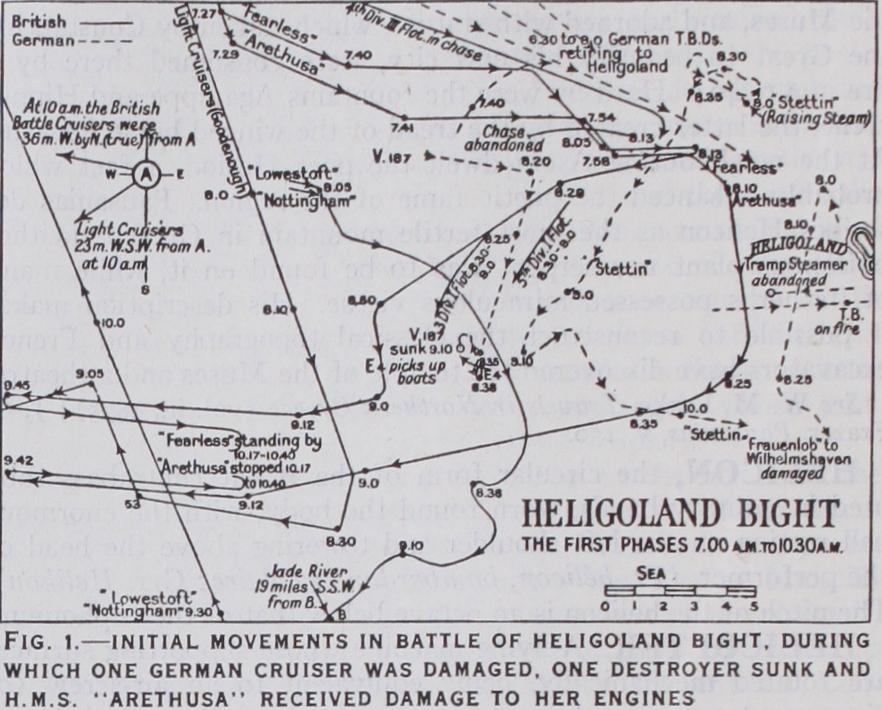
The survivors of the sinking German were rescued by boats from the British destroyers. Whilst the rescue work was in prog ress "Stettin" appeared from the north and, opening fire upon the destroyers, scattered them, herself receiving a few hits whilst doing so. In the confusion, five boats, full of German wounded and prisoners, were left behind. Submarine "E.4" (Lt.-Com. heir), made an unsuccessful attack upon "Stettin," which caused that ship to withdraw; then, appearing suddenly on the surface, she went to the rescue of the British boat's crews. One German officer and three men were kept as prisoners; the remainder were left in the British boats, were supplied with bread and water, and given the course to Heligoland. "E.4" then submerged as dramat ically as she had appeared.
Goodenough, with four cruisers, turned westward at 8.3o A.M., being at that time ten m. ahead of the flotillas. "Nottingham" and "Lowestoft," after heading off "V.187," tried to rejoin Goode nough, but failing to regain touch, they steered N.W. for the battle-cruiser position. Keyes in "Lurcher," still unaware of the presence of the northern force, sighted and shadowed them, under the impression they were enemy ships. Through the mist, just be fore 9.o A.M., Keyes sighted Goodenough's four other ships astern. He informed "Invincible" that he was being chased by four cruis ers and was trying to lead them towards her. Goodenough fol lowed "Lurcher" for about ten minutes and then turned back to the westerly course. This took his ships over the outer line of British submarines, who were still unaware of his presence. At 9.3o A.M. "Southampton" sighted "E.6" and promptly attempted to ram; the submarine escaped only by making a rapid dive. Towards Io.o A.M., the weather to seaward becoming clearer, mutual recognition took place between Keyes and Goodenough and the latter went on to the westward, in order to give the sub marines freedom of action.
Tyrwhitt had intercepted Keyes's message to "Invincible," and at 9.45 A.M. he gallantly turned back to his assistance with the crippled "Arethusa." "Fearless" turned back at the same time, and by 10.o A.M. the 3rd and 5th divisions, having rejoined after sinking "V.187," the re-united flotillas turned once more to the westward. But by this time "Arethusa" could only steam at ten knots, and at 10.17 she was forced to stop to repair her engines. "Fearless" stood by her, and by 10.45 A.M. the two ships were under way again, steaming slowly W., with the destroyers spread out ahead of them.
The German command, in the Jade river, had by now realized the situation and was endeavouring to concentrate the light cruis ers to attack the British flotillas (see fig. 2). "Mainz" left the Ems river at 9.o A.M. and was coming up from S.W., hoping to cut off the destroyers and to join "Strassburg." That ship left the Jade river at 9.3o A.M., followed at intervals by "Coln," "Ariadne," "Stralsund," and "Kolberg," while the "Stettin" was on her way W. from Heligoland. Thus six light cruisers were endeavouring to encompass the British flotillas, whose position from I I .o A.M. onwards was precarious. Soon after "Arethusa" resumed her westerly course at Io.45 A.M. "Strassburg" appeared from S.E., and after firing a few salvoes at long range disappeared in the mist to the northward. She was followed at 11.5 A.M. by "Coln," which also passed on after exchanging a few salvoes. When "Coln" appeared Tyrwhitt asked Beatty for support. At 11.16 A.M. "Strassburg" reappeared to the northward and opened a heavy fire upon "Arethusa." A determined attack by the 1st and end divisions of the 3rd and the 1st division of the ist flotillas drove her off. and the stricken "Arethusa" continued her course to W., supported by "Fearless" and the destroyers. When "Strass burg" reappeared "Fearless" sent out an urgent call for help, and Beatty, at 11.20 A.M., ordered Goodenough to turn back to the assistance of the flotillas.
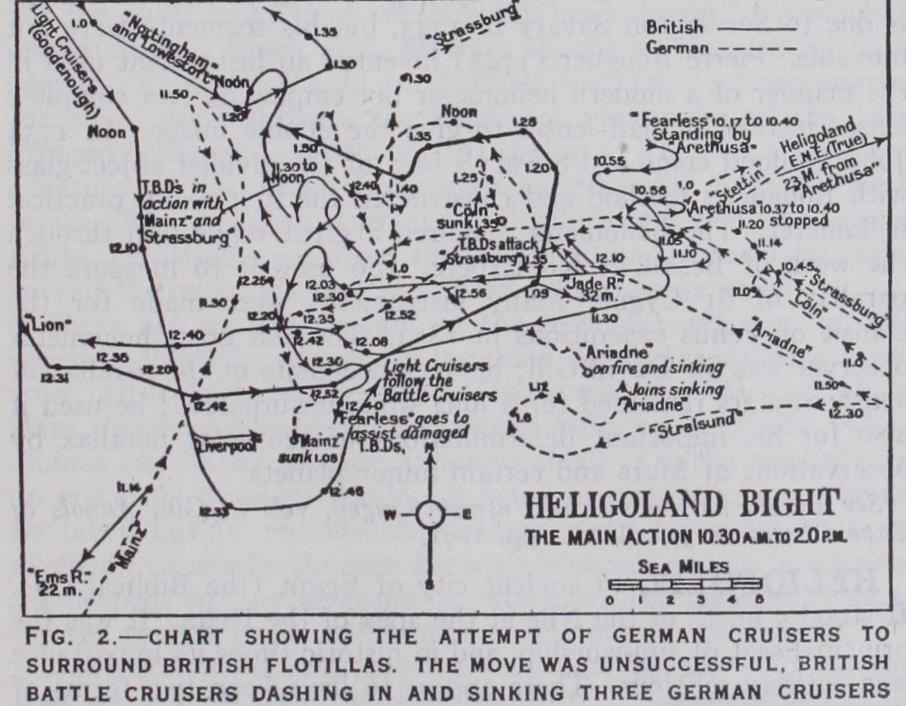
To Beatty, who had been steaming at high speed around a position about som. to the N. and W. of Heligoland, the course of events had by no means been clear. The urgent call from "Fearless," however, made it evident that she and the "Arethusa" were in action with two or more cruisers. The flotillas were still within 3om. of Heligoland, and at any time after noon there was a possibility of heavy enemy ships appearing from the Jade river. Goodenough was turned back, and Beatty, accepting the risk of mines and submarines, determined to take his whole force into the Bight to clear matters up and to extricate "Arethusa" and the flotillas. By 11.3o A.M. the battle-cruisers were forming single line ahead on a S.E. course and were working up to full speed.
The Sinking of the "Mainz."—At 11.30 A.M. the end, 3rd, and 5th divisions of the 1st flotilla were about six m. to the westward of "Arethusa" when the "Mainz" appeared right ahead and chased them away to the north. At I 1.50, after a 20 min. chase, "Mainz" sighted Goodenough's four cruisers coming out of the haze from N.W. and the whole aspect of affairs was at once changed. "Mainz" turned S., followed by the destroyers she had been chas ing, and was hit twice by the cruisers before she could draw away in the mist. At 12.08, she met "Fearless" with the remainder of the 3rd flotilla, and in the sharp fight that followed her rudder and port engine were damaged and she was hit by a torpedo from one of the destroyers. Goodenough's cruisers were now closing up and the fate of "Mainz" was sealed. She turned and dealt sav agely with the 4th division when they attacked. "Laurel" had her after-funnel blown away and her captain severely wounded, "Laertes" was stopped dead by four hits from the same salvo. and "Liberty's" mast was shot away and her captain killed. But "Mainz," under the concentrated fire of the cruisers and destroy ers, soon became a helpless wreck. She struck at 12.5o, and 18 minutes later she rolled over and sank. Keyes, in the "Lurcher," went alongside and rescued 348 of her crew, narrowly escaping damage from her propellers as she sank.
The Battle-Cruisers in Action.--During the half-hour after noon the two British flotilla leaders were in grave danger of being overwhelmed. "Mainz" had appeared ahead, "Coln" and "Ari adne" were fast coming up astern, followed by "Stralsund" and "Stettin," and "Strassburg" was in action with the destroyers about five m. to the N.E. Goodenough's arrival and the sinking of the "Mainz" relieved the pressure and Tyrwhitt continued to limp slowly to the westward. At 12.3o "Arethusa" sighted a large ship in the mist ahead, and after a moment of breathless suspense recognized her as the "Lion," followed by the battle-cruiser squad ron. Steaming at high speed, Beatty left the "Arethusa" to port and the sinking "Mainz" to starboard and swept on. Goodenough's cruisers joined in astern and "Fearless" turned away to the as sistance of "Laurel" and her damaged consorts. The German cruisers fled. "Strassburg" turned N., disappeared into the mist, and was no more seen. "Coln," sighted on the port bow of the "Lion," made a desperate attempt to escape to N.E. but a few salvoes disabled her engines. "Ariadne" tried to pass ahead of "Lion" on a S.E. course, but, hit by the first two salvoes fired at her, she disappeared to the southward, badly on fire and sinking. "Stralsund" and "Stettin" turned eastward and escaped. At Log P.M. Beatty, being only 32m. from the mouth of the Jade river, made the general signal to retire. The battle-cruisers turned in a wide circle to the N. and W. and at 1.25 P.M. the "Coln" was seen again, steaming slowly to the S.E. Three salvoes caused her to list to port and at 1.35 P.M. she sank, taking with her the Ger man cruiser admiral and all her ship's company.
Thus, in a brief hour, Beatty's bold stroke with the battle cruisers had turned an awkward situation into a brilliant success. The British force withdrew homewards and all ships arrived safely at their ports. Two only, the "Arethusa" and "Laurel," had to be towed home. The German battle-cruisers were slow in getting to sea and did not leave the Jade river until 2.0 P.M. By 4.o P.M., accompanied by destroyers and the remnants of the light cruiser squadron, they reached a position close to where the "Coln" had sunk, and, seeing no enemy, returned to the shelter of their base. The success achieved in this operation exceeded all expecta tions and its effects were far-reaching. It came at a time when the British nation needed a success to dispel the dismay caused by the overwhelming advance of the German armies. Upon the British navy the effect was exhilarating. The command of the North Sea had been asserted right up to the gates of the enemy and the young destroyer commanders had acquired a sense of superiority over their enemy and a trust in their leaders. Serious as was the material loss to the German fleet, it was not com parable to the effect upon its morale. Admiral Tirpitz stated that "August 28 was a day fateful, both in after effects and in inci dental results, to the work of the German navy." Certainly, the marked disinclination shown by the German fleet throughout the war to be drawn from the protection of its bases is attributable to this early British success in the Bight of Heligoland.
(S. T. H. W.)