LETHAL AND SEMILETHAL GENES. DEFICIENCIES The various phenotypes of a given organism generally differ slightly in viability, for a gene, although its main effect may be local, always affects the organism as a whole. Of course the via bility depends on the environment. Thus hairless (recessive) mice are clearly more likely to die of cold than the normal type. Usually the expectation of life of the normal, or wild type, ex ceeds that of others significantly, but occasionally a mutant may be longer lived or more fertile than the wild type. A combination of several abnormal genes may yield a better expectation of life than any of the genes alone. The table below gives the expecta tions of life for Drosophila melanogaster produced by several genes in the second chromosome.
The expectations given are of course under laboratory and not natural conditions. But many phenotypes have an extremely low viability. When only a few per cent of the unsuccessful pheno types survive to maturity the gene is called a semi-lethal. When none survive it is called a lethal. The deaths may be due to various causes. Thus a recessive sex-linked gene in Drosophila melanogaster causes the deaths of half the females heterozygous for it, as the result of a malignant tumour. In plants a very com mon type of lethal gene produces plants lacking chlorophyll, which therefore soon die.
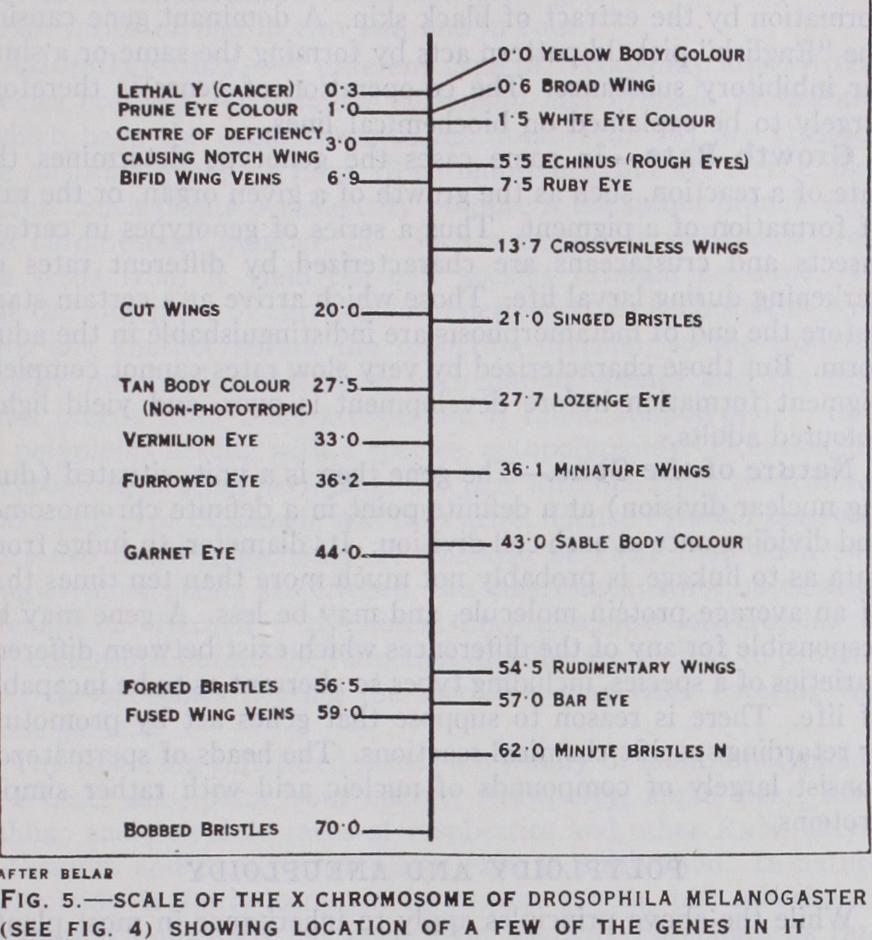
Lethal genes are often discovered be cause they lead to abnormal ratios in the progeny. Thus in Drosophila a female heterozygous for a recessive sex-linked lethal will produce twice as many daughters as sons, for half her sons will receive the lethal gene and die, while half the daughters are heterozygous for it, and resemble the mother in their geneti cal behaviour. If such a female be mated with a male which carries a sex-linked dominant gene, all her daughters will bear this gene in one of their X chromosomes, and half will bear the lethal in the other. Hence all surviving sons of the latter class of females will receive the dominant gene from their grandfather, except where this has crossed over into the same chromosome as the lethal. In this way the cross-over values between lethal and other genes can be found, and the lethal genes can be assigned to their proper places in the chromosome.
Where the normal or wild type of organism is known, more genes are generally found recessive than dominant to it. And of the few dominants a fair proportion are generally lethal when homozygous. Thus when a yellow mouse is mated to a non-yellow, half the offspring are yellow, i.e., the yellows behave as hetero zygous dominants. When two yellows are mated, the ratio of yellows to non-yellows is two, not three, to one, and the yellow children are heterozygous. The homozygous yellows per ish at an early embryonic stage. Similarly the Dexter Kerry cows (a short-legged form) when mated with normal cattle give equal numbers of normal and short-legged. Mated together they give i normal : 2 dexters : i aborted or still-born. These homozygotes are dwarfs with bulldog-like faces and only rudi ments of a thyroid gland, whose practical absence presumably accounts for their abnormality. In the fowl the homozygotes of the frizzled and Scotch Dumpy breeds die in the shell.
Some, but not all, lethals are due to the absence of a section of chromosome including several genes. If a zygote heterozygous for such a lethal (which is called a deficiency) is mated to another recessive for the genes left out in the deficiency, all the offspring which carry the lethal show the re cessive characters, since the dominant allelomorphs carried by a normal chromosome are absent from the deficient section. The probability of crossing-over is diminished in the neighbourhood of a deficiency. The lethal effect when homozygous is clearly due to the complete absence of one or more genes necessary for life. Gametic Lethals.—In the higher plants the haploid genera tion, especially the pollen grains, have an independent life of their own. Genes carried by them may affect their behaviour to a greater or less extent. In some cases pollen carrying a given gene may be quite sterile. In others it is handicapped to a greater or less extent in comparison with the normal. Plants heterozygous for such genes therefore give normal ratios when used as mothers, abnormal when used as pollen parents. It is doubtful if gametic lethals occur on the female side of plants. They do not in ani mals. Spermatozoa may be capable of swimming and fusing with an ovum, even if they contain too few or too many chromosomes.
One of the dominant genes modifying wing shape in Drosophila, beaded, (B) is lethal when homozygous. Nevertheless it has been possible to obtain a stock with beaded wings breeding nearly true. When mated with normals only half the offspring are beaded. But the other half also carry a lethal, located, like B, in the third chromosome.
BL bl When mated together they give I BL (dies) :
ibl (dies) BL bl bl bL with a few
which
and — and bl bL'
are bl Bl bl bL normals, due to crossing over. If a recessive gene is present
either chromosome in the neighbourhood of the lethals, very much less than one in four of such recessives appear when the stock is inbred. Such cases of balanced lethals occur in nature.
Most species of the genus Oenothera breed nearly true, but give a few "mutants." When crossed with another species the offspring are generally of two, rarely of four, different types, whereas in normal species-crosses all are alike. This behaviour has been shown to be due to balanced lethals. A pollen lethal (causing sterility of half the pollen) may lie in the corresponding chromosome (or chromosome group, for the chromosomes are often attached to one another) with a zygotic lethal (causing sterility of half the seeds) or with a gene acting as a pseudo-lethal to the ovules. Such a gene is not lethal in itself, but when present in the heterozygous condition with a certain allelomorph, a megaspore containing the latter proliferates taking the place of the cell normally giving rise to the embryo. The few "mutants," which are not in general mutants in the ordinary sense, are mostly due to crossing over, which allows the reappearance of recessive genes. Other "mutants" are due to chromosomal aberrations. Any two, or all three, of these lethals may be present in a single plant.
