
HIPPOPOTAMUS, the largest living non-ruminating even toed mammal (see ARTIODACTYLA). The common hippopotamus (H. amphibius) inhabits the large rivers of Africa, though its range has now become much restricted. It is the type of the family Hippopotomidae, whose nearest relatives are the pigs.
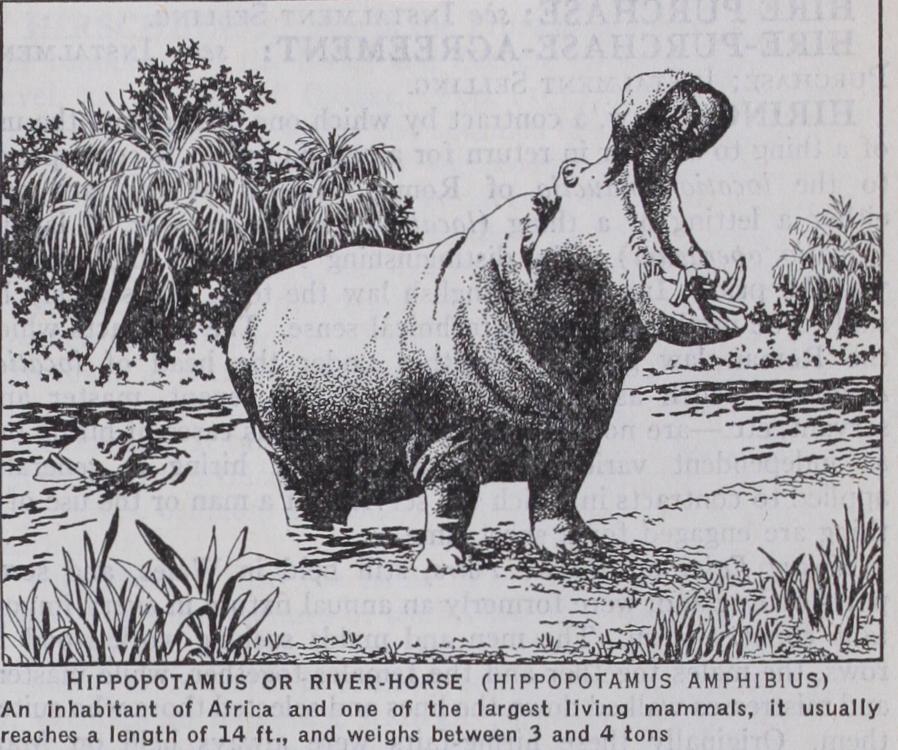
In form the hippopotamus is huge and unwieldy, reaching a length of i4ft., a height of 3ft.Ioin. at the shoulder, and a weight of at least 3 tons. The ears are small but flexible, the body thick, the legs short. The eyes and nostrils protrude so as to be out of water when the animal is floating; the gape is enormous and the upper lip thick and bulging. Both canines and incisors are of continuous growth and very large. The skin, which is tin. thick in places, is almost destitute of hair. Hippopotami live in herds of 20 to 4o on the banks and in the beds of rivers, feeding mainly at night and on aquatic plants growing in the water, but they also come on shore to feed, frequently doing immense damage to crops. Of a mild and inoffensive disposition, the hippopotamus can exhibit great ferocity when wounded or defending its young; its immense strength and agility, despite its unwieldy bulk, render it a formidable antagonist. As among elephants, old bulls may be come "rogues" and will attack all and sundry without provoca tion.
The only other living species is the pygmy hippopotamus (H. liberiensis) inhabiting the rivers of West Africa. In the Pleisto cene epoch, a hippopotamus inseparable from H. amphibius, in habited the greater part of Europe, while dwarf species were natives of Crete, Malta, and Sicily, India, Burma, and northern Africa. More recently, one species, H. lemerlei, lived in Madagascar.