
HOLLAND VEHICULAR TUNNEL. In 1906 the States of New York and New Jersey created the New York State bridge and tunnel commission and the New Jersey Interstate bridge and tunnel commission for the purpose of studying means of vehicular intercommunication across the Hudson river, which separates them. The joint commission recommended a vehicular tunnel from Canal street in the borough of Manhattan to Journal square, Jersey City. In 1919 actual preparations for construction began under the direction of Clifford M. Holland, who died on Oct. 27, 1924, and was succeeded by Milton C. Freeman. Mr. Freeman died on March, 24, 1925 and was succeeded by Ole Singstad, who was in charge of the work until its completion.
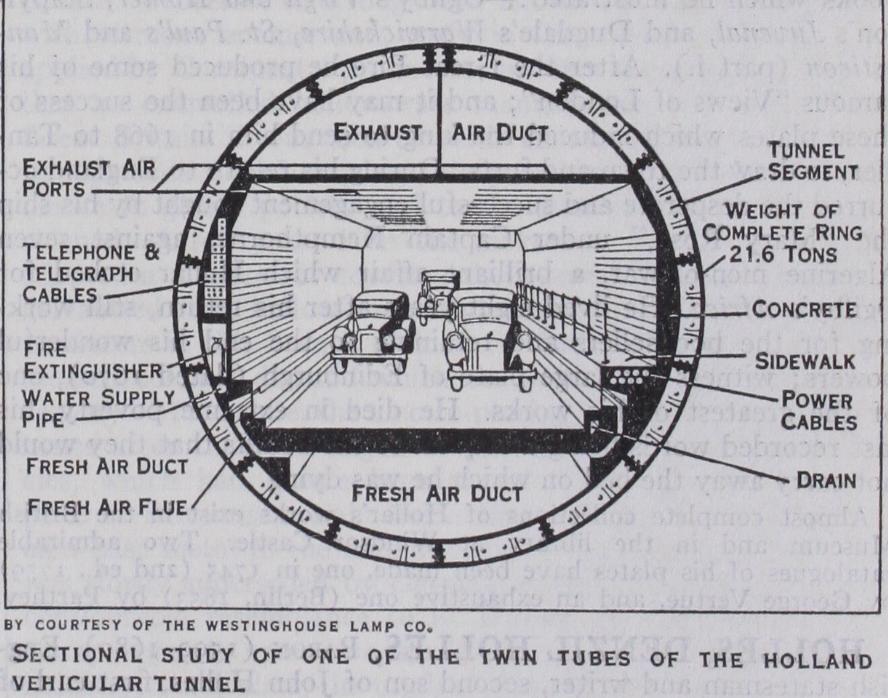
The first 4oft. boring shield was set up in the Canal street shaft on Sept. II, 1922. On Oct. 2q, 1924, the first two entries were connected. The total cost of construction was $48,400,000. It has provided two tunnels, 9,25oft. long and 29ft. 6in. in diameter, each capable of accommodating a double line of traffic. Its designed capacity is 40,000 vehicles per day.
The tunnel is ventilated by fresh air forced through the spaces between the roadway and the bottom of the tube, and drawn by fans through a similar space at the top. The provision for traffic control and for fire emergencies are unusually complete. The tun nel was opened for traffic on Nov. 12, 1927. In 1936-37, a record year of traffic, 13.026,549 vehicles passed through it.