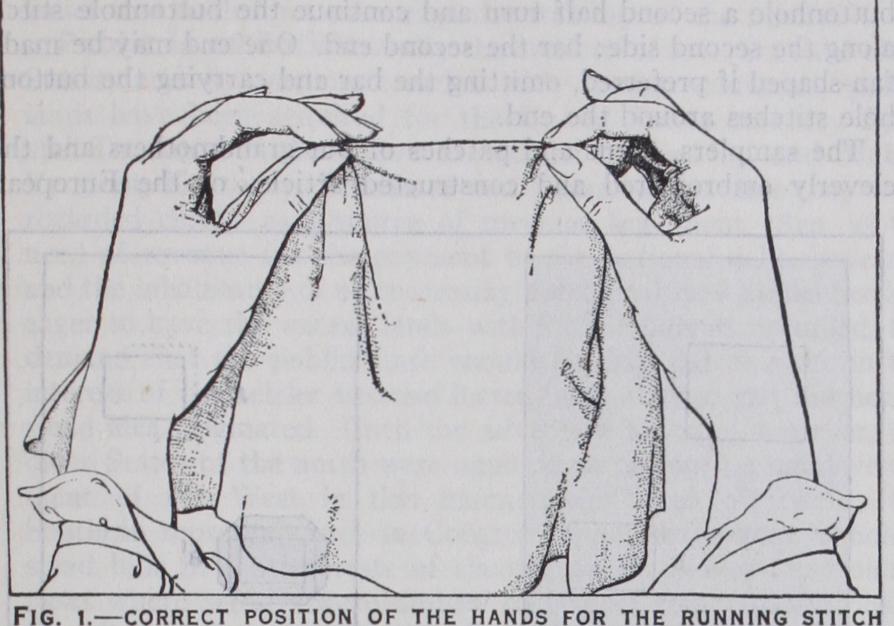
HOME SEWING. The sewing actually done in the home to-day centres in darning, repairing, remodelling, and making children's clothing and simple adult garments. To acquire skill in hand sewing, attention must be given to the correct position of the hands. For general use, cotton thread No. ; o in an 18 in. length, and needle No. 7 sharp give satisfactory results. The point of the needle should be held in the right hand between the thumb and forefinger. The hand must be so spread that the needle's eye rests on the upper side of the thimble, on the sharply bent second finger. The needle points diagonally over the left shoulder and the work progresses from right to left, except in em broidering, which usually progresses from left to right.
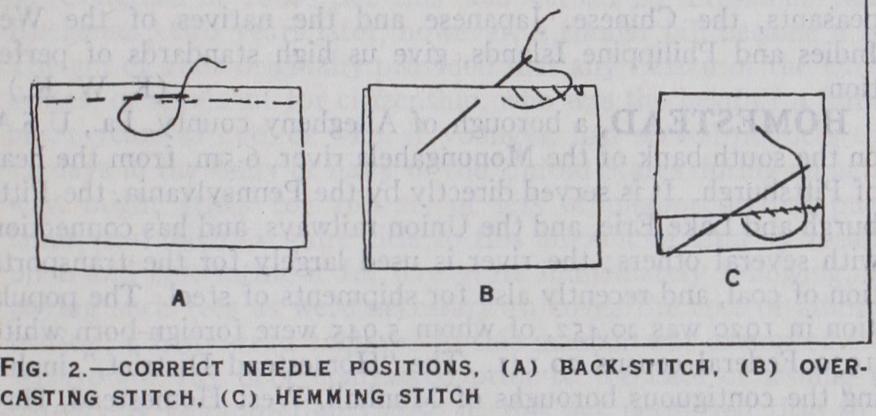
The following stitches are helpful for constructing garments by hand. However, the sewing machine gives added strength to garment construction and saves much time and effort ; hence, it should be used wherever feasible.
The running stitch is a succession of small, even stitches used to join two pieces of cloth, as in tucking or seaming. It is made by holding the cloth between the forefinger and thumb of both hands; the left keeps the cloth taut and permits it to slip forward as needed; the right holds the point of the needle as well as the cloth and makes the stitch by twisting the wrist as the needle is pushed forward. The needle should be taken from the cloth only when it has travelled the entire length. Slight variations are used for basting or gathering an edge.
Backstitching is a reinforced running stitch. The needle is brought out of the cloth at every third stitch and re-entered at the beginning of it.
In overcasting, a small slanting stitch is repeated on a raw edge to prevent its ravelling.
The hemming stitch is a small slanting stitch beginning in the cloth and ending in the folded edge it should hold in position.
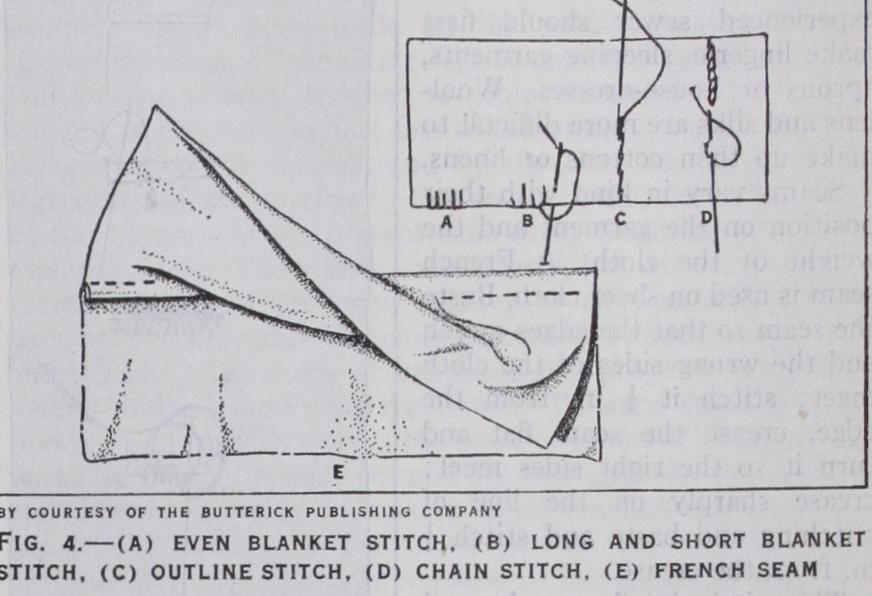
Simple embroidery stitches give charm. The blanket stitch pro tects the raw edge as well as decorates it. The outline and chain stitches outline a design or hold a hem in place.
placing and cutting thoroughly before cutting any pieces; test the pattern before cutting; cut pieces for the right and left side of the body with the right or the wrong sides of the cloth together if the material has a right and wrong side in order to avoid con structing both pieces for the same side ; when the material has a decided design, each piece should be cut with consideration for its relation to pieces in juxtaposition on the finished garment. The in experienced sewer should first make lingerie, sleeping garments, aprons or house-dresses. Wool lens and silks are more difficult to make up than cottons or linens.
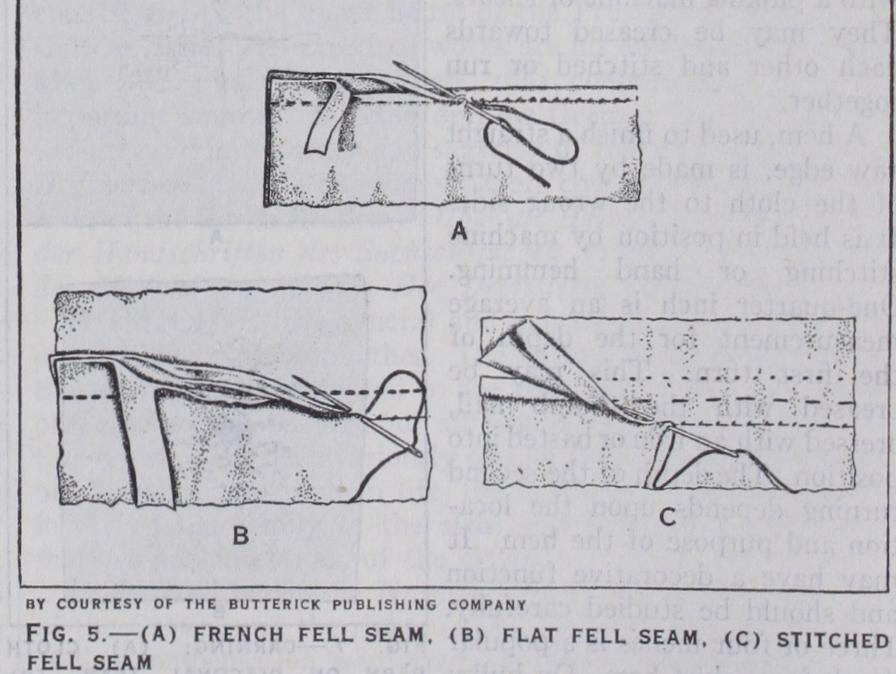
Seams vary in kind with their position on the garment and the weight of the cloth. A French seam is used on sheer cloth. Baste the seam so that the edges match and the wrong sides of the cloth meet; stitch it in. from the edge, crease the seam flat and turn it so the right sides meet ; crease sharply on the line of stitching and baste and stitch in. from the crease.
The stitched fell seam is used on heavy material and gives a tailored finish. Baste the seam so that the wrong sides of the material meet and stitch 2 to in. from the edge. Trim one piece to within s in. of the stitching and crease the other edge towards the trimmed one. Lay the seam flat on the garment and baste and stitch from the creased edge. This leaves a double row of stitching on the right and makes a smooth seam.
A plain seam is used on heavy material that does not readily ravel. Baste the seam so that the right sides of the material meet ; stitch it in. from the edge ; trim and bind or overcast the edges separately or together. On wool, they may be pinked with a pinking machine or shears. They may be creased towards each other and stitched or run together.
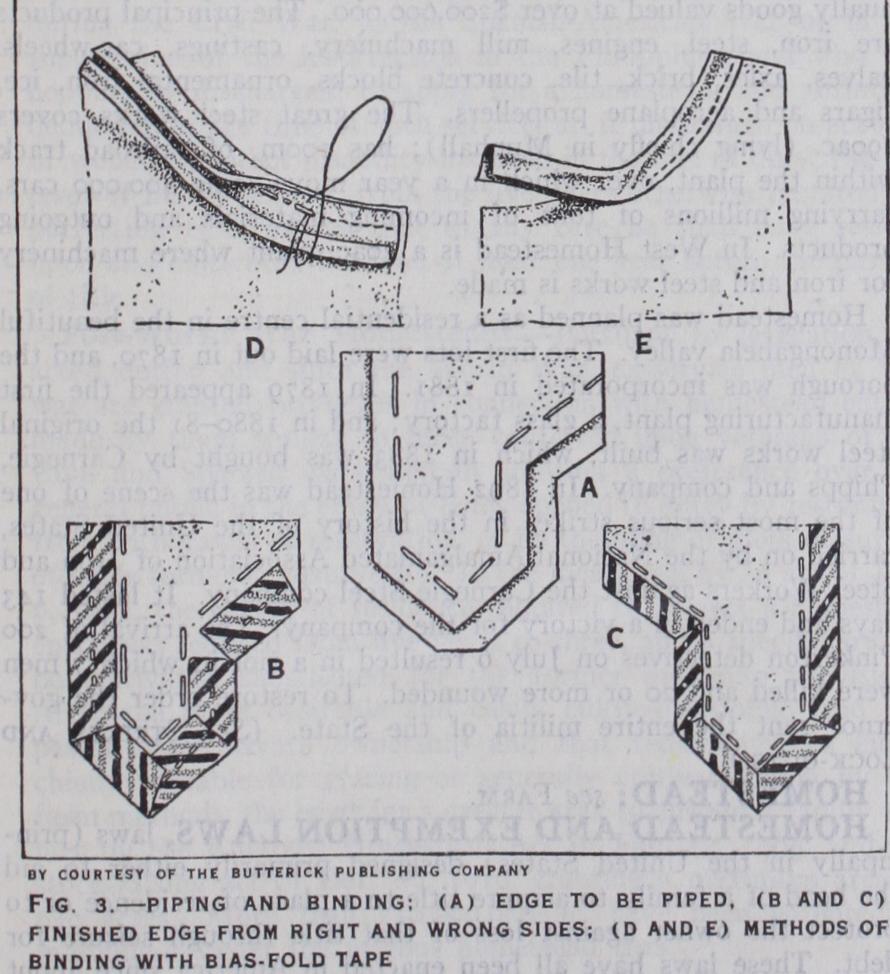
A hem, used to finish a straight raw edge, is made by two turns of the cloth to the wrong side. It is held in position by machine stitching or hand hemming. One-quarter inch is an average measurement for the depth of the first turn. This may be creased with the thumb nail, pressed with an iron or basted into position. The depth of the second turning depends upon the loca tion and purpose of the hem. It may have a decorative function and should be studied carefully. Three or four inches is a popular depth for a skirt hem. On bulky material the edge may be turned but once and bound before hemming. A bias facing or binding may finish a shaped edge.
Set-in pockets and bound buttonholes do much to give a tailored dress a professional look. A worked buttonhole should be made in at least two thicknesses of cloth. Mark and cut a slit on a thread of the cloth slightly longer than the diameter of the button. Hold the buttonhole along the first finger of the left hand and box the slit ; overcast the edges, making two stitches on either side and tying stitches across either end. Buttonhole stitch along the first side to the tying stitches and put in two more "ties" ; turn it half around and work a bar of fine blanket stitches across the end covering the tying stitches. Give the buttonhole a second half turn and continue the buttonhole stitch along the second side ; bar the second end. One end may be made fan-shaped if preferred, omitting the bar and carrying the button hole stitches around the end.
The samplers, darns and patches of our grandmothers and the cleverly embroidered and constructed articles of the European peasants, the Chinese, Japanese and the natives of the West Indies and Philippine Islands, give us high standards of perfec tion. (K. W. K.)