
HORSETAIL (Equisetum), the sole genus of the botanical class Equisetaceae, consisting of a group of vascular cryptogamous plants (see PTERIDOPHYTA) remarkable for the vegetative struc ture which resembles in general appearance the genera of flowering plants Casuarina and Ephedra. They are herbaceous plants grow ing from an underground much-branched rootstock from which spring slender aerial shoots which are green, ribbed, and bear at each node a whorl of leaves reduced to a toothed sheath. From the nodes spring whorls of similar but more slender branches. Some shoots are sterile while others are fertile, bearing at the apex the so-called fructification—a dense oval, oblong conical or cylindrical spike, consisting of a number of shortly-stalked peltate scales, each of which has attached to its under surface a circle of spore cases (sporangia) which open by a longitudinal slit on their inner side. The spores differ from those of ferns in their outer coat (exospore) being split up into four club-shaped hygroscopic threads (elaters) which are curled when moist, but become straightened when dry. In most species the fertile and sterile shoots are alike, both being green and leaf-bearing, but in a few species the fertile are more or less different, e.g., in E. arvense the fertile shoots appear first, in the spring, and are unbranched and not green. Any portion of the underground rhizome when broken off is capable of producing a new plant ; hence the difficulty of eradicating them when once established. There are 25 known species of the genus which is universally distributed, 9 of which occur in Great Britain.
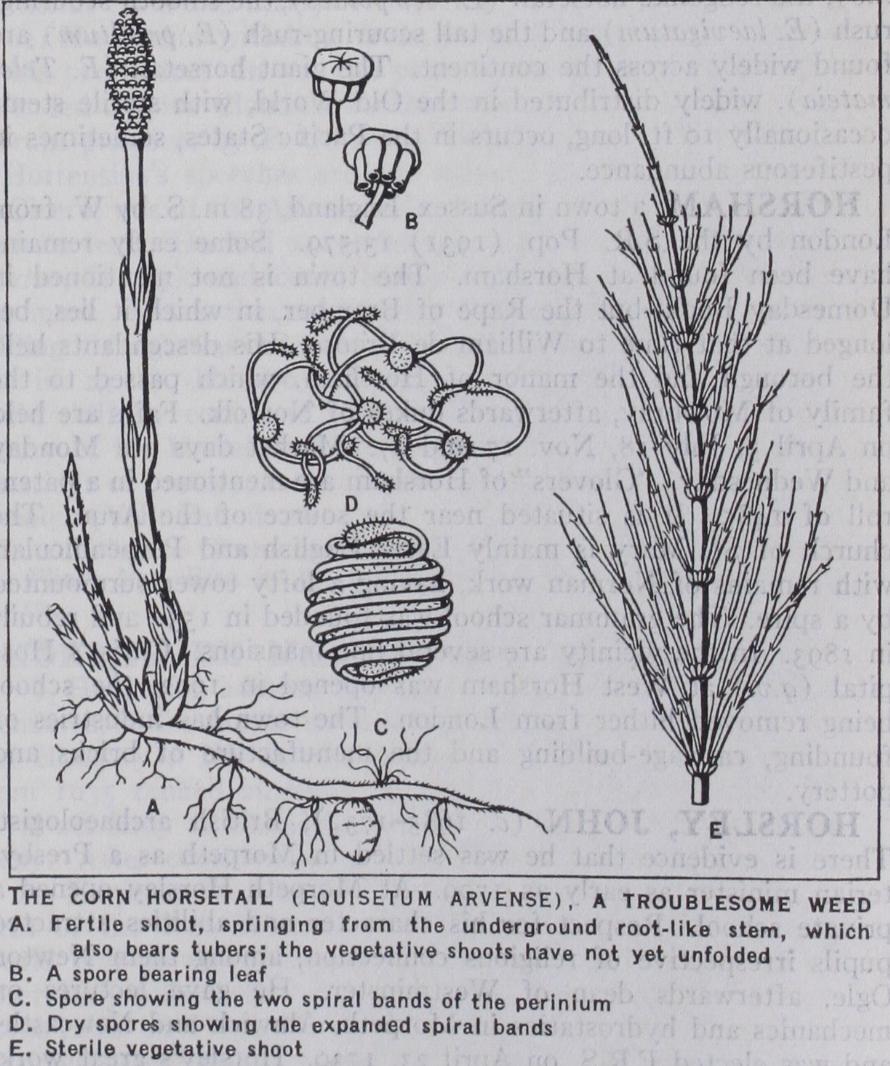
The common horsetail E. arvense, one of the best-known spe cies, is sometimes a troublesome weed in clayey fields. The fructifi cation appears in March and April, terminating in short un branched stems. It is said to produce diarrhoea in such cattle as eat it. The bog horsetail, E. palustre, is said to possess similar properties. It grows in marshes, ditches, pools and drains in meadows. The fructification in this species is cylindrical, and in that of E. fluviatile, which grows in similar situations, it is ovate in outline. The largest British species, E. Telemateia, grows in wet sandy declivities by railway embankments or streams, etc., and is remarkable for its beauty, due to the abundance of its elegant branches and the alternately green and white appearance of the stem. In this species the fructification is conical or lanceolate, and is found in April on short, stout, unbranched stems which have large loose sheaths. E. hyemale, commonly known as the Dutch rush, is much more abundant in Holland than in Great Britain; it is used for polishing purposes. E. variegation grows on wet sandy ground, and serves by means of its fibrous roots to bind the sand together. The horsetails are remarkable for the large quantity of silica they contain in the cuticle (hence their value in polishing), which often amounts to half the weight of the ash yielded by burning them ; the roots contain a quantity of starch.
In North America the majority of the known species of horse tail occur, several of which, as the common horsetail (E. arvense), the bog horsetail (E. palustre), the swamp horsetail (E. fluvia tile), the sedgelike horsetail (E. scirpoides), the smooth scouring rush (E. laevigatum) and the tall scouring-rush (E. prealtum) are found widely across the continent. The giant horsetail (E. Tele mateia), widely distributed in the Old World, with sterile stems occasionally 1 o ft. long, occurs in the Pacific States, sometimes in pestiferous abundance.