
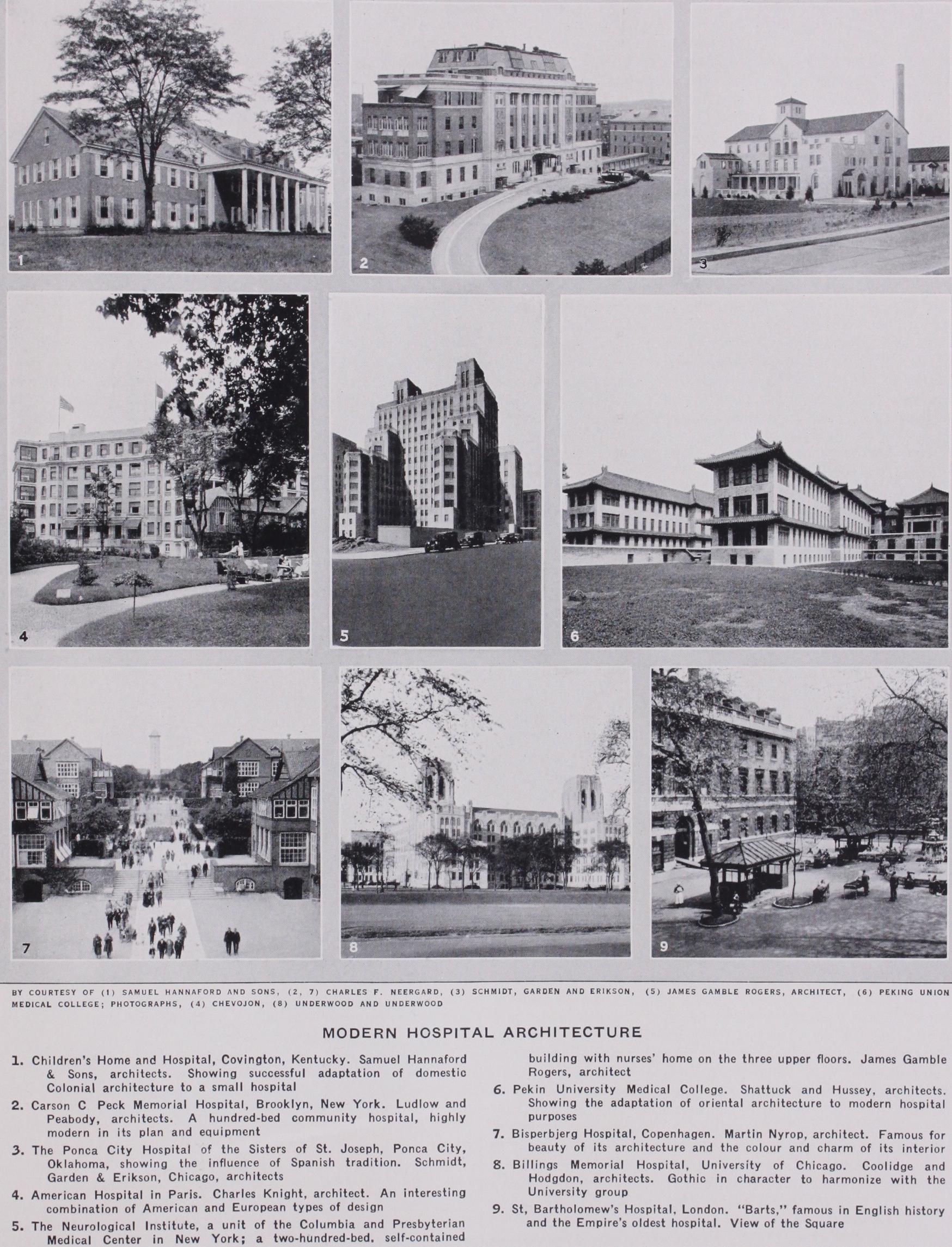
HOSPITAL PLANNING. The world-wide advance in medical science and public health in recent years has effected a similar growth in the scope of hospital work and the demand for adequate hospital service. The more varied and complex require ments of diagnosis, treatment and research, and medical and nurs ing education have also complicated the architectural problem. England, since 1926, has erected many new buildings—the Guard ians at Manchester, the Woolwich Memorial and the Torquay General are good examples. Australia and New Zealand have advanced hospital programmes. In Scandinavia, the Ulleval Syke hauser in Oslo, Norway, is a noteworthy example of balanced hospital organization and architectural conception. Denmark, with its progressive social programme for public relief, has supple mented its widespread health insurance with exceptional hospitals. The Bispebjerg in Copenhagen, a group of charming vine-clad buildings in a spacious park, within and without, is one of the most beautiful modern institutions for the sick in the world. Holland and Sweden have many fine hospitals of post-war con struction.
America, too, has contributed somewhat of its hospital expe rience to Europe. The maternity pavilion of the University of London hospital, a gift of the Rockefeller Foundation, is a fine example of dignified design. The American hospital in Paris transplants American organization, policies and standards, and its beautiful buildings represent an interesting architectural transi tion between the modern compact type of multi-storey hospital of the United States and the spacious Continental tradition. Western influence has likewise spread into the Orient. In China, the Peking Union Medical college, the Yale Medical school and hospital, the new Country hospital in Shanghai, and many splendid mission hospitals; in Japan the new St. Luke's, Tokyo, among others, harmonize the spirit of oriental architecture with modern hospital efficiency. Outstanding among the many new hospitals in India are the Mirraj hospital in west India, an American missionary institution, and the Neve Brothers' in the Vale of Kashmir, a private English enterprise.
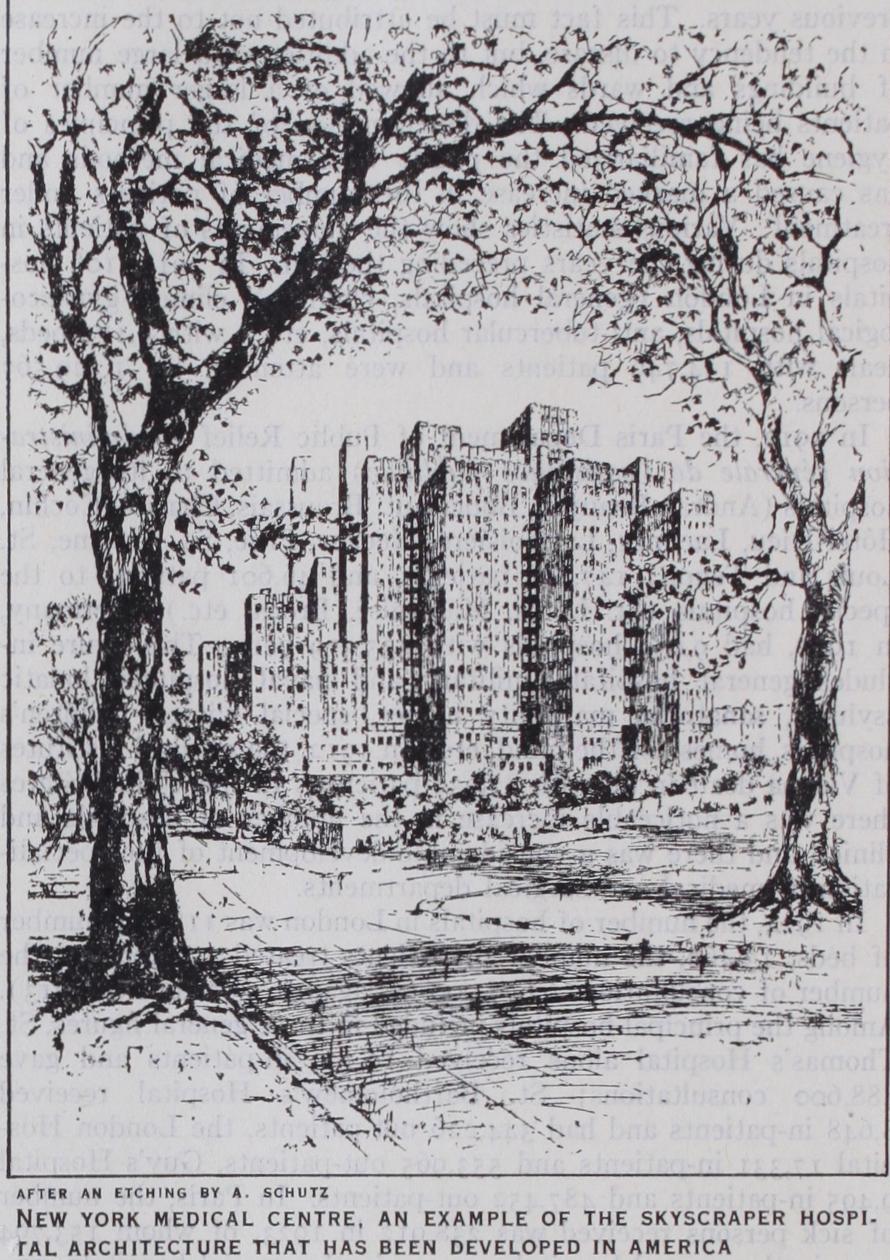
In America itself the trend in hospital architecture has been away from the dreary institutional type to buildings symbolizing a greater aesthetic blending of warm colours in walls and furnish ings; fire-proof construction is almost universal; in the mass the tendency is from the horizontal to the vertical, from the pavilion type of Europe to the multi-storey. The Rudolph Virchow hospital in Berlin, with some 36 two-storey pavilions housing more than 2,500 beds, and the Columbia Presbyterian Medical centre in New York, some 20 storeys high with 1,700 beds, represent the two poles.
The flexible plan of the modern hospital, with its small wards and semi-private rooms, represents a major step in operating economy; the broader scope of hospital service and the impelling necessity for economy have effected many radical changes in the traditional plan. The 24-bed ward with its service and utilities at one end no longer meets requirements. Instead, four, six and eight-bed wards, with doubled service units to save nursing effort, are becoming common. Beds must be arranged, yet without rigid lines, so that medical patients may be treated apart from the surgical, and maternity apart from both, with separate provision for the contagious, the noisy, the delirious and the dying. For merly new patients were placed wherever there was a vacant bed. New practice, for convenience in nursing, groups the acutely ill together and places those recovering where they will not be dis turbed by very sick neighbours. The modern hospital bed, which is easily and silently moved on its large casters, makes this possible.
The needs of the general service also are being more carefully studied, so that the nurse is not compelled to walk long distances to accomplish frequent routine tasks. With small wards a utility room seems justified for every ten patients. Nor is it generally realized how relatively small is the proportion of floor space devoted to the actual housing of patients. In one compact Ioo bed hospital, out of a total available floor area of 62,00o sq.ft., less than 2o% was used for patients' rooms, wards and solaria; 6% for professional units, operating, delivery and treatment rooms, laboratories and X-ray department ; while the balance, 74%, was required for the general service—corridors, elevators, kitchen, laundry, engineer's department and housing of personnel. Ideal provision also calls for open porches and enclosed solaria to which all patients can be conveniently wheeled in their beds. BIBLIOGRAPHY.--The best sources of information on hospital plan ning are the various magazines devoted to hospitals; among these may be mentioned Hospital Management and The Modern Hospital (Chi cago), Hospital Progress (Milwaukee), and The Hospital Gazette (London) . (See article HOSPITAL.) (C. F. N.)