
HOSPITAL, a term now in general use for institutions in which medical treatment is given to the sick or injured. The place where a guest was received was in Lat. hospitium (Fr. hospice), but the adjective hospitalis came into use in the same sense. Hence were derived on the one hand the Fr. hospital, hopital, applied to establishments for temporary occupation by the sick for the purpose of medical treatment, and hospice to places for permanent occupation by the poor, infirm, incurable or insane; on the other, the form hotel, which became restricted (except in the case of hotel-Dieu) to private or public dwelling-houses for ordinary occupation. In English, while "hostel" retained the ear lier sense and "hotel" has become confined to that of a superior inn (q.v.), "hospital" was used both in the sense of a permanent retreat for the poor infirm or for the insane, and also for a regu lar institution for the temporary reception of sick cases; but mod ern usage has gradually restricted it mainly to the latter, other words, such as almshouse and asylum, being preferred in the former cases.
In Great Britain hospitals for the treatment of general and special diseases are generally maintained upon what is known as the voluntary system. On the European continent, hospitals as a rule are maintained by the state or municipalities, and this sys tem is so fully developed in Sweden and elsewhere that the poor law and voluntary institutions are brought into intimate associa tion, although they may be managed by separate governing bodies. The plan pursued is to demand payment from all patients who are admitted to the hospital under a scale of charges graduated accord ing to their means. In the United States most large towns have city hospitals, administered and mainly supported by the munici pality. Many such institutions have pay wards and they are rap idly being instituted in Great Britain. The great argument for their establishment is that whereas the very rich and very poor can command the best of medical treatment, the middle classes are unprovided for. As a result many persons who could afford to pay for medical advice and treatment used the hospitals without payment, and it became necessary early in the present century for the larger hospitals to appoint almoners who should question the patients or their friends as to their financial fitness to receive hospital relief without payment. While necessitous patients are treated as formerly without payment, others pay according to their means, the actual weekly sum being arranged between the almoner and the patient or his friends. Since national insurance came into force the funds for sickness benefit have accumulated till they amount to many millions of pounds. The hospitals maintain that they should receive a substantial portion of this sum in return for the services they render to the insured and the question is still under discussion between the interested parties. In 1923 the Hospital Saving Association was formed in London whereby for threepence a week contribution full medical treatment in hospital was assured. In 1926 it had attracted 370, 00o persons, had an income of over L200,000 a year, had paid to the hospitals over L I 2 7,000 for treatment given to 100,00o persons and had a surplus on the hospital budgets of £250,000.
Comparison of Voluntary and Rate-supported Systems.— As to the relative merits arid demerits of the systems of govern ment of municipal hospitals and voluntary hospitals a few words may be useful. The voluntary hospital in Great Britain has had a remarkable effect for good upon all classes in modern England. The management is frequently representative of all classes, while the Hospital Sunday and other similar collections unite all creeds in the good work of caring and providing for the sick and injured members of each community. Again, the voluntary system makes for efficiency in administration; an ill-managed voluntary hospital is sure to disappear in due course. Each voluntary hospital has to live by competition, a fact which guarantees that everything in the way of new treatment and scientific development shall find its proper place within its walls. Open as they are to the full inspec tion of everybody whose knowledge and presence can promote efficiency, they have shown, especially since the last quarter of the i 9th century, a continuous development and improvement. The voluntary hospitals are attended, however, by certain dis advantages which do not attach to municipal institutions. A municipality which undertakes the provision of hospitals for the entire community is largely able to plan out the urban area, and to provide that each hospital site selected shall not only be suitable for the purpose, but shall contribute to make the whole system of hospital provision easily accessible to all classes who may require its aid. The voluntary hospitals, on the contrary, have grown up without any comprehensive plan of the districts or any real regard to the convenience or necessities of their poorer inhabitants. The best municipal systems provide a central office where the number of vacant beds in each hospital is known, so that the average of occupied beds in all the hospitals can be well maintained from an economical point of view. This inter-communication between all rate-supported hospitals in a city, which might be secured under the voluntary system, prevents delay in the admission of urgent cases, and makes for economy by keeping the average of beds occupied in each establishment high and uniform. On the other hand, the absence of competition, and the freedom from continu ous publicity and criticism such as the voluntary hospitals enjoy, make for inefficiency and indifferent work. Of course it is essen tial to have rate-supported hospitals where cases of infectious disease and the poorest of the people can be cared for, and of late years the administration of both these types of rate-supported hospitals has greatly improved, largely owing to the importance now accorded to medical officers of health. The poor-law infirmary in large cities, so far as the buildings and equipment are concerned, very often leaves little to desire. Poor-law infirmaries lack, how ever, the stimulus and the checks and advantages which impartial criticism continuously applied brings to a great voluntary hospital.
At the same time there is produced a healthy rivalry between all the bodies concerned which, upon the whole, reacts favourably on the treatment of patients within the hospital walls.
(W. S. L.-B.) Twentieth Century Development.—At the beginning of the century two special points are to be noted : I. The development of operating and clinical methods led to an increasing specialization in the departments of general medicine and surgery in hospitals.
2. From the architectural point of view, simplicity and com fort were being increasingly sought and buildings and hospital premises were being to an increasing extent adapted to the neces sities of sanitation and hygiene.
General Features.—Attempts to create large hospitals out side urban centres and in favourable climatic conditions have been to a large extent successful. In the case of old hospitals, where it was difficult to make rapid changes, the various services have been installed in special buildings and annexes, divided one from an other, each dealing with a special subject ; e.g., surgery, clinical work, ophthalmic work, otolaryngology, children's diseases, gynae cology, epidemics, etc. Whereas in Anglo-Saxon hospitals the principle of placing hospitals under independent management maintained by voluntary aid has been adhered to, in continental countries there has been an increasing tendency to centralize hos pitals by placing them under municipal, local or national authority.
Statistics.—Hospitals were more frequented in than in previous years. This fact must be attributed not to the increase in the tendency to disease, but to the addition of a large number of buildings and wards which allowed of a larger number of patients being received. The dissemination the principles of hygiene has familiarized the public with medical methods and has caused a marked increase in the number of patients under treatment. Various statistics show the movements of patients in hospitals during the years preceding the war. In 1913, 106 hos pitals in London (general hospitals, children's clinics, gynaeco logical hospitals, anti-tubercular hospitals, etc.), with 9,171 beds, dealt with 134,749 patients and were attended by persons.
In 1912, the Paris Department of Public Relief (l'administra tion generale de L'assistance publique) admitted to its general hospitals (Andral, Beaujon, Boucicaut, Broussais, Charite, Cochin, Hotel-Dieu, Laennec, Lariboisiere, Necker, Pitie, St. Antoine, St. Louis and Tenon) 147,828 patients, and 46,601 patients to the special hospitals (St. Louis, Maternity, Broca, etc.) . Germany, in 1912, had 9,054 hospitals with 535,579 beds. This figure in cludes general hospitals, military and naval hospitals, lunatic asylums, sanatoria, maternity homes, special clinics, children's hospitals, homes for the blind, etc. In 1912, the medical institutes of Vienna dealt in all with 82,939 patients. In the United States there was a noticeable increase in the number of hospitals and clinics, and there was a considerable development of the speciali zation of medical and surgical departments.
War Conditions.—The World War of 1914 compelled hos pitals to adapt themselves rapidly to new requirements. Exist ing hospitals were transformed, large numbers of extra establish ments were improvised and various other special measures were adopted : (a) Permanent military hospitals, already existing in time of peace, were specially adapted for the reception of sick and wounded soldiers; (b) Civil hospitals were placed, together with their staff, under the direction of the military authorities; (c) Hospitals were installed in public or private buildings, such as hotels, schools, private houses, etc., to receive and deal with the flow of wounded from the front.
(d) Hospitals in the zone of military operations were carried on in permanent premises or under canvas, even underground, nursing posts and relief posts dealing with first aid to the wounded before their evacuation to the rear; (e) As described in the article MEDICAL SERVICE (ARMY), am bulances of every type were employed. Trains, barges, liners and even aeroplanes, specially built or converted and equipped, were used for the transport of sick and wounded to base and home hospitals.
(f) Special hospitals for orthopaedic, tuberculous, neurasthenic, paralysed and gassed cases were organized. Electro-therapeutical, hydro-therapeutic, helio-therapeutic, massage and special sec tions were also developed.
(g) Convalescent homes were set up and many private man sions were used for this purpose. Convalescent camps were formed near the base hospitals overseas.
(h) Temporary hospitals were erected to receive influenza pa tients, and malaria camps were organized.
During the loth century, and more particularly in the period from 1914 to 1925, the development of hospitals in the United States has been unprecedented. This development may be con sidered under the heads of (a) the present trend of hospitals as a social factor, (b) the present day construction, (c) specific examples and (d) statistics of 1925 and the increase during the period in question.
Hospitals as a Social Factor.—While there is a continued de velopment and refinement of the care of the sick in the hos pital to-day, the conception of the function of this institution has materially broadened, with a rapidly increasing tendency to regard it as a community health centre from which to radiate all health activities, particular emphasis being placed upon the development of out-patient departments (this as a means of teaching and prac tising preventive medicine and thereby obviating the necessity of the hospital bed), district nursing and social service. In the larger cities medical centres are being developed, in which case the foregoing community functions are associated with the instruc tion of student bodies in various branches, including medicine, nursing, public-health work, social service, and, in many instances, dentistry. The tendency to develop isolated speciality hospitals is being replaced by provisions for the specialities as departments of the general hospital or by the affiliation of already existing speciality hospitals with existing general hospitals. The different types of schools teaching health work, with the various hospitals, form these medical centre groups, in which are included convales cent homes as an integral or co-ordinated part.
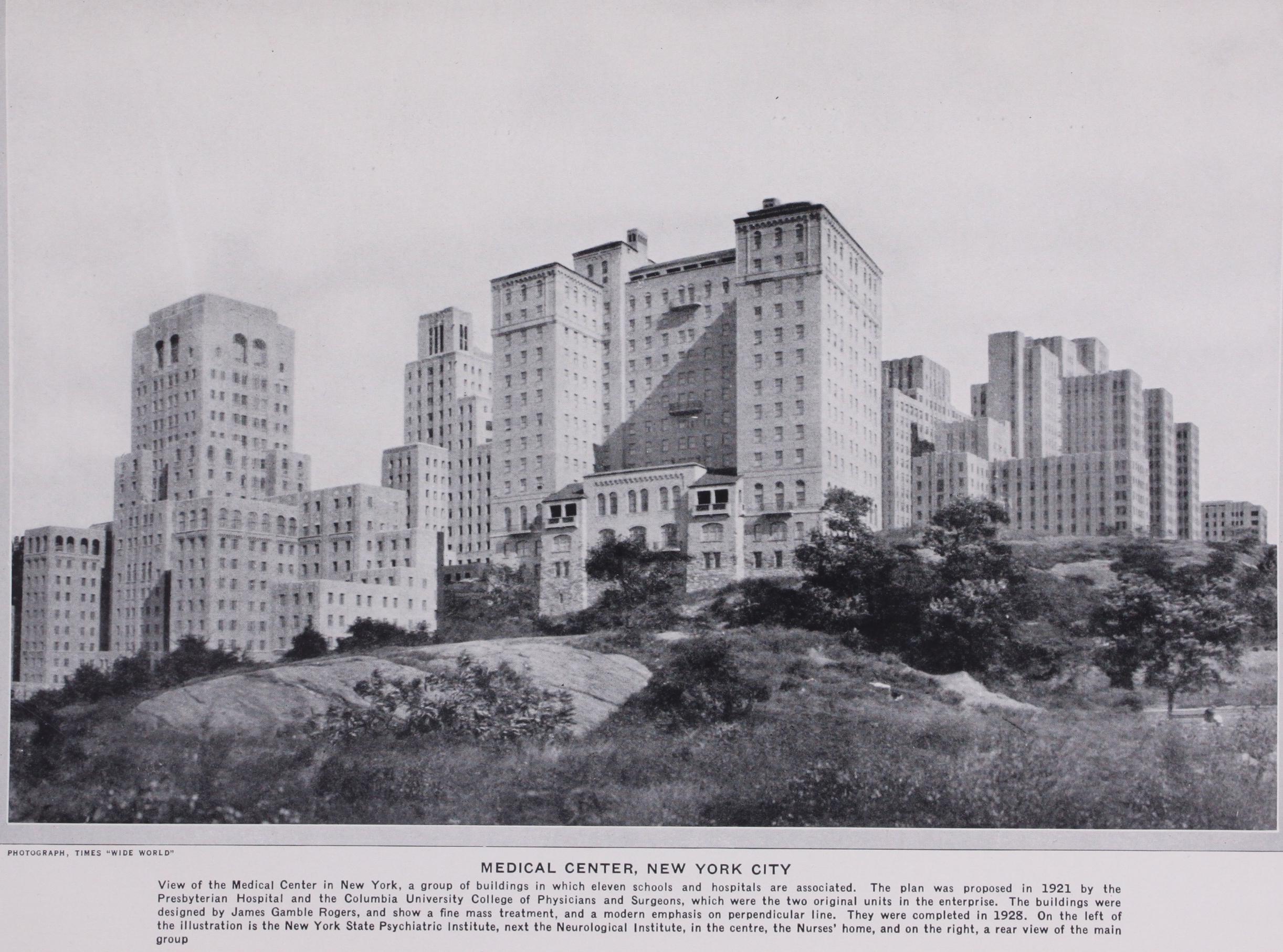
Economy and effectiveness of administration is claimed by the promoters of the multi-storey hospital movement. This type of construction and administration, which is distinctly American, is not being followed in the United States to the entire exclusion of the methods commonly pursued in Europe. The hospital move ment in the large American cities is typified in the medical centre in the City of New York, in which the Columbia university Col lege of Physicians and Surgeons, Columbia University School of Dental and Oral Surgery, Presbyterian hospital, Sloane hospital for women, Squier Urological Clinic, Vanderbilt Clinic, The Babies' hospital, Neurological institute, State Psychiatric insti tute and hospital, Presbyterian Hospital school of nursing and the Harkness Pavilion for Private Patients have reconstructed their institutions on a single plot of ground, having jointly under taken all the branches of medical teaching, research and care of the sick, their simultaneous constructional programmes involv ing $25,000,000.
There have been omitted from the foregoing figures 462 institu tions with a bed capacity of which, for one reason or an other, have not come in the class of so-called "registered hos pitals." While the development of the large institutions has made un usual progress, the growth of the small institutions in the smaller communities seems to have a special significance and to be in dicative of the popularisation of the hospital in the public mind. In 1920 44% of the 3,027 counties in the United States had com munity hospitals; the record for 1925 shows an increase to Nearly 52% of all the hospitals in the United States are of 4o beds or less. The close of 1927 finds recorded 408 new buildings planned, with $109,179,000 involved in a year's construction; the total value of hospital properties being variously estimated between $4,000,000,000 and $5,000,000,000.
In the year 1926 the 55 privately owned hospitals of all types in New York city receiving partial support from the United Hos pital Fund reported 11,978 hospital beds of which 78% were used, 232,157 cases, 3,446,176 days of hospital care, the average number of days' stay being 14.1; treated 710,297 cases in out patient departments and had a total of 2,616,226 out-patient de partment visits,—this being independent of the State and munic ipal hospitals in New York city. All types of hospitals in New York city, excepting those for the insane, proprietary and United States Government hospitals, provided 32,097 beds of which were used, treated 519,222 patients and gave 8,881,763 days of hospital care, the average number of days' stay being 17; treated 1,151,871 cases in out-patient departments and had a total of 3,960,204 out-patient department visits.
BIBLIOGRAPHY.-Keports by counsel on medical education anaBibliography.-Keports by counsel on medical education ana hospitals of American Medical Association ; Corwin, The Hospital Situation in Greater New York; Private archives and surveys of Joint Administrative Board, New York ; Surveys of Architectural Forum, New York; Reports of United Hospital Fund. (C. C. B.)