
HOUSE, originally any structure built for human habitation; by extension the word is used at the present time in a much wider sense, as of a building which is the centre of activity of an organ ization (e.g., houses of parliament). Thus in certain universities, schools and colleges, dormitories are sometimes known as houses; and the term house mother or house doctor is used of the matron or physician of any group of people resident together. Owing to the close association, in feudal times, of a family with its place of residence or fief, the word house is frequently used of a family (e.g., house of Habsburg), and by a still further transference, of any group of people gathered together for any specific purpose (e.g., a theatre audience).
At some ancient time the primitive cave dweller discovered that his cave could be enlarged and strengthened by constructing in front of it a wall of piled rocks, and roofing the space between the cave and the wall with logs or skins. Growing skill in this type of construction led to the development of such elaborate cave dwellings as those found on certain river banks in the south-west of the United States, whose date is unknown, but which are ob viously far earlier than the pueblo culture. Viollet-le-Duc (His toire de l'habitation humaine, 187 5) hypothecated similar com binations of cave and masonry dwellings as one of the universal primitive forms of Aryan houses. Thus the hut is the parent form of all timber houses, and the cave dwelling of those of masonry. Most of these houses were of one room, but with the development of a more complex civilization, sub-division became necessary and the plan was articulated. At first this seems to have been accomplished by merely combining several hut units within a single enclosure. Many remains of floors and foundations of such groups of round huts, probably of straw in some cases and of unbaked brick in others, dating from the Neolithic age, have been found throughout the Aegean world. Later, elliptical forms with sub-dividing partitions appeared, like that at Chamaizi in Crete, of about 2000 B.C., and the so-called tholos of the lowest stratum at Tiryns, perhaps even earlier. It is noteworthy that the richest tombs of the Mycenaean culture were of the tholos, or beehive type, and there is a universal tendency to make house forms follow contemporary or earlier culture.
Another form of development characterizes late Stone and Bronze age villages of northern and Central Europe, the so-called lake dwelling in which many rectangular houses, some of two or more rooms, were built upon a pile-supported platform over a lake. Modern examples of precisely similar types occur along many of the rivers in Siam, Cambodia and the neighbouring countries. In European lake dwellings, not only does primitive frame construction, a development of the hut type, appear, but also the use of crossed logs overlapping at the corners—the typical log cabin construction.
In the Aegean culture, both court houses and those in a single block are found. The great palaces of Cnossus, Phaistos (both c. 2000-1500 B.c.), like the more highly developed and architect ural palace at Tiryns (c. 'zoo B.e.) all have a court as their most important feature, but the plan of the town of Gournia shows simply a maze of crowded, close built rooms. Moreover, many paintings and terra cotta placques show Cretan houses as cubicle blocks, often in two storeys, with flat roofs and many windows.
The early Mesopotamian house, which remained fairly con stant in form over at least 2,000 years, and probably more, throughout the Chaldean and Assyrian periods, was of three types. The first, represented frequently in Assyrian bas-reliefs, is a de velopment of the conical hut, constructed, apparently, in un burned brick, and consists of a tall, narrow, dome form, sometimes set on a small square base. The second, also known from the reliefs, was probably the country residence of the well-to-do and is shown as a rectangular building or group of buildings with flat roofs, battlemented parapets, arched doorways and many long, low windows close to the roof, sub-divided by colonnettes. The third type, the city house, consisted of an assemblage of long, narrow rooms, with walls of immense thickness arranged around one or more courts. Some of these rooms may have been barrel vaulted in brick. Architectural decoration is of the simplest. What richness they possessed must have been produced by a lavish use of textiles.
The most complete idea of early Semitic houses is given in the description of Solomon's palace in the Bible (I. Kings, vii.). Timber was much used. Flat roofs were universal, and in the larger chambers they were supported by rows of wooden columns. Decoration was by means of repousse metal work applied to the wooden surfaces.
Classical.—In both classic Greece and Rome, the court type of house, that had appeared in Assyria, was brought to its highest point of development. Extensive remains of Greek houses have been investigated, especially at the Peiraeus, Priene and Delos. In almost all of these the house consisted of a group of rooms around a central colonnaded court or peristyle. In some there is indication of the existence of an upper storey. In the larger houses there was frequently a gallery across the front. There are only few evidences of the division between the andron and the gynaeceum, the men's and women's quarters; either the women's apartments were on the second floor, or else the division was only architecturally expressed in the largest houses through the existence of two or more courts. The most important position, at the end of the court opposite the entrance, was reserved for the reception room and the chief bedroom or the thalamos, the official centre of the house life. The remains of a large house of late Greek date exist at Palatitza in Macedonia. Here, not only were there multiple courts, but also long wings, or ranges of rooms, with colonnades along the front.
In the Roman house the court idea was superimposed upon an earlier tradition of a single room dwelling with a hole in the centre of the roof for the emission of smoke—the primitive atrium (q.v.). Prehistoric cinerary urns in the shape of these early houses have been found in various places in Italy, particu larly in the Alban hills. In the historic period, the atrium had already become primarily a court, with the living rooms around it, and the excavations at Pompeii have proved that by the 2nd cen tury B.C., at least in southern Italy, the typical Roman house comprised a colonnaded court as well. In the imperial period, the atrium, with its surrounding rooms, was reserved for business and official functions. Family life centred in the peristyle. Apart from detail, the general appearance of the large Roman house of the imperial era is almost perfectly reproduced in many of the cities of northern and central China to-day. Indeed, so close is this resemblance that Miinsterburg (Chinesisclie Kunstgeschichte) claims the presence of definite classical influence.
Variant types of Roman houses were the great country houses or villas, so well described in the famous letters of Pliny the Younger concerning his villas at Tusculum and Laurentium, of which many restorations have been brought together by H. Tanzer (The Villas of Pliny the Younger, 1924). Remains of such buildings are found frequently throughout the Roman empire. Another type is the farm-house, such as that discovered at Boscoreale, in which barns, oil and wine presses, storage rooms and the house proper were in one building around one main court. A vast provincial farm establishment in N. Africa, that of the Laberii at Uthina (dating from various periods from the 1st to the 4th centuries) shows a palatial central residence with many wings to take advantage of the view and prevailing winds, and separate small buildings for the farm. Another variant form was the great apartment house of several storeys which was the usual residence of the poorer free classes, not only in Rome, but in many of the more crowded centres. Indications on the marble plan of Rome which was prepared under Septimius Severus sug gest that these structures frequently surrounded a court in which was placed the stair tower that gave communication to the vari ous storeys. The fronts of these buildings were surprisingly modern in appearance; usually there were shops on the ground floor and rows of simple windows, often with projecting balconies above. The whole was usually faced with brick, unstuccoed, with the mouldings, etc., worked on the face of the brick itself. Recent excavations at Ostia have at last rendered possible definitive restorations (see G. Mars, ed., Brick Work in Italy, 1925).
Roman tradition continued unbroken through the Gallo-Roman time up to the Merovingian empire, and at Martres-Tolosanes, in south France, remains of large villas of this date, similar to those of Roman times, have been studied. Other interesting provincial derivations from the Roman stem are seen in the stone houses of Syria, vast numbers of which exist, dating from the 3rd to the 7th centuries, when the villages and towns seem to have been suddenly abandoned at the time of the Mohammedan conquest. These Syrian houses are sometimes roofed in stone and all of them are remarkable in the extent to which stone is used, not only for walls, but for doors, railings, screens, etc. There is gen erally an enclosing wall around a forecourt, with the house in a block at the rear, fronted with a colonnaded gallery.
In Italy, where cities were more highly developed, town houses were even further advanced, and it was during this period that the typical north Italian city palace, built around an arcaded court, with enormously high storeys, and many small coupled windows, and frequently with a projecting battlemented parapet, took form. The special conditions of Venice produced there a more open type of design, with a great use of long ranges of windows under Gothic tracery, rich projecting balconies and walls sheathed in coloured marbles. These, like the French houses, were often long and narrow in plan, but one or two rooms deep, with a court at the back. In all Italian examples, and in most of those in France, the main living floor was one storey above the entrance and the ground floor was reserved for shops and service rooms. In north Europe, in the 14th and 15th centuries, more and more houses, both city and country, were being built of half timber (q.v.), so that although stone or brick seemed to predominate in the 13th century town it was half timber which predominated in the 15th century town, as may be seen to this day in por tions of Rouen, Beauvais, Strasbourg, Hildesheim and Chester. The same period, moreover, saw the origin of the great burgher or wealthy free peasant's house, and the development of types for the nobility which were no longer mere castles or châteaux, but like the English manor houses, designed primarily for comfort. Of the important town houses, two still exist in perfect preservation, that now used as the Cluny museum at Paris (1485-9o), and the house of Jacques Coeur at Bourges (c. 1450). In both of these there is to be observed a growing sub division of the areas to give greater privacy and to separate the various functions of eating, sleeping and the social life. The planning is still, however, embryonic, with no grasp of corridor circulation and many stairs.
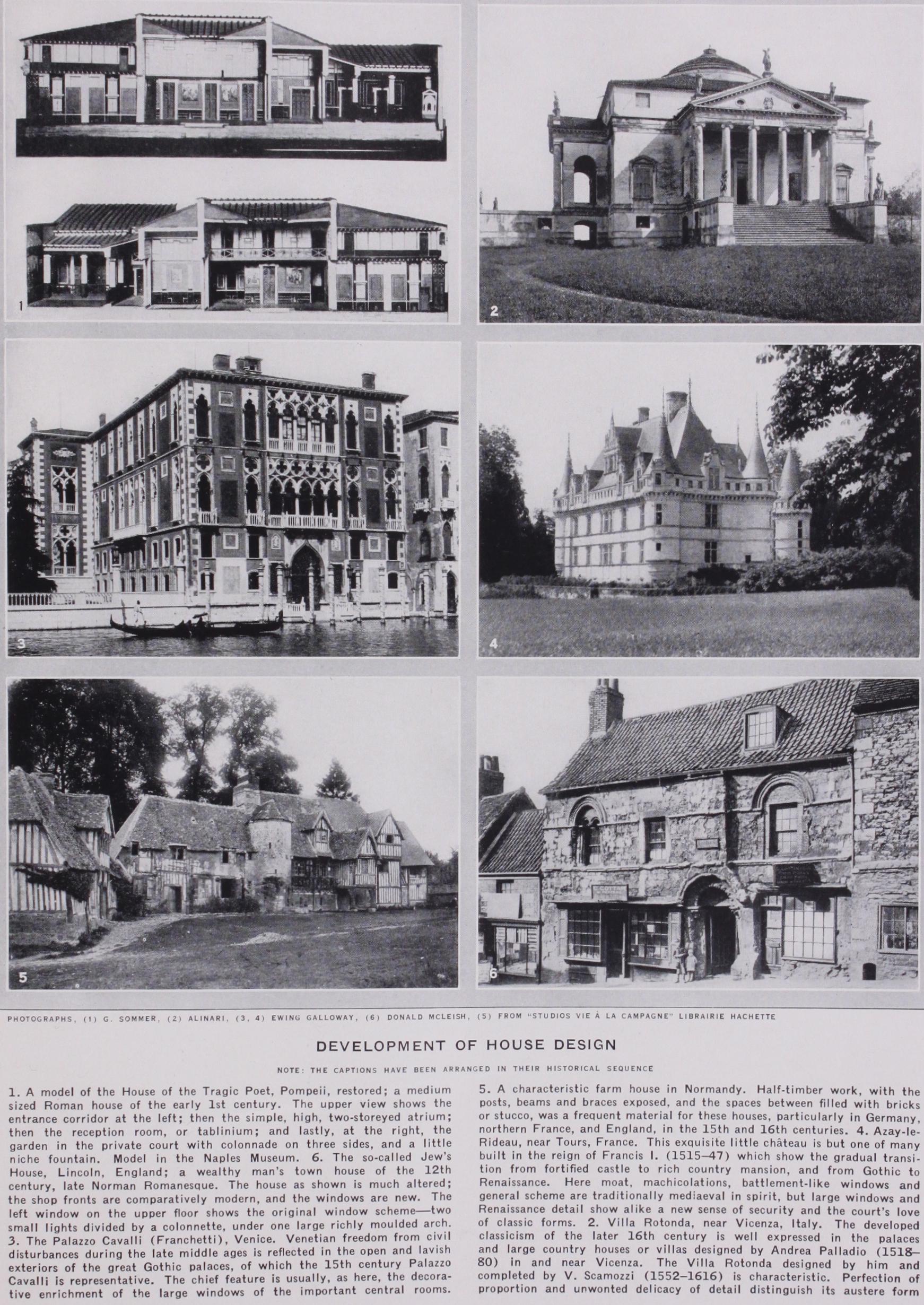
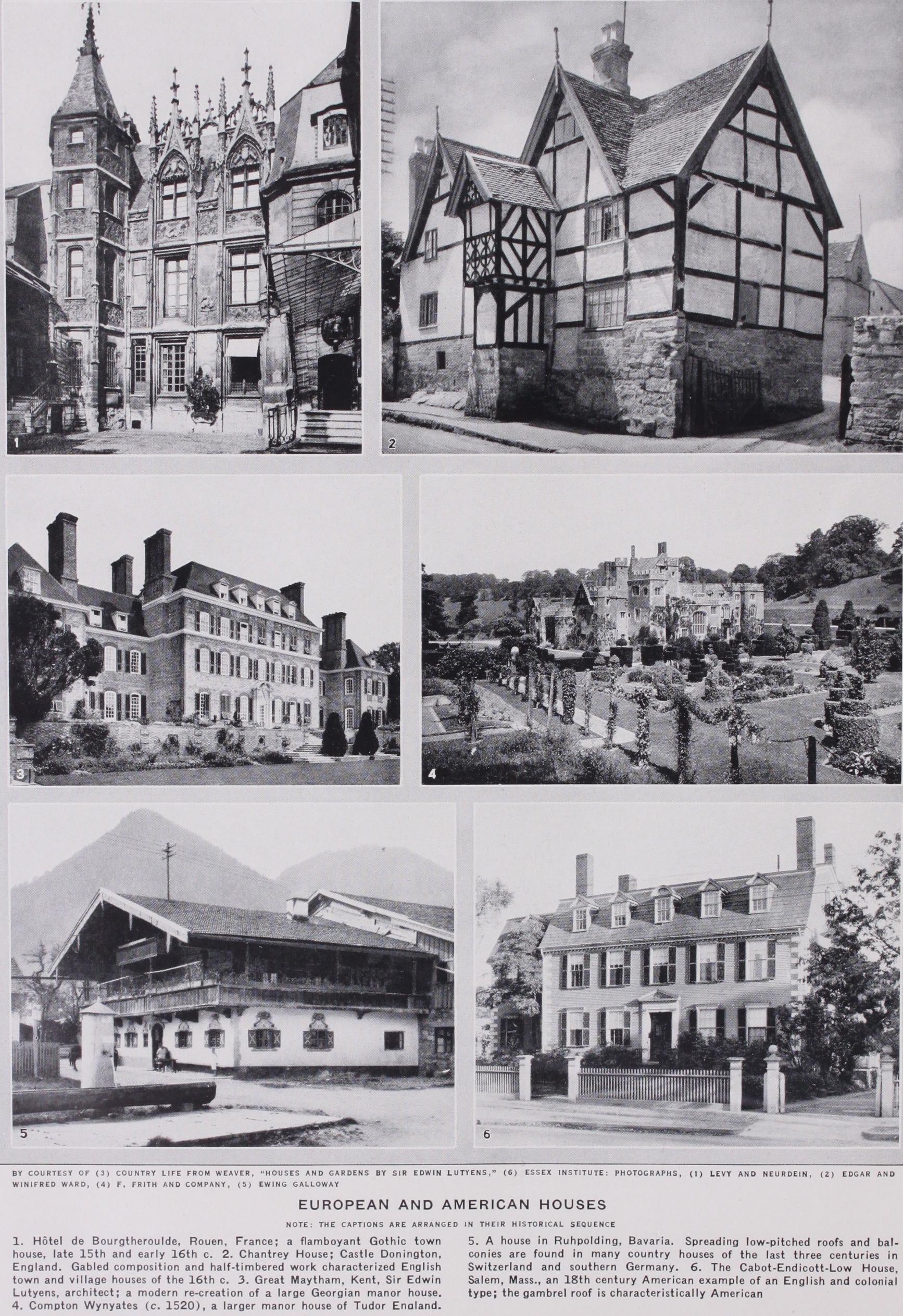
The same sub-division and the same struggle for convenience and privacy characterizes the entire history of the English house from 1400 to 1700. At first merely a great hall (q.v.) with service rooms at one end and private rooms at the other, the house rapidly developed into a plan which in all main respects is modern, with parlours, dining rooms, sleeping rooms, etc., all carefully differ entiated. The beautiful manor of Compton Winyates (c. 152o) shows the type; Kirby hall, by John Thorpe (begun 157o), and Hardwick hall, Derbyshire (early 17th century, John Smithson architect), show the complexity and growing symmetry of the English plan as well as the introduction of Renaissance ideas, and Speke hall, near Liverpool (17th century), shows the similar type treated in half timber. In all of these, lavishness of interior finish, by means of plaster and wood panelling, is a noteworthy feature.
Meanwhile, in America, different conditions were developing from English precedent a slightly different type of house, more compact, and usually less monumental. In the north, the house of a single block, with two or four rooms to the floor and a central chimney (e.g., Capen house, Topsfield, Mass., 1693), or the larger houses with end chimneys (e.g., Warner house, Portsmouth, N.H., c. 172o) became the accepted type. In the south, where social conditions were more like those in England, the houses more closely resembled those of the mother country. Thus Mt. Airy, Va. (1758), of cut stone, and Westover, Va. (c. 173o), could be almost duplicated in many English counties, and Washington's home at Mt. Vernon, with its multitude of service out buildings, slave quarters, etc., is but a version in wood of a com mon English type. Close contact with France during and after the American Revolution, French architects working in America (e.g., l'Enfant), and the fact that many early American architects trav elled widely in France (e.g., Bulfinch), led to the development in America of the French monumental house plan, as in Woodlands, Philadelphia (remodelled 1788), and the Gore house, Waltham, Mass. (1799-1804, possibly by Bulfinch).
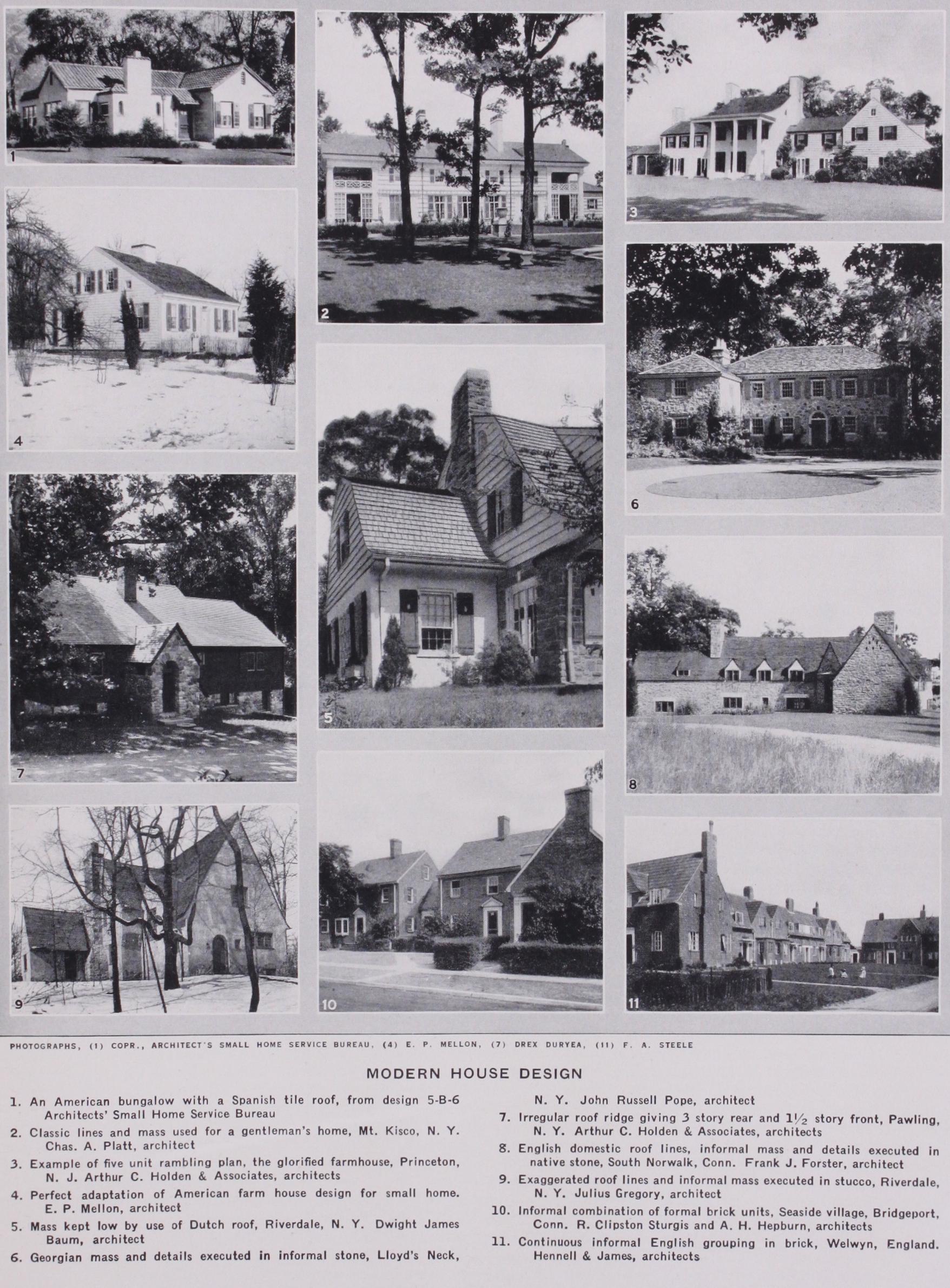
In the design of these houses (see HOUSE PLANNING) as well as in the industrial housing surrounding many factories, and in the larger country houses of the more well-to-do, there has been a gen eral advance. Waste spaces have been reduced and the problem of furnishing adequate communication, and at the same time pre serving privacy, has been to a great extent solved. Moreover, the service arrangements have been simplified and perfected so that every possible waste of time may be avoided in serving meals or caring for the house. The lack of an inhibiting tradition in much of America has remarkably aided this development and, more and more, such originally American ideas as a multiplicity of bath rooms, the use of a central heating system, and the evolution of space-saving kitchens and kitchenettes are appearing in the newer houses, not only of England, but of the entire continent of Europe. No such development or standardization of architectural treat ment has occurred. A chaos of varying styles is evidenced in con temporary American building; colonial, "English," "Italian" and modernist houses stand on the same street. In England, the stronger traditionalism characterizes the greater number of mod ern houses, with Georgian or Tudor forms predominating, but both frequently coloured by a modern style freedom. On the continent of Europe, generally, the present (1928) tendency seems to be almost universally towards the most radical and modernistic treat ment, with cubicle directness and simplicity replacing any search for a more esoteric or sentimental beauty. In apartment house de sign (see SOCIAL ARCHITECTURE) the stringent limiting condi tions have exerted a controlling influence that is more and more producing a similarity of type, whatever the architectural style.
In areas not deeply affected by the industrial revolution, as in most of the Mohammedan world (see MOHAMMEDAN ARCHITEC TURE), and in Asia generally, house design carries on traditions frequently centuries old. Thus the modern Moroccan house, with its colonnaded court and flat roof, is a direct descendant of the court type of ancient Rome and Syria. Even the separation of the house into a public and private portion, or harem, bears a simi larity to the old double centre in the atrium and peristyle of Rome. In Egypt and Turkey, however, the court type has largely gone out of existence, and has been replaced by the single block type of house, frequently with a large central hall, often con taining a fountain which recalls the use of water in ancient courts. In Japan, also (see JAPANESE ARCHITECTURE), the single block type of house is found to be universal; the house is usually a long and rambling structure, tile-roofed, sometimes in several storeys. The sliding interior partitions, the matting floors, and the exquisite use of wood make interiors of delicate and sophisti cated charm. In China, on the other hand (see CHINESE ARCHI TECTURE), the court type is the rule where European influence has not modified native ways. The use of colonnaded galleries and large symmetrical halls often gives a markedly classic appearance.
See also ARCHITECTURE, ATRIUM, HALL, HOUSE PLANNING, STYLE, SOCIAL ARCHITECTURE, and the various articles on the history of architecture, described under the heading ARCHI