
HOUSE.) Style Evolved from Efficient Use.— Style in architecture is equipment for effi cient use and is a natural evolution. It is a product of the factors of economics, climate, tradition and natural environment.
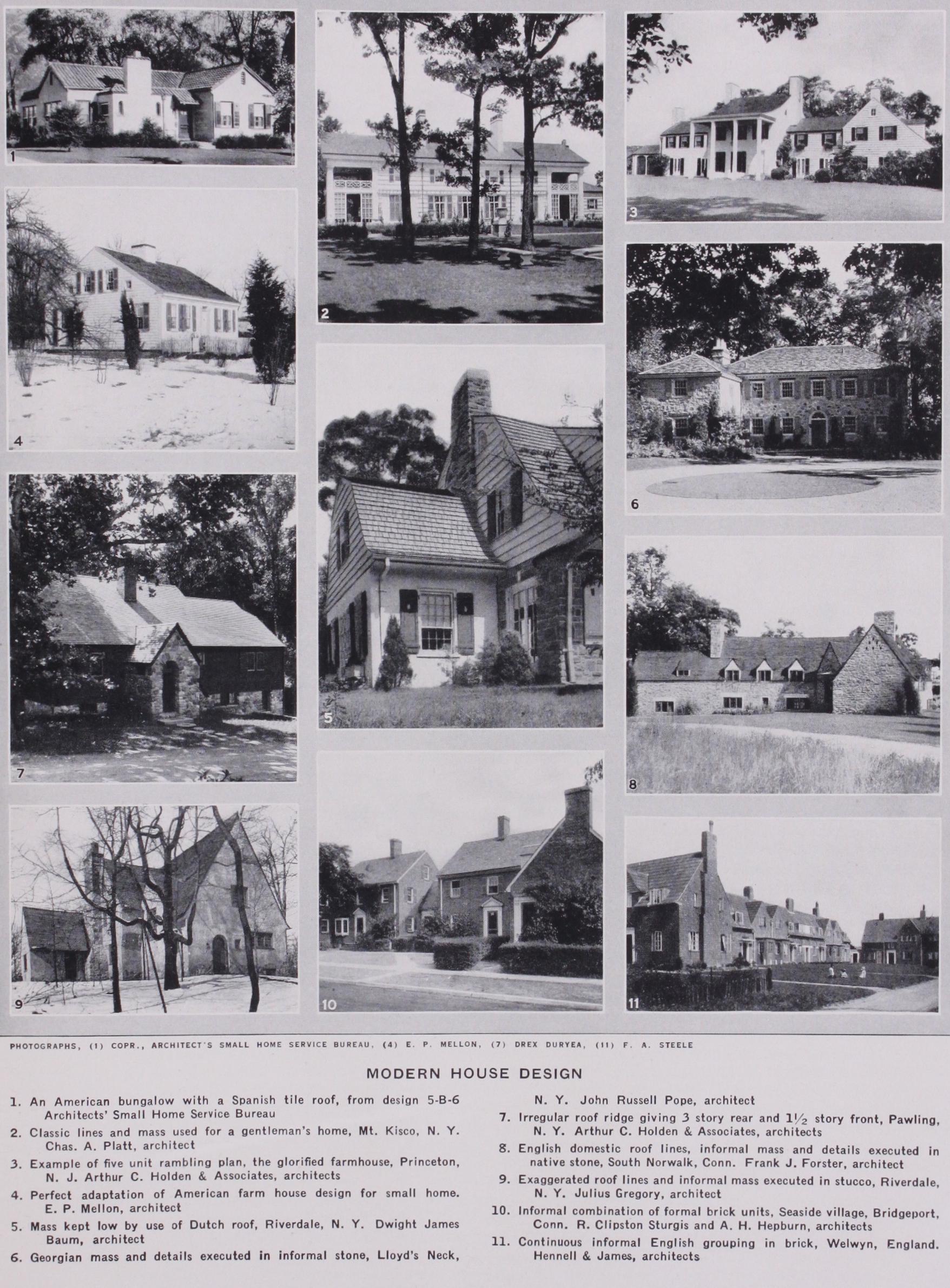
To-day the lessons of the entire past ex perience of mankind can be drawn on. This heritage teaches methods for roofing the narrow house, the square house, the house of irregular or formal plan and the long rambling type of house. It need not be slavishly followed, but a person unfamiliar with it trying to design is like a child. He thinks that the ridge of the roof of a square rectangular house must always be in the centre. He is ignorant of the "salt box" type, built by the New England farmers, where the roof on the north side ran down almost to the ground; or of the extra space the Dutch type of gambrel roof af fords where a small compact plan makes it difficult to keep the mass low.
When considering the irregular 'form of plan it is most impor tant to consider roof treatments and stair locations. Indeed, there are many irregular treatments of roof plan possible with a first floor plan that is perfectly square or rectangular in outline but unsymmetrical within. The lines of the English domestic way side cottage have been an inspiring guide to modern architects seeking to obtain irregular roof lines. Plans must never be thought of as flat but always as having volume as well as length and breadth. The second floor cannot be planned out of all relation to the floor below ; bearing partitions must run through ; its win dows must be in reasonable relation to the first floor openings. The special consideration for locating the stair is so to place its point of arrival on the second floor that it may easily serve the greatest possible number of rooms without waste of hall space ; on the ground floor it must be convenient to the entrance.
It is desirable to locate the dining room and kitchen with eastern exposure so that they will have the advantage of morning sun and yet be sheltered in the afternoon. If possible the kitchen should have cross ventilation. The living-room and porch should be ex posed to the prevailing breeze. In a northern climate the less im portant rooms should be located on the northern side of the house, unless the outlook happens to be to the north. In any case, great care should be taken never to shut off an important room from the benefit of sunlight and the prevailing breeze.
In making any plan it should always be remembered that rooms must be correctly related with regard not only to interior arrange ment but also to their proper relation to the out-of-doors. In an irregular plan this is easier to do than in a rectangular or formal plan. Many unsymmetrical interiors were laid out in outwardly formal houses by the builders of colonial Maryland and Virginia. The best modern planners of domestic architecture have learned from the expe rience of their 'forerunners. Avowedly irregular plans were not laid out in the early days. They grew as wing was added to wing. Often the arrangement within was most inconvenient. Modern architects have built up irregular plans having all the charm of the outward aspects of the old rambling houses but carefully developed for internal convenience and the greatest benefit of contact with the out-of-doors.
To secure the fullest benefit of the site is one of the most im portant considerations. Especially is this true of the hillside or irregular site, where very frequently, if cleverly taken advantage of, differences in level may result in real economies of construc tion because of the practical utilization of space which otherwise might go into an excessive cellar or attic.
An exterior feature that must not be neglected is the chimney. Too many chimneys are wrongly located with respect to the roof ridge and are too small to have character. If it can be done in no other way chimneys may be enlarged at the roof line by corbels inside the attic space. Modern chimneys in well built houses are invariably lined with fire clay flues.
Interior Finish.—The interior is that part of the house with which people come most in contact, so not only its arrangement and convenience but also its finish is most important. The usual materials of interior finish are wood floors, plaster walls and ceil ings and wood trim for openings. There is a vast difference in possible methods of treatment.
The best plaster is put on in three coats : the scratch, the brown and the white. The final coat may be a fine eggshell finish, an irregular surface or a sand finish. No finish better than plaster has been found for interior walls but it has many disadvantages: it is a very wet, messy job and it introduces moisture into the building at just the wrong time ; it delays the work because it stops all other work and no wood trim or finish can be put in until the plas ter is thoroughly dry. Therefore, many types of plaster substitutes have begun to come on the market. These range from plaster boards over which the final white coat is applied to other types of board to which paint or wall paper may be applied direct. There are many excellent grades of wall board now on the market, but with all of them there are two defects that so far have been only partially overcome : if broken the walls are difficult to repair; the cracks between the boards are almost impossible to conceal even when thoroughly plastered over with a fine mesh covering strip. In the house of modest cost, wood panelling and fine carving are not likely to be used. A single panelled wall, if well worked out, will add charm not easily gained otherwise. It is true that we are likely to stain our oak and pine too yellow, our walnut too brown and our mahogany too red, but we are learning to finish woods to make the most of their natural beauty. (See INTERIOR