
HOUSEHOLD APPLIANCES. Domestic help, previously plentiful and cheap in most countries, is now, especially in the industrial centres, difficult to obtain. As in industry, when labour is difficult to obtain, more efficient methods must be introduced to obtain the same volume of work. Labour- and time-saving appliances must be employed if homes are to be run smoothly under changed social conditions.
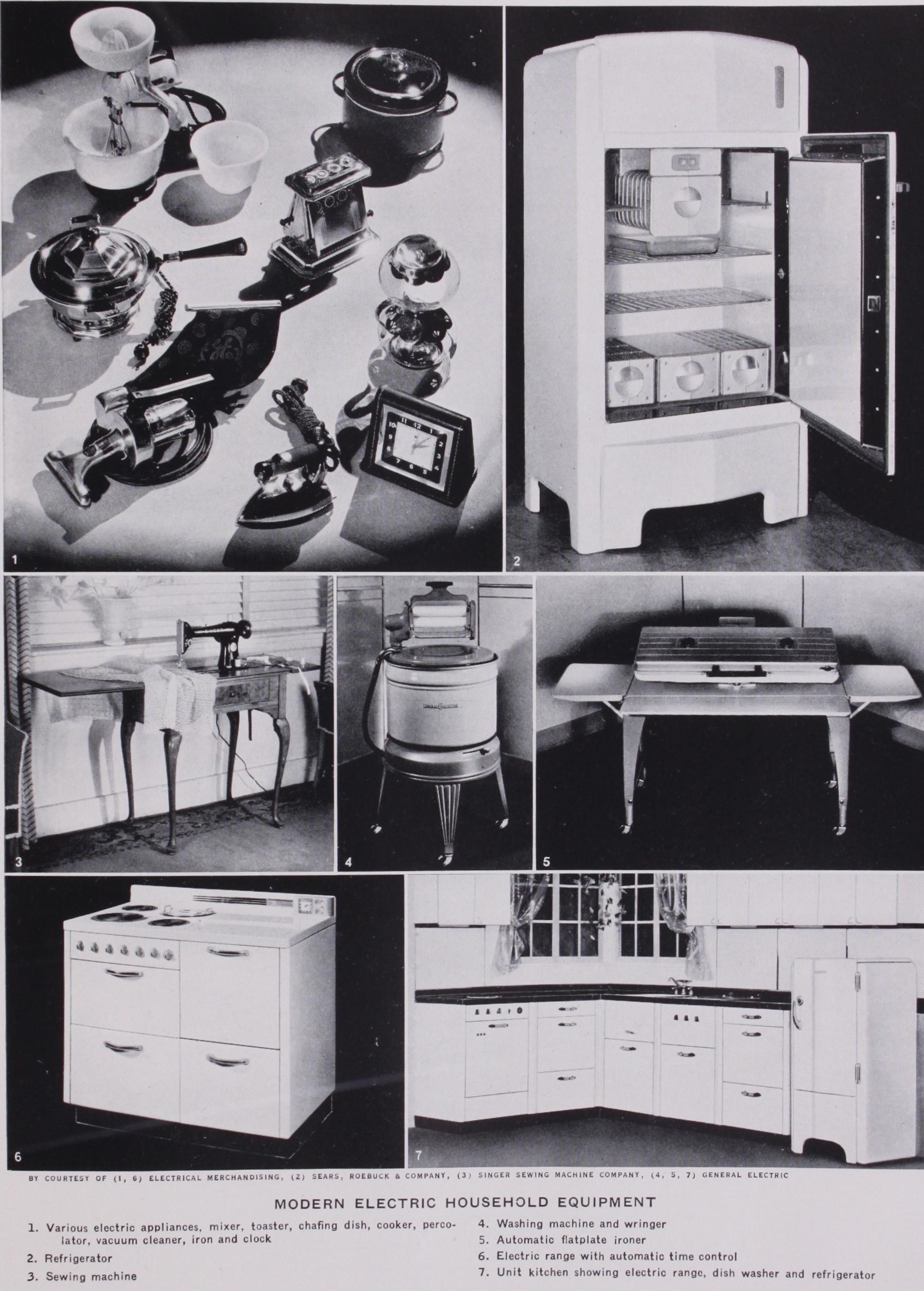
Modern household appliances developed to meet this need can be divided into two main headings, electrical and non-electrical appliances. Under the classification of electrical appliances are grouped : irons, toasters, waffle irons, heaters, coffee percolators, vacuum cleaners, washing machines, floor polishers, refrigerators, dish washing machines, cookers and stoves, ventilators, water heaters. In the non-electric group may be noted: gas cookers, stoves and furnaces, gas refrigerators, hot water heaters, kitchen cabinets and tables, fireless cookers, pressure cookers, service lifts, tray wagons, tradesmen's service ways, aluminium ware, steam cookers, oven cooking glass, oil burning furnaces. Under the spur of necessity and demand, inventors, manufacturers and house holders are devoting their energies to the elimination of unnec essary work.
The movement commenced in the United States about 1910, where it has enjoyed its greatest popularity. A discussion of conditions in America is given below and constitutes the more general treatise on the subject of household appliances. In Great Britain and European countries it was not until after the World War that any particular progress was made in household efficiency. A description of the progress in Great Britain follows that of America. (G. E. W. C.) The general adoption of improved working equipment for the home has been relatively slow, even in the United States, and dependent upon social and economic factors which have exerted their chief influence only since 1918. Essential to the use of mechanical home equipment is electric or gas service and it was not until 1908 that electricity began to be generally adopted for home use. Even by 1918 the use of domestic appliances employing electricity had made no substantial progress, being con fined mainly to electric irons and minor cooking devices ; although the electric washing machine had been on the market since 1905 and the electric vacuum cleaner since 1909. From 1918, the adoption of household appliances utilizing power, as well as heat, increased rapidly. One reason for this is to be found in the educational and marketing activities of light and power companies. With increasing generating capacity, these companies felt the need of developing a domestic market for their service. By the aid of advertising and selling methods hundreds of thousands of old and new homes were yearly wired for electricity.
Gas appliances were at the same time being energetically marketed. Although gas had by 1928 practically passed from use for illumination in America, it had become the most generally used fuel for cooking. The successful result of these marketing activities were partly due to the rising standards of living. An American study of the weekly money earnings in 25 industries over a period from July 1914 to July 1927 compared with the cost of living over the same period, shows clearly that the increase in the sale of mechanical home devices follows the increase of the family income in the wage and salaried classes.
The rapid disappearance of the domestic servant, in all but the homes of the wealthy, is a factor of less importance in the increasing use of mechanical housekeeping appliances. Equipment has had its greatest acceptance and use in localities where a part at least of the domestic service has always been performed by the housewife herself. In the cities an important factor in the adoption of these devices has been the apartment house and the resultant necessity for utilizing space to the greatest possible advantage. A modern apartment offers gas or electric ranges of an improved type, automatic refrigeration, an electric dish washer built into the sink, incinerators and an adequate provision of wall outlets for the connecting of portable electrical devices in every room. Education in the use of mechanical housekeeping equipment has been a necessary part of its public acceptance. Gas and electric companies, manufacturers, schools, colleges and government departments have all given this matter a place in their programme. Another factor of great importance has been the educational work by home magazines and newspapers which have established bureaux where domestic equipment is tested for electrical and mechanical design and construction and where experiments with a wide variety of equipment in practical use are continually carried on.
The development (about 1910) of resistance wires of nickel and chromium gave an impetus to the manufacture and use of these devices since this alloy can be heated to redness in the air without oxidation. Prior to that time heating units had to be sealed or enclosed. A recent development is the automatic operation of many small appliances. By means of thermostats irons are maintained at a constant temperature; toasters shut off the heat and eject the toast after a predetermined interval; warming pads limit the heat to a desired temperature. The extent and use of the more common of these appliances in the United States is shown by the following figures. Appliances in use as of Jan. 1935 (estimated) : irons, 20,130,00o; toasters, 9,608,000; heaters, 3,732,000.
The modern electrical dish washer, as a part of the sink, has overcome much of the indifference felt toward the earlier types of this appliance. It is easily filled and drained and the washing action is provided by a motor-actuated propeller throwing hot water into and over the suitably arranged china and glassware. Less expensive means for dishwashing is provided by a rubber tube with spray, dependent on water pressure from the tap, over wire baskets in which the dishes are arranged. The electric heat ing and mixing machine has many uses in the kitchen. In modern apartments and in many homes, the garbage incinerator has become important. In its most highly developed type this is a small furnace built directly under a wide chimney. This chimney is provided at each kitchen level with a door through which trash and garbage are dropped directly to the furnace below. Periodically fire is kindled and the accumulated mass burned.
A recent development 5) is a motor driven device for re ducing garbage to a slush. This is made a part of the drain from the kitchen sink, carrying the reduced scraps directly into the sewage system. Along with the transformation of the old kitchen into a new laboratory has come a demand for decoration. Until recently white or light shades of gray and blue have been con sidered most suitable for this room. There was in 1928, how ever, an active demand for kitchen equipment in the most brilliant of primary colours. En amelled small utensils are of solid colour. Nickel-plated ap pliances have coloured handles of wood or bakelite, while ranges, refrigerators and kitchen cabi nets have their flat surfaces re lieved with bands of colour. A national movement for kitchen modernization is sponsored by organizations representing the gas and electrical industries.
Plans for such a change are available from industry organi zations and national women's magazines as well as local utilities. This kitchen modernization movement provides for the re equipment of kitchens utilizing either electricity or gas.
Electric cookers of the fireless and pressure types are also used to a considerable extent. These are valuable mainly as auxiliaries to other cooking equipment. An improvement over former fireless types, these cookers not only give an oven heat for baking, but can within limits perform a wide variety of other cooking. Because of double walls, on the vacuum bottle principle, they maintain food at high temperatures for some hours. In the pressure cooker the steam is confined within the utensil and by increasing the pressure raises the boiling point of the liquid. This cooker is chiefly used for canning and for cooking in high altitudes. A development of the portable cooker principle is the electric cas serole and roaster type of cookers introduced about 1933 and gaining an increasing popularity. In the larger of these an entire meal may be cooked with economical expenditure of current.
In spite of the development of these improved types of cook ing ranges a large number of families still employ coal and wood as cooking fuel. The following figures as of Jan. 1, 1935 (esti mated) show the primary cooking methods of the United States; cooking by gas (manufactured) 9,428,00o families; by gas (nat ural) 5,391,000 families; by coal and wood 8,790,00o families; by oil 6,000,000 families; by electricity 1,255,75o families.
In addition to the wide use of automatic refrigerators with a self-contained operating unit, there are several systems where one or more units, located at a central point, operate freezing units in a number of cabinets throughout an apartment house. This multiple type of installation sometimes follows the design of the individual electrical units, and in other systems is an adaptation of the brine circulation refrigeration systems.
One of the results of the introduction and development of automatic refrigeration has been a general improvement in the type of refrigerator cabinets. Wooden cabinets, unless of excep tionally high-class construction, have been found to be less de sirable than metal cabinets for use with electrical or other automatic units.
Accessory Heat and Ventilation.—Although the small elec tric fan has a certain popularity in the south of the United States and sells rapidly during a few weeks or months in the very warm weather, elsewhere electrical ventilation has never received the public response or use that is possible. Manufacturers provide domestic ventilating fans in a variety of units. They are usually reversible, so that used air from within the house may be ex hausted or fresh air from without drawn in. These fans require no elaborate installation, being provided with adjustable frames which may fit into a partly opened sash window. (See HEATING AND VENTILATION.) For accessory room heating portable gas heat ers are most popular. Many types of portable gas heaters, includ ing gas grates, are widely sold. Electric heaters of the radiant type are also in general use. These, however, produce but a small amount of actual heat, since they are limited to the amount of current which can be taken from a wall outlet. Portable kerosene heaters also find a considerable market, the common type being a large wick burner set in a steel cylinder for radiating heat.
The instantaneous gas water heater provides hot water at the turning on of any hot water tap on the pipe line attached to the heater, operating by means of a hydrostatic valve. When all the taps on the hot water line are closed, the pressure on both sides of the hydrostatic valve is such that the latter remains closed. When any tap is opened, the release of the pressure operates the valve, which, in turn, opens the gas valve supplying the burner. Kerosene water heaters are in use in many districts where gas is not available. These heaters are generally similar to the gas water heater. Electric water heaters, flexible and easy to operate, have been in use for many years. Until recently they have been comparatively expensive, even where electricity rates were low. However, development of a type employing low-wattage consumption indicates a broad use of this equipment for water heating in the future. The storage electric water heater cannot furnish an immediate supply of hot water, requiring several hours for sufficient amount to be heated. The efficiency of the electric water heater, however, is very high, owing to the fact that the heating element is mounted directly in water.
(L. E. M.) In 192o in London the first post-war Ideal Home Exhibition be gan the movement in Great Britain. The time payment or hire pur chase method of selling has been utilized by makers of household appliances with astonishing success. In Great Britain and other English-speaking countries increasing numbers of housewives are purchasing household appliances out of their housekeeping allow ance, setting aside sums—equal to the amount formerly paid for a human assistant—to purchase mechanical aids.
Vacuum cleaners are becoming increasingly popular, and it was estimated in 1928 that more than 150,00o are sold annually of the electrically operated and non-electric types. Electric floor polish ers are not as widely used in Great Britain as in the United States and in a lesser degree in European homes. The educational propa ganda of companies interested in marketing mechanically operated refrigerators has caused similar activity by companies making artificial ice, and householders are realizing that a good refrigera tor is a necessary appliance in the modern home.
Large capacity dish washers are available for hotels and restau rants and several reliable and efficient dish washers for household use are marketed but the cost in 1928 was high and a considerable amount of human attention necessary. A household ventilator has recently been marketed in England which may considerably change the method of house planning. Whereas architects had to exercise great care in the location of the kitchen—especially in flats or boarding houses—by this ventilator, cooking smells, steam, etc., can be satisfactorily dispersed, no matter where the kitchen is placed. This device consists of an electrically driven fan, either set into the wall of the kitchen, bathroom, etc., or placed in the window. The motor is reversible, so that the fan will either ex haust cooking smells, fumes, steam, etc., or bring fresh air into the room. It is particularly useful to prevent discolouration of walls by fumes, or condensation of steam.
Two new forms of cooking are now claiming attention. One is the inducer or transformer system of electric cooking and the other is a loth century adaptation of Denis Papin's "Marmite," invented in 1685. This system of steam pressure cooking has been attracting attention for several years and although entirely suc cessful is not in general use largely owing to lack of public infor mation. In France, cooking by pressure is increasing in popularity rapidly. At recent exhibitions of household appliances, pressure cookers have been freely exhibited. With the French cookers, cooking is done at temperatures of 26o° to 275° F and at pressures of from 20 to 3o lb. to the square inch.
The transformer or inducer system of electric cooking can hardly be termed, as yet, commercially successful. Contingent factors which may mar its ultimate success are that it is restricted to use Dn alternating current, and, the utensil itself forming part of the heating unit which is made of the relatively costly stainless steel (q.v.), the initial outlay is heavy. The frying pan, kettle or sauce pan is arranged to act as the opposite side of the transformer, tak ing current at low voltage. On a 3.7 kw. inducer a pint of water can be boiled in one minute. Twenty minutes after switching on, a 4.5 kw. heater will supply 5 gal. of boiling water at the rate of 4 pints per minute, or provide for a 20 gal. bath at a cost of 2+ units. The electric inducer provides a method of cooking whereby the entire quantity of heat generated by the amount of current consumed is actually transmitted to the food through the walls of the container, there being no escape to the atmosphere. The power factor of the inducer is usually well above .9. It seldom falls as low as .85. The maximum loading of a complete inducer equip ment is less than that of a corresponding electric equipment although the loading of one or more units may be much lighter than is customary in other equipments. For instance, an oven and grill with one large (3,700 watts) and two small inducers (75o watts each), will have a maximum loading of 5,200 watts as against a maximum loading of 6,000 to 8,000 watts on other elec trical cookers. The heat is induced in the vessel itself, the inducer remains cool, no surrounding metal parts are heated along with the vessels. The action being instantaneous, this method of cook ing will, if successful, do much to eliminate one of the present disadvantages of electric cooking.
Aluminium ware has now become almost universal for sauce pans, kettles, etc. It has been found to be serviceable, easy to clean and light in weight. Enterprising manufacturers have devised many interesting and useful vessels in this metal. Porcelain enam elled table tops, sink draining boards and tray tops are now widely used in the kitchens of both American and British houses. The perfection of a pure iron has enabled vitreous porcelain to be satisfactorily applied to this metal, giving a white smooth surface easily cleaned and hygienic. Linings for refrigeration are also made of this material.
Trolleys or dinner waggons are found to be the best solution of clearing or setting the dinner table. The best type of waggon has 4" swivel acting, rubber tyred wheels, which enable the trolley to run over rugs, etc. without jarring. (G. E. W. C.)