
HUDSON BAY, an inland sea in the N.E. of Canada, ex tending from 78° to 95° W. and from 51° to 70° N. On the east it is connected with the Atlantic Ocean by Hudson Strait, and on the north with the Arctic Ocean by Fox Channel and Fury and Hecla Strait. Its southern extremity between 55° and 51° N. is known as James Bay. It is 590 m. in width, and 1,30o from south to north, including James Bay (35o m.) and Fox Chan nel (35o m.). The customary use of the term includes James Bay, but not Fox Channel. The average depth of water is about 7o fathoms, deepening at the entrance of Hudson Strait to ioo fathoms. James Bay is much shallower, and unfit for shipping save for a central channel leading to the mouth of the Moose river. The centre and west of the main bay are absolutely free from shoals, rocks or islands, but down its east coast extend two lines of small islands, one close to shore, the other at 70 to ioo m. distance, and comprising a number of scattered groups (the Ottawa Islands, the Sleepers, the Belchers, etc.).
Into Hudson and James Bays flow numerous important rivers, so much so that the water of the latter is rather brackish than salt. Beginning at the north-west, the chief of these are Churchill, Nelson (draining Lake Winnipeg, and the numerous inland rivers of which it is the basin), Hayes (the old boat route of the voy ageurs to Winnipeg), Severn, Albany, Moose, Nottaway, Rupert river (draining Lake Mistassini), East Main, Great Whale and Little Whale.
Save for some high bluffs on the east and north-east, the shores of the bay are low. Around much of James Bay extend marshes and swampy ground. Geologically the greater part of the Hud son Bay district belongs to the Laurentian system, though there are numerous outcrops of later formation; from Ordovician to Devonian on the south and west, and on the east coast a narrow belt of Animikie rocks, of which the islands are composed. Iron ores occur in the latter rocks. Spruce, balsam and poplar grow to a fair size as far as the northern limit of James Bay. Caribou, musk ox and other animals are still found in large numbers, and there is an abundance of feathered game—ducks, geese, loons and ptarmigan; hunting and fishing form the chief occupations of the Indians and Eskimo who live in scattered bands near the shore. The bay abounds with fish, of which the chief are cod and salmon. There are also porpoise and whales. The last have long been pursued by American whalers, whose destructive meth ods have so greatly depleted the supply that the government of Canada is anxious to declare the bay a mare clausum.
Hudson Strait is about 450 m. long with an average breadth of ioo m., narrowing at one point to 45. Its shores are high i and bold, rarely less in height than 1,000 ft., save on the coast of Ungava Bay, a deep indentation on the south-east. No islands or rocks impede navigation. Its depth is from Ioo to 200 fathoms. Owing to the violence of the tides, which rise to a height of 35 ft., it never absolutely freezes over.
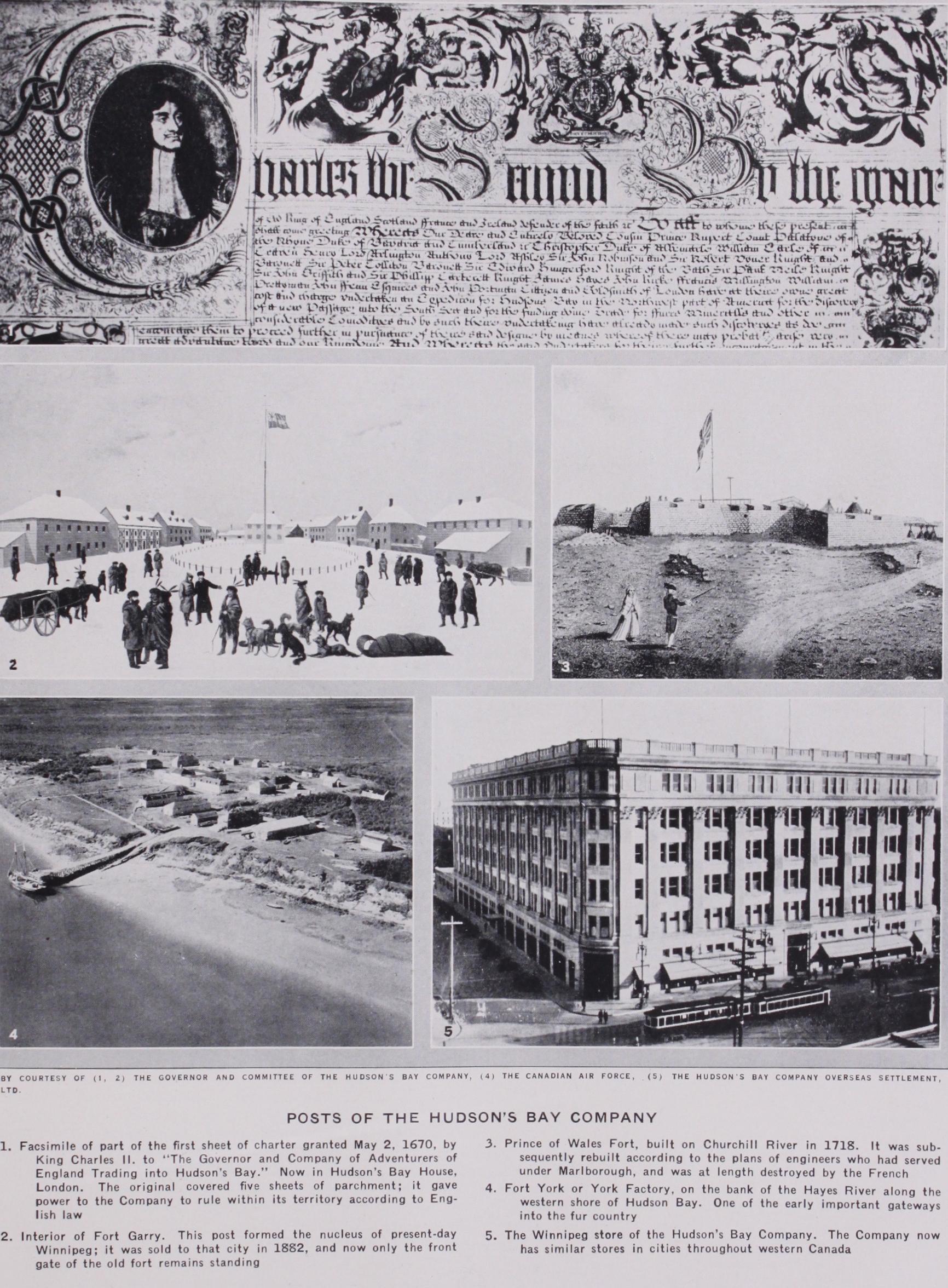
After three centuries of exploration, the navigability of Hudson Bay and Strait remains a vexed question. To Canada it is one of great commercial interest, and numerous expeditions have been made and reports issued by the Geological Survey. From Winni peg to Liverpool via Churchill is over 500 m. less than via Mon treal, and from Edmonton to Liverpool almost i,000 m. less. Were navigation open for a sufficient time, such a route for the grain of the Canadian and American west would be of enormous advantage. But heavy ice often drifts about in the strait. Past the mouth flows a stream often over 1 oo m. wide, of berg and floe ice, carried by the Arctic current. Owing to the proximity of the Magnetic Pole (in Boothia) the compass often refuses to work. For sailing ships, such as the Hudson's Bay Company has long employed, the season for safe navigation is from July 15 to Oct. 1. In over 200 years very few serious accidents have occurred to the company's ships within these limits. It is claimed that specially built and protected steamers would be safe from June 15 till Nov. 1, and the problem may be solved by ice-break ing vessels of great power. Churchill has possibilities of the mak ing of a good harbour and a railway has been laid to it but is not yet opened. Moose Factory (at the foot of James Bay) and York Factory (at the mouth of the Nelson) are mere road steads. Marble Island, south of Chesterfield Inlet, where the whalers winter, is too far north for regular shipping.
The Cabots entered the strait in 1498, and during the next century a series of Elizabethan mariners; but the bay was not ex plored until 161o, when Henry Hudson pushed through the ice and explored to the southern limit of James Bay.
See Lieutenant Gordon, R.N., Reports on the Hudson's Bay Expedi tions (1884, 5, 6) ; William Ogilvie, Exploratory Survey to Hudson's Bay in 1890 (Ottawa, 1891) ; R. F. Stupart, The Navigation of Hudson's Bay and Straits (Toronto, 19o4) .