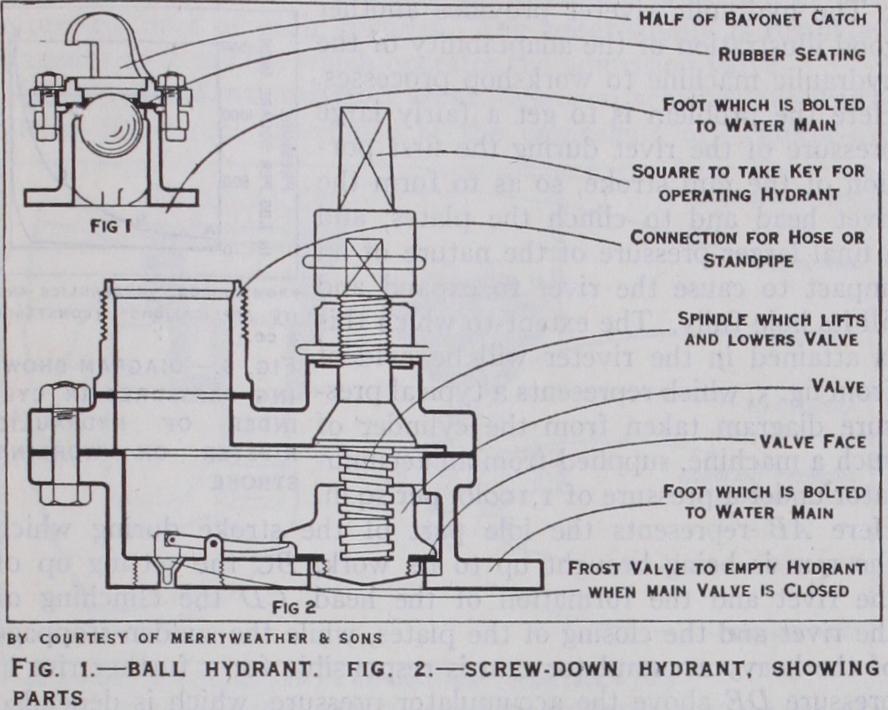
HYDRANT, a form of valve by which water is drawn from a supply in a main either underground or in a building. The earliest hydrant was a simple wood plug driven into a socket at the top of a main.
There are three main types of valves, the ball, the spindle, and the sluice-valve. The first is of simple construction, and opens instantly when the spindle of the standpipe is screwed down to press the ball off the seat. The example shown has a bayonet joint for the connection of the standpipe, and the ball presses up against a rubber seating by the pressure in the main until the hydrant is in use. The spindle type has a leather-faced flat valve forced down on a seating by the screw at the lower end of the spindle. The spindle is kept water-tight, as the figure shows, ny the coned collar and the nut and cross-pin. The purpose of the frost-valve, also shown in the drawing, is to clear the interior of the hydrant of water by the tipping of the little lever when the valve is shut down. Both of these hydrants are of ground type; many are con nected to vertical pipes, as in theatres and other buildings, and the arrangement is very compact, to leave the least possible projection from the pipe. The sluice-valve hydrant gives a full clear run through the pipe, the shut-off being by a wedge valve which crosses the bore.
Some hydrants have one pipe connection, or a standpipe per manently in place, in cases where its presence is not objectionable. Multiple outlets are arranged in many fire hydrants. The con nection of the hose or standpipe is made by a screw coupling, a bayonet catch, or an instantaneous coupling. (See also STAND PIPE.) (F. H.) HYDRASTINE, an alkaloid (see ALKALOIDS) , found with berberine (q.v.) in the rootstocks of golden seal (Hydrastis cana densis) , isolated by Perrins in 1862. It crystallizes, from alcohol, in colourless, rhombic prisms, which melt at 132° C, is soluble in chloroform or benzene, less so in alcohol, and almost insoluble in water. A solution of hydrastine, in dry alcohol is laevo rotatory, and in So% alcohol dextro-rotatory. The salts are un stable in water and difficult to crystallize. A nitrohydrastine has been synthesized (Hope and Robinson, 1912), though not the alka loid itself. The hydrolytic product, hydrastinine, is an important drug, being used as an internal styptic, and numerous processes have been devised for its synthesis.