
NISHES.) The fireplace and the stairs are two points where beauti ful woodwork may be used in ways that count. A good cornice in one room counts more than meaningless strips arranged around the walls of all the rooms. Mouldings when applied to walls have value principally for the variations of shade and shadow that they give, and they must be carefully designed or their effect will be lost. Walls are made beautiful by colour, texture and, where paper is used, by pattern in the proper scale combined with colour. Many people are afraid of colour. All colours are relative. Some times what seems to be a strong colour is selected for a back ground but when furniture and hangings are introduced, it pales into insignificance. (See INTERIOR DECORATION.) Revolt in Style.—With many new materials becoming available, there is little doubt but that new methods of expression will be developed (see ARCHITECTURE). To be different merely for the sake of being different is infantile. To be wise enough to discover more effective methods of building than those that have been tried, and then to put those methods into practice at the risk of being different, is courageous and worthy of applause. A part of the tendency to modernism is a revolt against the use of classic forms in decoration. It is a movement to be commended in so far as it deals with the elimination of unmeaning and unintelligent forms. A movement confronted with the development of new forms, however, must be led by men who are familiar with the aesthetic subtleties of historic ornament, else the whole movement to revolt will be merely a fumbling in the dark, with accidental achievement its only hope of success. New methods of construc tion and new forms are certain to evolve from the intelligent effort of an alert and virile race. But progress does not come from shut ting the eyes to experience and disregarding tradition.
The small suburban lot has been a bane on the full enjoyment of natural advantages. It so cramps the plan and the arrangement of both house and grounds that the beauty of the out-of-doors is either spoiled or lost. To combat this difficulty, where the means of the owner are small, there has been developed in England a method of grouping houses so as to concentrate open spaces and make them more useful and enjoyable (see GARDEN CITIES).
One of the great problems remaining to be solved is the ques tion of the efficient utilization of land. There must be a proper balance between the areas utilized for streets and public use and the areas to be put into private lands. In some cases actual dis credit has been brought upon the garden city movement by unin telligent and impossible community plans. Mistakes which require disproportionate expenses for streets, pavements, water and sewer and other service features handicap house planning, for these mis takes must be made up for by skimping in design and construc tion. It is popular to blame the diminishing size of the house upon the high cost of labour. This, however, is only one of the contributing factors. Excessive land costs and wasteful promotion and financing are responsible for innumerable cases which are uneconomic before a single brick is laid or a nail driven.
Bath-room.—Bath-rooms occupy perhaps one-fifth of the area of the average room but their cost is nearly double. Not so long ago one bath-room in a house was a luxury. Now those who can afford it demand a bath for every bedroom and two bath-rooms are common in even the smallest houses. Bath-room costs vary greatly, but an important part of the expense is in bringing the water-pipes to the room and in carrying off the drainage and the gases from the pipes in a sanitary manner. Money is saved when the plan is so arranged that the structural difficulties in volved in carrying pipes through walls and ceilings are reduced to a minimum. The finish of walls, base and bath-room floors in tile or other special material, which brings another trade to the job, is the cause of a very siderable part of the expense of the bath-room, for obviously the tile-work must wait until all work behind the walls is plete. The many kinds of special tile and other fittings in all grades and combinations of colour that may be had to-day are a tion to the average owner. quently there are long waits for special orders, and delays above all things are expensive in struction. Further details in re gard to plumbing and bath-room equipment are given in the section of this article dealing with Mechanical Equipment.
Heating.—House heating has become an exact science with a system of ducts, pipes and valves just as complicated as those that serve the bath-room. Economy in heating is gained like all econo mies by reducing waste. A great step in advance has been made by more thoroughly insulating the shell of the house against exterior cold. Insulating material applied to the sheathing of a frame house or under the furring of a masonry house and in the attic, together with effective window stripping, will greatly increase the efficiency of any heating unit. The principal methods of modern heating are described in the section of this article dealing with Mechanical Equipment.
Garage.—The garage has developed from a shed in the back yard into a part of the house, in most cases commodious enough for two cars and with at least the simplest provisions against the spread of fire to the house proper. The floor should be of cement and the walls of masonry ; hard cement plaster on a fire-proof backing may be used for both walls and ceilings. The door, at least on the garage side, should be metal clad, though conformity with insurance companies' regulations requires even greater protection. The tendency to make the garage a part of the house has helped to clean up unsightly back yards and, because of the greater privacy possible, to reverse the desirability of front and rear for living or service features. It is certain that in modest cost suburban developments the removal of the clutter and noise from the back yards has been a great step in the direction of better homes.
Kitchen. The kitchen has developed from a large room con taining a huge coal stove, a hot water drum and a tiny sink into a smaller room designed in detail and equipped with labour saving devices. The modern sink and the small efficient gas or tric stove should be properly related to each other. The dressers, cupboards and counters should be arranged convenient to the sink and service dining table; dry groceries should be convenient to the preparation table. There are various types of dressers. Open shelving is the cheapest.
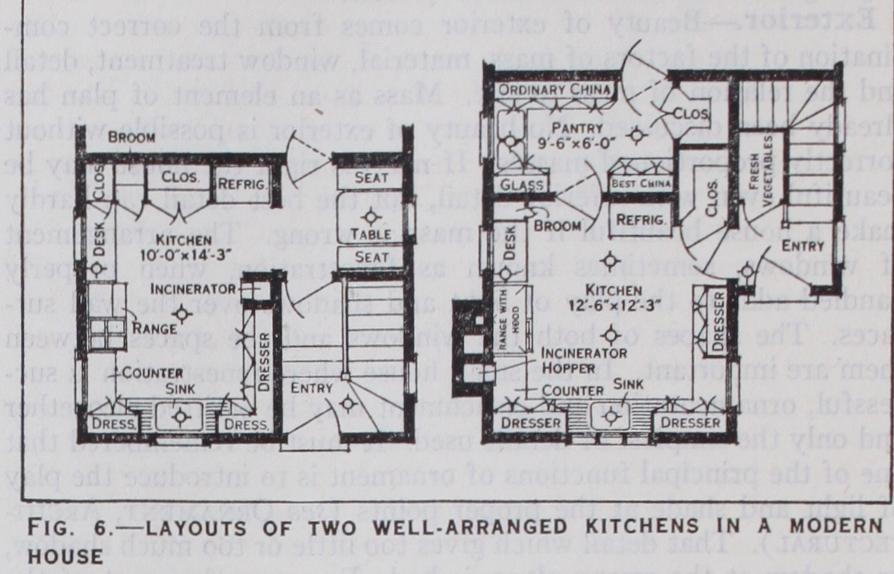
Enamelled metal shelves with glass doors are perhaps more sani tary than those of wood.
There are two types of kitchen efficiency, one for the house designed to be operated with one or no servants and the other for the house designed for several servants. There is the combination sink and the single laundry tray, and the combination sink and dishwasher. There is the electric washing machine and the elec tric mangle, which of course in the larger houses are placed in a separate laundry. The built-in dining alcove is typical of the modern tendency to save space and labour. Folding ironing boards are also space savers. The electric iron has displaced the old fashioned flatiron. The electric outlet used for the iron should always have special fuse provision and a bull's-eye signal switch. Electric or gas refrigeration is fast displacing the old-fashioned ice man and the old annoyances of ice deliveries and overflowing ice drains. For those who can afford its installation, the incinerator is the cleanest and most convenient method of garbage and rubbish c isposal. These modern conven iences add to the complexity and expense of construction, but they facilitate housekeeping and in crease the productivity of the housewife or her servants.
The drainage system is controlled by traps which should always be filled with water. Their purpose is twofold : to prevent things from going down the drain that should not, and to prevent gases from backing up through the drains and creating unhealthful odours in the house. Drain pipes from water closets (known as soil lines) are larger than sink, tub and basin drains. They should be of extra heavy cast-iron pipe rather than wrought-iron or steel. When a water closet is flushed it creates a suction in the pipe sufficient to syphon the water out of traps on the same line. There are two ways of preventing this : by using anti-syphon traps, and by running fresh air vents from all traps to the outer air, which also permits the back gases from the drains to pass off. The system of vent pipes is very expensive but is required by law in most cities. The drainage is not complete until it is connected to a town sewer or an individual cesspool or septic tank and disposal field.
The supply system is controlled by valves. The size and ma terial of the pipes is important. Practically all water contains impurities which, to varying degrees, produce corrosion in certain metals. Hot water corrodes pipes more rapidly than cold. Brass pipe does not corrode. Iron and steel pipes even though galvanized tend to corrode. Genuine wrought-iron pipe is the most superior grade of iron pipe and corrodes very slowly, depending, however, upon the character of the water. Pipes in exposed walls should be protected against freezing. Provision should always be made so that the water-supply system may be drained when the house is unoccupied.
The selection of the fixtures is of the greatest importance. There are many different models. Roughly, the materials are of two classes, vitreous china and porcelain enamelled iron. The plumber generally purchases from what is known as a jobbing house, where popular models are kept in stock. Usually there is a long delay if a less popular model is ordered, even though it is carried in the regular manufacturer's catalogue. The plate number in the catalogue describes the fixture complete with nickel-plated, or chromium-plated, fittings and faucets.
There are many different means for heating water for washing: (I) a hot-water back in a coal range ; (2) a gas coil; (3) a small auxiliary coal stove ; (4) an automatic gas heater ; (5) a coil for winter use inside the steam boiler; (6) a steam coil over which the water passes. In all cases a drum or tank is used. The best location is in the cellar. A ground floor bath-room is a better location for the tank than the kitchen.
The treatment of bath-room walls and floors may vary greatly from wood floor and plaster walls to the more expensive grades of tile for both walls and floor. Different colours, finishes and shapes of tiles are now obtainable. There are also many varieties of tile substitutes.
Warm Air.—The air is warmed by passing through the heating apparatus and then delivered through ducts into the rooms. Where conditions are favourable it will work easily, for it is based on the single principle that warm air rises. Great advances have recently been made in the "conditioning" of air. Electric fans accelerate and control the circulation. In addition, it is possible to "wash" the air so as to avoid the usual objectionable dust and to circulate cooled air in summer. Cold air currents check or alter the circulation of warm air currents; thus in a long rambling house, the colder the weather the less heat will be de livered to remote rooms. A cheap variation is the pipeless 'furnace where all the air passing through the furnace comes through one single large register and circulates directly through the rooms instead of through ducts. This works best in a small square compact house.
Steam.—There are various varieties of steam-heating. Water is boiled in the boiler and steam rises through properly sized pipes passing through radiator coils which give off heat to the rooms. The number of square feet of surface of the coil de termines the amount of heat given off in each room. Radiators should be so placed as to combat cold air currents where they enter the rooms but with consideration for economy of the piping runs necessary to reach them. Variations in the system depend upon the way the steam is made to circulate. The simplest form is the one pipe up-feed system. The pipes are large enough to carry the rising steam and at the same time the return water caused by condensation of the steam in the radiators. The pipes must be carefully graded so that the water will flow back to the boiler. Also there must be air valves on the radiators to allow the entering steam to force out the air. Care must be taken in grading pipes so that the returning water may not get trapped and thereby shut off the steam. In a two-pipe steam system the steam supply and the water return are separate. Where a steam system works easily and quickly it will, because of the vapour given off by the warm water, begin to heat up before steam is actually formed in the boiler. This vapour may be made to do the work of the steam by using special quick-acting valves and a separate pipe to return the water to the boiler, and by inducing the vapour to rise quickly from the boiler by creating a partial vacuum in the radiators. This is known as a vapour system; it is really a refinement of a steam system. Recent improvements in radiator types have greatly changed the appearance of the steam vapour system.
Hot Water.—A hot water system is based on the principle that warm water rises. Circulation commences immediately. By vary ing the fire the radiators may be kept at any desired temperature up to F. Because they never reach the temperature of steam, greater radiation surface is necessary. In other words, in a water job the radiators must be about half again as large as in a steam job, usually larger pipes are required—installation cost is greater. Where space is precious, hot water heat is objectionable. If the circulation is poor a hot water system will not work. Care should be given to the layout of pipes and to connections and branches.
Oil.—Great progress has re cently been made in oil burning devices for residences. Oil, as a substitute for coal, is now in practical use in steam, vapour and hot water systems. Different types of oil burners are required, dependent upon whether electricity or gas is used for ignition.
is sold by the public service companies at different prices, at a lighting rate and at a power rate. Where there is a low power rate, it is worth while considering having the house wired for modern electrical labour-saving equipment.
Electric current is controlled by a system of switches and fuses. The latter are especially important because they will not allow a greater than a safe current to pass through a given system of wiring. Fuses burn out when they are overloaded ; therefore they should always be installed in metal panel boxes protected against fire.
The cheapest form of wiring is known as knob and tube. Most city codes will not allow this method, because the insulation is unprotected. The use of flexible armoured cable is much safer and worth the differ ence in price. Rigid iron conduit has further advantages, though it is used principally for large scale work. Connections between runs are made at junction boxes, between runs and fixtures at outlet boxes. All electric work should be securely held in position to prevent straining or breaking which might cause a dangerous fire. The connections be tween fixtures and wiring should be soldered and then wrapped with tape inside the outlet-box.
All sorts of money can be spent on fixtures. Where economy is necessary the modern tendency is to provide a few essential wall fixtures and a large number of base outlets to which standard and table lamps may be attached. (See LIGHTING.) Calculation of builders think in terms of quantities, prices of materials and the time and cost of labour necessary to put them together. The home owner thinks in terms of the finished prod uct and he is likely to be frequently misled, because he is apt to con fuse construction costs with finished product costs, which include also the cost of land and improvements to land, and the cost of financing, sales and promotion. The architect is likely to think in terms of units of construction. His method is likely to be most helpful to the pros pective owner. Cost per cubic foot is often used. A modest sized home may range anywhere from 35 to 85 cents per cubic foot. It is more reliable, however, to attempt to assign a cost to each room tak ing into consideration size, finish and complexities of construction. Taking each unit of the house, such as cellar, halls and stairs, kitchen and pantry, living-room, bedroom, bath-room, etc., it is relatively simple to grade each of these between fairly reasonable limits and thus arrive at an approximately accurate figure for the house.
Following the very critical mortgage situation which came to a head in 1931 and 1932, Federal legislation created a system of national mortgage insurance which permitted the insuring by the Federal Housing Administration of mortgage loans up to, and in some cases exceeding, 8o% of appraised values. As a result of this legislation and the work of the Federal Housing Administration, both the rate of interest on mortgages and the expense of carrying them were greatly reduced. Total financing charges on the small house, includ ing a regularized and improved system of amortization, now amount to io% or less per annum where similar charges formerly cost over 16%,o or approximately a total of 20% for total financing when the cost of discounts is included.
This reform in financial matters has had a healthy effect upon de sign and planning from two points of view. In the first place the largest proportion of amounts paid by the owner has been more directly applied to repayment of construction costs and less to high charges to pay for the use of money. In the second place, the policy of the Federal Housing Administration has favoured the well designed and well planned house ; there has been a consistent refusal to insure mortgages on houses for which proper plans have not been prepared. No less important in the field of finance has been the work of the Federal Home Loan Bank which has built up a system of member banks, all making loans of an improved type and all requiring high standards of design and planning. In the building up of the Home Loan Bank system, the building, savings and loan societies of the United States have played a most important part.
BIBLIOGRAPHY.-Architectural Book Publishing Co. (N.Y.), AmeriBibliography.-Architectural Book Publishing Co. (N.Y.), Ameri- can Country Houses of Today (1912 to date) ; R. F. Whitehead, ed., White Pine Series of Architectural Monographs (1915 to date) ; F. Kimball, Domestic Architecture of the American Colonies and of the Early Republic (1922) ; J. F. Kelly, Early Domestic Architecture of Connecticut (1924) ; C. H. James and F. R. Yerbury, Small Houses for the Community (5924); H. Major, Domestic Architecture of the Early American Republic (1926) ; M. Mead, Homes of Character (1926) ; E. Power, ed., House Beautiful Building Annual (1926) ; R. W. Sexton, Interior Architecture (1927) ; A. C. Holden, Pocket Guide to Good Construction (1927), Primer of Housing (1927); L. E. Hubbell, ed., The Book of Little Houses (1927) ; E. B. Power, The Smaller American House (1927). Files of the following magazines may also be consulted: Architecture, Arts and Decoration, Country Life, House and Garden, House Beautiful, The American Architect, The Architect, The Archi tectural Forum, The Architectural Record, The Small Home. The Architect's Small House Service Bureau of the United States, New York city, which operates under the auspices of the American Institute of Architects, provides prospective home builders with valuable infor mation. In England, the Housing Department of the Ministry of Health, London, advises home builders. (A. C. Hoe..)