George 173 2-1 799 Washington
virginia, time, vernon, custis and mount
His Marriage.
Immediately after the surrender of his com mission occurred his marriage Jan. 6, 1759, to Martha Dandridge, the widow of Col. Daniel Parke Custis. She had been born the same year as himself, was the mother of two children living and two dead, and possessed one of the largest fortunes in Virginia.
Washington had met her the previous March, had been attracted by her brown hair, hazel eyes, and plump figure and had asked her hand before his campaign with Forbes. She had the qualities of a good housewife and companion, and the marriage was happy. But she no more represented his first love than he did hers; he had been rejected by a Miss Betsy Fauntleroy; tradition states that he had paid unsuccessful suit to Mary Philipse of New York, and there is clear evidence that he temporarily felt a romantic attachment for Sarah, wife of his friend Geo. William Fairfax.
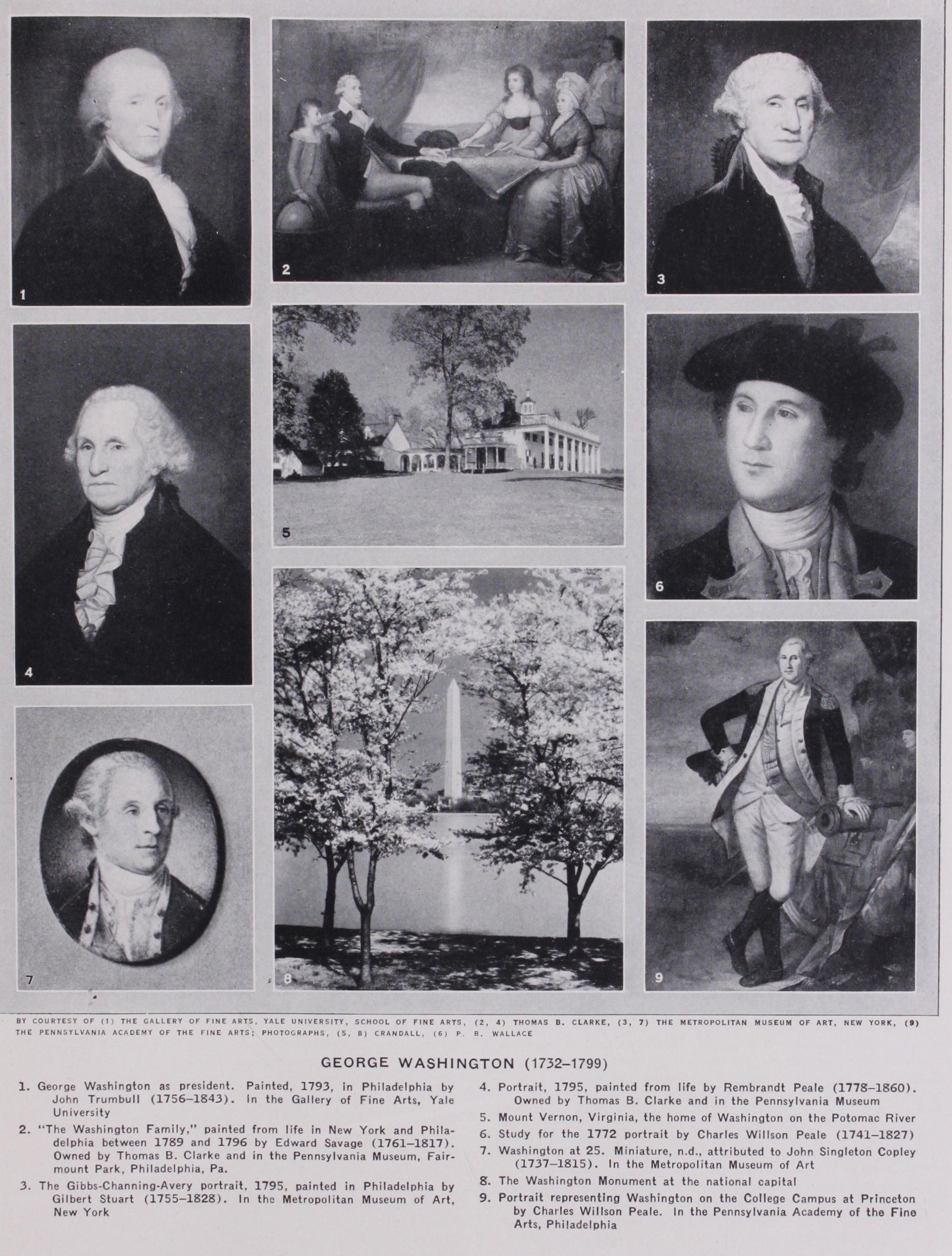
The estimate of John Marshall that Washington's marriage brought him personally an increase of $75,000 in property, and of G. Washington Custis that it brought him $ioo,000, are ex cessive; a precise computation shows that the sum was about $66,000, then of course a handsome fortune. The holdings included about 15,000 ac., much of it valuable because placed near Wil liamsburg, a number of town lots, and i 5o slaves, and from this time Washington added to the cares of Mount Vernon those of the Custis estate at the White House on the York river. From his marriage to the eve of the Revolution he devoted himself to the duties and pleasures of a great landowner, varied a few weeks every year by attendance as member of the house of burgesses.
He was elected to this body in 1758, after standing treat to the voters a prodigious quantity of rum punch, wine, brandy, beer, and "cider royal." A Virginia Planter.—In no light does Washington appear more characteristically than as one of the richest and largest of Virginia tobacco-planters. He was industrious, punctual, efficient, and economical. Disliking slavery on economic and social rather than moral grounds, he made the best of it, carefully clothed and fed his hands, and employed a doctor for the sick. He practised crop rotation, diversified his products to raise enough food for all his people and experimented in breeding horses and cattle.
He had a peach and apple orchard, grafted many cherry, pear and plum trees, and grew Madeira grapes and the "Mississippi nut" or pecan. Till after the Revolution the Mount Vernon house was a small edifice of eight rooms, but he spent much pains on beautifying the grounds. The health, education and property of his stepchildren Patsy Custis and John Parke Custis were care fully supervised, Washington rendering minute yearly accounts to the court. He engaged a tutor, made special exertions to cure Patsy Custis of the epilepsy to which she succumbed in 1772, and sent John to King's college in New York for a few months. In the social life of the Tidewater, he played a prominent role. Mount Vernon was usually full of guests, casual travellers, invited friends and relatives. House-parties were frequent ; Wash ington mentions many expenditures for arrack, wine and punch at neighbourhood clubs; he liked afternoon tea, served in summer on the Mount Vernon verandah; he was fond of picnics, barbecues, and clam-bakes; and throughout his life he enjoyed dancing, fre quently going ten miles to Alexandria to attend balls. On the frontier he sighed in a letter for "assembly balls" and "routs," and at the age of 64 in 1796 he still danced. He went regularly to the Williamsburg races, where he sometimes ran horses of his own ; and his account books frequently note sums lost at cards, the largest being £9 14s. In bad weather his diary sometimes states "at home all day, over cards." At billiards also he frequently won or lost small sums. At Mount Vernon riding to hounds was a favourite pastime, to which he devoted generous space in his diaries, while he took pains to improve the breed of his favourite hounds. In season he went gunning for ducks, and fished the Potomac for sturgeon and bass. He missed few opportunities to see plays at Alexandria or Williamsburg. He was able to quote aptly from Shakespeare, Addison and Sterne.
Pre-Revolutionary Politics.
While Washington's associates marked him, in Col. John L. Peyton's words, as "a young man of an extraordinary and exalted character," he gave before 177o no signs of greatness and few of interest in affairs of State. He played a silent part in the house of burgesses. But he was present when Patrick Henry introduced his resolutions against the Stamp Act in May, 1765, and shortly thereafter gave token of his adher ence to the cause of the colonial Whigs against the Tory ministries of England. In 1768 he told George Mason at Mount Vernon thathe would take his musket on his shoulder whenever his country called him. The next spring, April 4, 1769 he sent Mason the Philadelphia non-importation resolutions with a letter declaring that it was necessary to resist the strokes of "our lordly masters" in England, that courteous remonstrances to parliament having failed, he wholly endorsed the resort to commercial warfare, and that as a last resort, no man should scruple to use arms in de fence of liberty. When, the following May, the royal governor dissolved the house of burgesses, he shared in the gathering at the Raleigh tavern which drew up non-importation resolutions, and he went farther than most of his neighbours in adhering to them. At this time and later he believed with most Americans that peace need not be broken. He had been interested since youth in West ern lands, and in 1767 had asked Capt. William Crawford to find for him a fertile tract in western Pennsylvania. Late in 177o he himself paid a land-hunting visit to Ft. Pitt, where George Croghan was maturing his plans for the proposed 14th colony of Vandalia. Washington directed his agent to locate and survey Io,000 ac. adjoining the Vandalia tract, and at one time he wished to share in certain of Croghan's schemes. But the Boston Tea party of Dec. 1773, and the bursting at about the same time of the Vandalia bubble, turned his eyes back to the East and the threaten ing state of Anglo-American relations. He was not a member of the Virginia committee of correspondence formed in 1773 to corn municate with other colonies, and when the Virginia legislators, meeting irregularly again at the Raleigh tavern in May, called for a Continental Congress, he does not seem to have been present. But he was a leading member of the first provincial con vention or revolutionary legislature late that summer, and to this body he made a speech which was much praised for its pithy eloquence, declaring that "I will raise one thousand men, subsist them at my own expense, and march myself at their head for the relief of Boston." The Virginia provincial convention promptly elected Washing ton one of the seven delegates to the first Continental Congress. He was by this time known as a radical rather than a moderate, and in several letters of the time he opposed a continuance of petitions to the British Crown, declaring that they would in evitably meet with a humiliating rejection. "Shall we after this whine and cry for relief when we have already tried it in vain?" he wrote. When the congress met in Philadelphia on Sept. 5, he was in his seat in full uniform; and his participation in its councils marks the beginning of his national career. Later Patrick Henry, being asked who was the greatest man in Congress, replied: "If you speak of eloquence, Mr. Rutledge of South Carolina is by far the greatest orator ; but if you speak of solid information and sound judgment, Colonel Washington is unquestionably the great est man on that floor." His letters of the period show that while still utterly opposed to the idea of independence, he was deter mined never to submit "to the loss of those valuable rights and privileges, which are essential to the happiness of every free State, and without which life, liberty, and property are rendered totally insecure." If the ministry pushed matters to an extremity, he wrote, "more blood will be spilled on this occasion than ever be fore in American history." Though he served on none of the com mittees, he was a useful member, his advice being sought on mili tary matters, and weight being attached to his advocacy of a non exportation as well as non-importation agreement. He also helped to secure congressional approval of the "Suffolk resolves," which looked toward armed resistance as a last resort, and which did much to harden the king's heart against America. Returning to Virginia in November, he took command of the volunteer corn panies now drilling there, and also served as chairman of the committee of safety in Fairfax county. The unanimity with which the Virginia troops turned to him, though the province contained many experienced officers and Col. William Byrd of Westover had succeeded Washington as commander-in-chief, was a tribute to his reputation and personality; it was understood that Virginia expected him to be her general.