Vienna
buildings, bank, style, rathaus and danube
VIENNA, the capital of the Austrian republic, has the status of an autonomous federal province and its municipal council fulfils the functions of a provincial diet. The city lies at the eastern foot of the Wiener Wald, on the right bank of the Danube within easy reach of a number of contrasted physical and economic regions. Here many of the great routes from north to south and west to east intersect while close at hand runs the linguistic frontier be tween German, Slav and Magyar. From the multiplicity of these contacts Vienna acquired a cultural leadership that placed it in the forefront of European cities. Only an arm of the river, the Danube canal, passes through Vienna. The main river was devel oped between 187o and 1877, and now has a quay length on the right bank of about 9 m. with accommodation in a winter harbour, Freudenau, to shelter above Soo barges of 500-700 tons cargo capacity. Navigation is possible for about 30o days per year. The new channel has an average width of 915 ft.; bordering its left bank is a free flood space about 3- m. in width, separated by a dam from houses that stretch to the old course of the Danube.
The city is divided into 21 districts of which the Inner Town on the right bank of the Danube canal is the nucleus. The fortifi cations which girdled this old town were removed in 1858-6o and replaced by a magnificent boulevard—the Ringstrasse-2 m. long and 15o ft. in width, planted with four rows of trees and lined with splendid buildings and monuments. Near the centre of this inner city is the cathedral of St. Stephen, a Gothic building dating mainly from the 14th and 15th centuries, but incorporating fragments of the original 12th century edifice, destroyed by fire 1193. Among its many impressive features may be mentioned the lofty tower (450 ft.), rebuilt in 186o-64, the catacombs, the groined ceiling, the 35 marble altars and the sarcophagus of Fred erick III. This district is rich in Baroque buildings, many occu pied by Government departments, banks and other commercial organizations, for it is gradually ceasing to be a residential neigh bourhood; here too are situated the larger and most fashionable shops, particularly in the Graben thoroughfare South-west of the cathedral and near the Ring is the Hofburg, a huge complex of buildings of various periods and styles enclos ing a number of courtyards, the oldest parts dating from the 13th century but including extensive additions since 1887. As a
former imperial palace it abounds in magnificently appointed pri vate and State apartments, numerous valuable collections and the National Library of about 1,200,000 volumes, 34,000 mss., 91,000 maps, 81,00o papyri, including the famous "Papyrus Rainer," and a large collection of musical and dramatic works. The Hofburg is separated from the Ring by handsome and spacious parks, the Hofgarten and Volksgarten. Other notable buildings in the old town include the 14th century Gothic Augus tine and Maria Stiegen churches, the Minorite church of similar date and style containing a remarkable mosaic of Leonardo da Vinci's "Last Supper" by Raffaeli, the richly-frescoed Baroque churches of St. Peter (1702-13) and the university (1625-31), the Capuchin church, the 13th century Schotten church (restored r828-83), the church of St. Ruprecht first built in 740 and the old Rathaus.
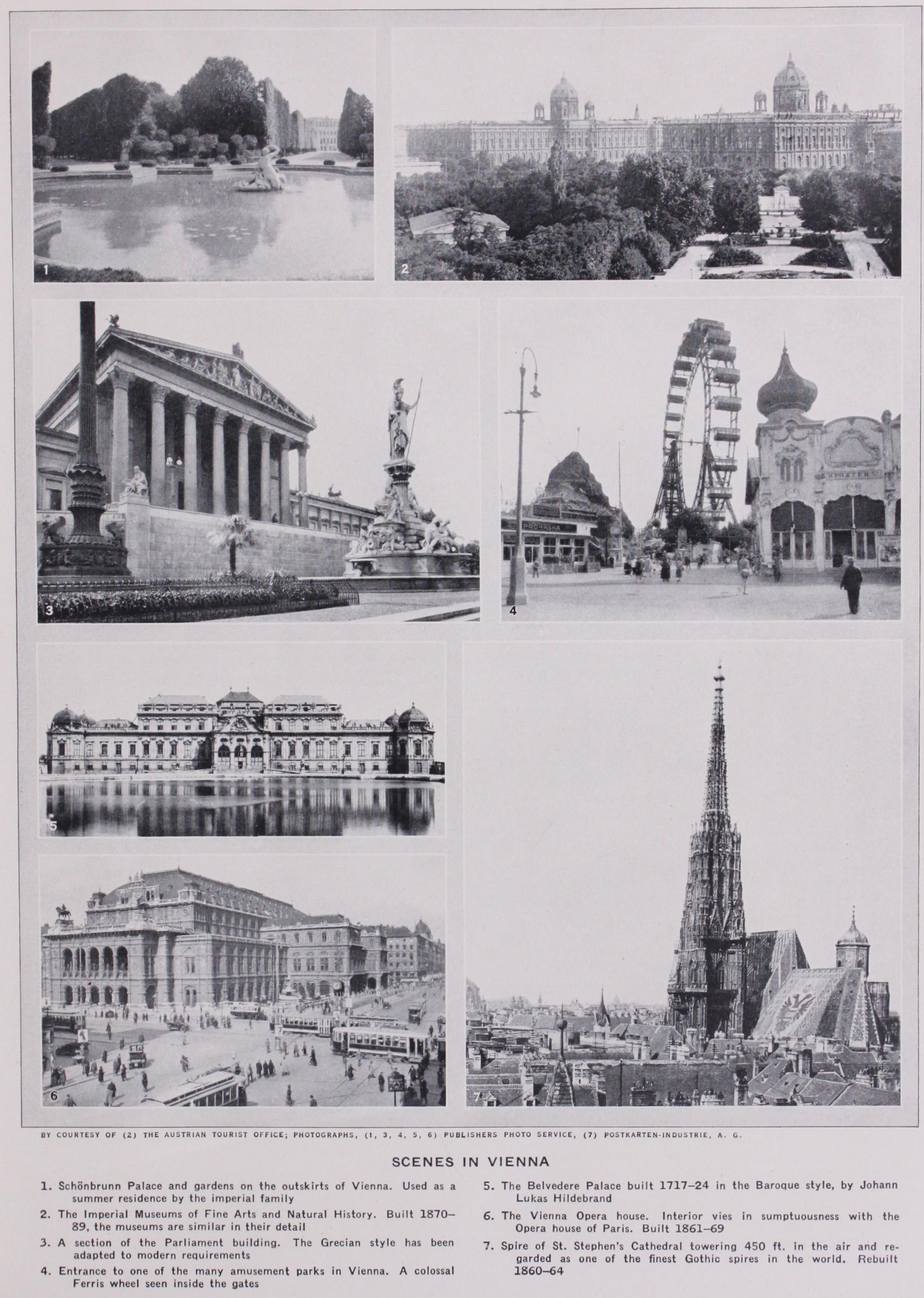
Beyond the imposing Ring and grouped around it are a num ber of impressive buildings and parks. Opposite the Hofburg stand the museums of natural history and art, two domed Renaissance buildings dating from 1872-81, identical in con struction but separated by gardens containing the Maria Teresa monument. Adjoining the museums to the west is the palace of justice 0880 burned during riots in 1927, and the houses of parliament (1883) in modified Grecian style. Beyond these stands the new Rathaus (1873-83), a very large and lavishly decorated building separated from the Ring by the Rathaus park. This edifice is in modern Gothic style which is a striking con trast to the Classical and Renaissance styles so strongly repre sented in Viennese architecture. To the north stands the univer sity, an example of Renaissance style (1873-74), even larger than the Rathaus. The university, the oldest German foundation (1365), has done much to raise Vienna to its high position as one of the leaders of culture amongst the European nations and its medical faculty is of world-wide reputation. The university library with 1,060,000 volumes is very well-equipped.