Vine
species, cultivated, seed, north and grape
VINE. The grape-vine, botanically Vitis (family Vitaceae), is a genus of about 4o species, widespread in the north temperate zone, but richest in species in North America. The best known and longest cultivated species is the old-world grape-vine, Vitis vinifera; a variety of this, silvestris, occurs wild in the Medi terranean region, spreading eastwards towards the Caucasus and northwards into southern Germany, and may be regarded as the parent of the cultivated vine.
History and Distribution.—It is of interest to note that grape-stones have been found with mummies in Egyptian tombs not less than 3,00o years old. The seeds have the characteristics of those of V. vinifera, but show some very slight variations from the type of seed now prevalent. Among the Greeks in the time of Homer wine was in general use. The cultivation of the vine must also have been introduced into Italy at a very early period. In Virgil's time the varieties in cultivation seem to have been exceedingly numerous ; and the varied methods of training and culture now in use in Italy are in many cases identical with those described by Columella and other Roman writers. Grape-stones have been found among the remains of Swiss and Italian lake dwellings of the Bronze period, and others in tufaceous volcanic deposits near Montpellier, not long before the historic era.
The Old World species is also extensively cultivated in Cali fornia, but the grape industry of the eastern United States has been developed from native species, chiefly V. Labrusca (northern fox grape), V. aestivalis (summer grape) and V. rotundifolia (southern fox grape, giving the muscadine grapes with the well known variety scuppernong), and their hybrids with V. vinif era. Some of the American varieties have been introduced into France and other countries infested with Phylloxera, to serve as stocks on which to graft the better kinds of European vines, because their roots do not suffer so much injury from the attacks of this insect as do European species.
The vine requires a high summer temperature and a prolonged period in which to ripen its fruit. Where these are forthcoming, it can be profitably cultivated, even though the winter tempera ture be very low. Tchihatchef mentions that at Erivan in Russian Armenia the mean winter temperature is 7°.I C and falls in
January to –30° C, and at Bukhara the mean temperature of January is 4° C and the minimum –22° C, and yet at both places the vine is grown with success. In the Alps it is profitably culti vated up to an altitude of i,000 ft., and in the north of Piedmont as high as 3,00o ft. At the present time the limit of profitable cultivation in Europe passes from Brittany, lat. 3o', to beyond the Rhine by Liege and through Thuringia to Silesia in lat. 50 55'. In former centuries vines were cultivated farther north.
Apart from their economic value (see CURRANT ; RAISIN ; WINE), vines are often cultivated for purely ornamental pur poses, owing to the elegance of their foliage, the rich colouration they assume, the shade they afford, and their hardihood.
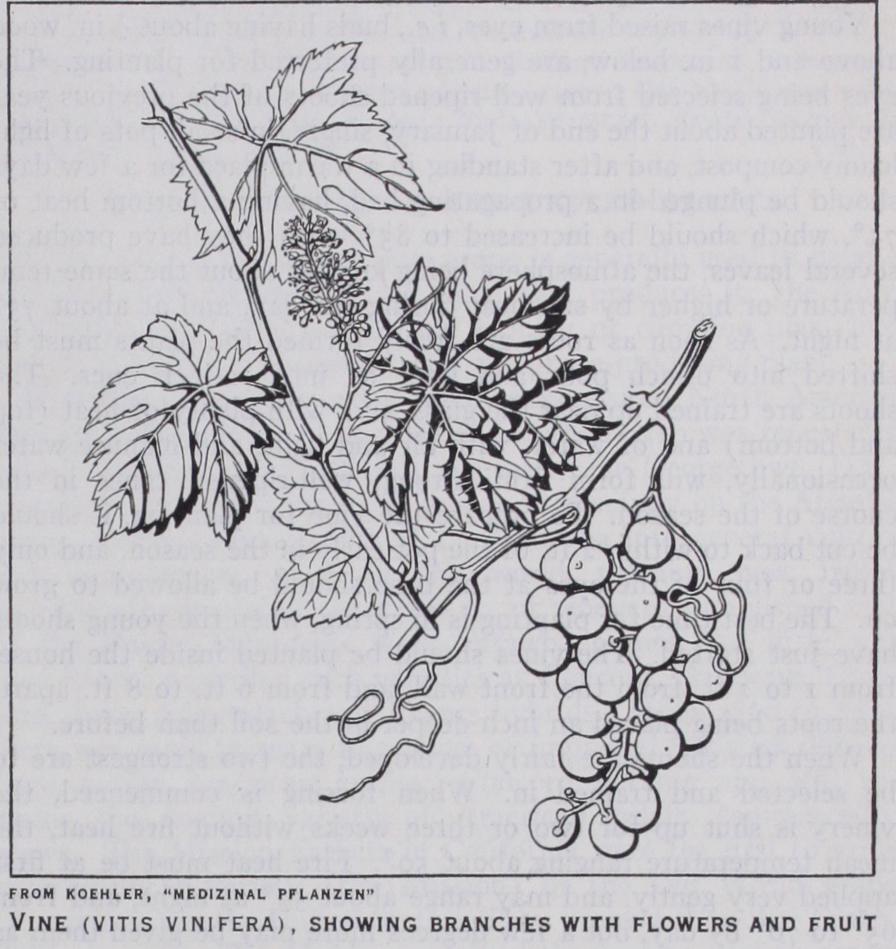
Vegetative Characters.—Vines have woody climbing stems, with alternate, entire or palmately lobed leaves, provided at the base with small stipules. Opposite some of these leaves springs a tendril, by aid of which the plant climbs. The flowers are small, green and fragrant, and are arranged in dense clusters. Each has a small calyx in the form of a shallow rim, sometimes five-lobed or toothed; five petals, which cohere by their tips and form a cap or hood, which is pushed off when the stamens are ripe; and five free stamens, placed opposite the petals and springing from a fleshy ring or disk surrounding the ovary; each bears a two celled anther. The ovary bears a sessile stigma and is more or less completely two-celled, with two erect ovules in each cell. This ripens into the berry and seeds.
The seeds or grape-stones are somewhat club-shaped, with a narrow neck-like portion beneath, which expands into a rounded and thickened portion above. On the inner or central side of the seed is a ridge bounded on either side by a shallow groove. This ridge indicates the point of union of the "raphe" or seed-stalk with the seed; it serves to distinguish the varieties of V. vinif era from those of other species. In endeavouring to trace the filiation and affinities of the vine, the characters afforded by the seed are specially valuable, because they have not been wittingly interfered with by human agency.