Viola
violet, species, flowers, violin and yellow
VIOLA, a member of the violin family standing in point of size between the violin and the violoncello. It is known variously as the tenor and the alto member of the family, the latter term obtaining in France and Italy and being derived from the fact that in earlier days, before the full development of the violin, the highest part was usually assigned to it. Having regard to its pitch moreover, which is a fifth below that of the violin, the term seems equally appropriate, the violoncello being then regarded as the real tenor of the family, with the violin and the double-bass com pleting the quartet as the treble and the bass respectively. To which it may be added that alto was originally the true and only name of the viola, there having been then another and a larger in strument, now obsolete, which was known as the tenor. Apart from its greater size, the construction of the viola is the same as that of the violin. Its tone lacks the brilliance and incisiveness of the latter, being much more dark and veiled in quality, and for this reason it is less effective as a solo instrument than the violin. But it is capable of producing fine results when played by a mas ter, while in the orchestra and in chamber music it is invaluable. For full discussion of instruments of the violin family see VIOLIN. VIOLET. The violets comprise a large botanical genus (Viola), in which about 25o species have been described, found principally in temperate or mountain regions of the Northern Hemisphere ; they also occur in mountainous districts of South America and South and Tropical Africa, while a few are found in Australasia. The species are mostly low-growing herbs with alternate leaves provided with large leafy stipules. The flowers, which are solitary, or rarely in pairs, at the end of slender axillary flower-stalks, are very irregular in form, with five sepals prolonged at the base, and five petals, the lowest one larger than the others and with a spur, in which collects honey. The irregular construction of the flower is connected with fertilization by insect agency. (See POLLINATION.) In the sweet violet (V. odorata) and other species, inconspicuous permanently closed or "cleistogamic" flowers occur of a greenish colour, so that they offer no attrac tions to insect visitors and their form is correspondingly regular; they are self-pollinated. (See POLLINATION.) Several species of Viola are native to Great Britain. Viola caning is the dog violet, many forms or subspecies of which are recognized; V. udorata, sweet violet, is highly prized for its
fragrance, and in cultivation numerous varieties have originated. Other species known in gardens are : V. altaica, flowers yellow or violet with yellow eye; V. biflora, a pretty little species 3 to 4 in. high with small yellow flowers, the large petal being streaked with black; V. calcarata, flowers light blue or white, or yellow in var. flava; V. cornuta, flowers pale blue—there are a few good varieties of this, including one with white flowers; V. cucullata, a free-flowering American species with violet-blue or purple flowers; V. Munbyana, a native of Algeria, with large violet or yellow flowers; V. pedata, the bird's-foot violet, with pedately divided leaves and usually bright blue flowers. The garden pansies or heartseases are derivatives from V. tricolor, a cornfield weed, or V. altaica, a native of the Altai mountains. (See PANSY.) About 75 species of Viola are native to North America, of which about 5o occur from the 'Rocky Mountains eastward, and the remainder chiefly on the Pacific coast. They are all herbaceous and fall into two general groups: (I) the leafy-stemmed and (2) the stemless violets. While the distinctive characters in many species are sharply marked, the determination of numerous others is very difficult, because of the profusion of natural hybrids. These hybrids were made the subject of intensive experimental study by E. V. Brainerd.
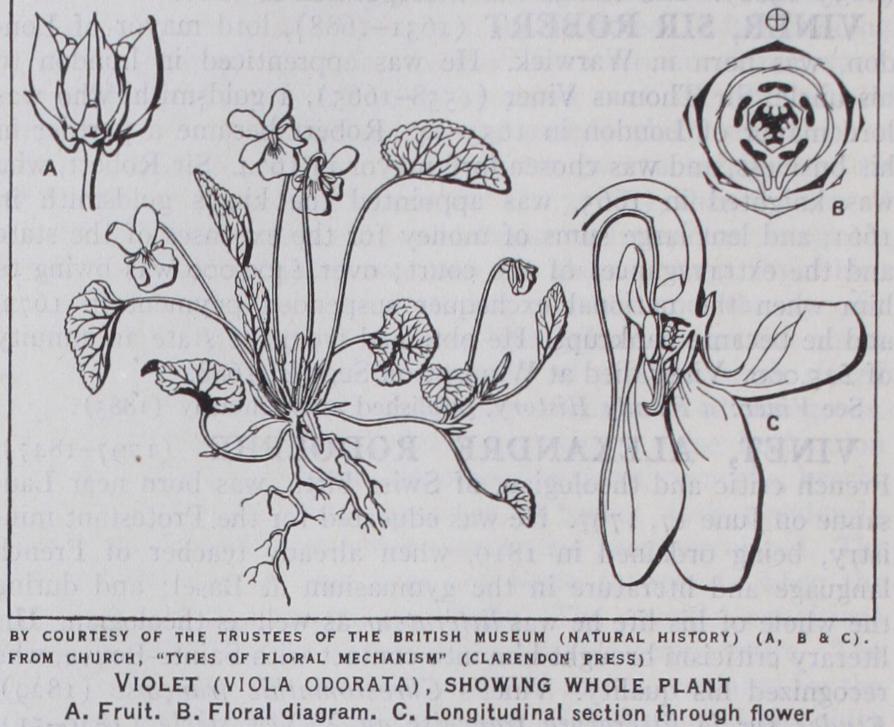
Representative North American violets are the bird's-foot violet (V. pedata), the early blue violet (V. palmata), the bog blue violet (V. cucullata), the arrow-leaved violet (V. sagittata), the meadow blue violet (V. papilionacea), the southern wood violet (V. villosa), the striped violet (V. striata), the sweet white violet (V. blanda), the beaked violet (V. rostrata), the Canada violet (V. canadensis), the round-leaved violet (V. rotundifolia) and the hairy yellow violet (V. pubescens), of the eastern States and Provinces; the prairie yellow violet (V. Nuttallii), of the Great Plains region; and the pine violet (V. lobata), the mountain violet (V. purpurea), the yellow pansy (V. pedunculata), the western heartsease (V. ocellata) and the wood violet (V. sarinentosa) of the Pacific coast. Numerous species are transplanted.
For further details regarding the North American species see E. P. Brainerd, "Violets of North America," Vermont Agric. Exper. Sta. Bull. 224 (1920 and "Some Natural Violet Hybrids of North America," ib. Bull. 239 (1924) •