Virgin Islands
st, thomas, john, united and british
VIRGIN ISLANDS, a group of small islands in the West Indies, about ioo in number, mostly uninhabited. They extend E. from Porto Rico, lying between 17° and 18° 5o' N.. and 1o' and 65° 3o' W.: total area about 465 sq.m. The islands are rocky, or sandy and barren, but the cultivated portions yield cotton, sugar and the usual W. Indian food-crops. Guinea grass grows abundantly on the hillsides, and good cattle are reared. The coasts abound with fish. The climate is healthy and the heat moderate. Culebra and Vieques or Crab Islands were acquired by the United States from Spain in 1898 with Porto Rico.
Of the British Islands, 32 in all with an area of 58 sq.m., the principal are Tortola, Anegada, Virgin Gorda, Jost van Dyke, Peter's Island and Salt Island. With the exception of the island of Sombrero they form one of the five presidencies in the colony of the Leeward Islands. The inhabitants are peasants who raise cattle and burn charcoal. Some are fishermen and boatmen. The chief town is Roadtown (pop. 40o) at the head of a fine harbour on the S. of Tortola, and trade is mostly with St. Thomas. Som brero is maintained as a lighthouse by the British government.
Population of the presidency, mostly negroes (1933 est.) 5,36o. The Virgin Islands were discovered by Columbus in his second voyage, in and named Las Virgenes, in honour of St. Ursula and her companions. In 1666 the British occupied Tortola, and have held it ever since. In the 17th century the Virgin Islands were favourite resorts of the buccaneers. The islands of St. Thomas and St. John were taken by the British from Denmark in
1801, but restored in the following year. In 1807 they surrendered to the British, and continued in their hands till 1815, when they were again restored.
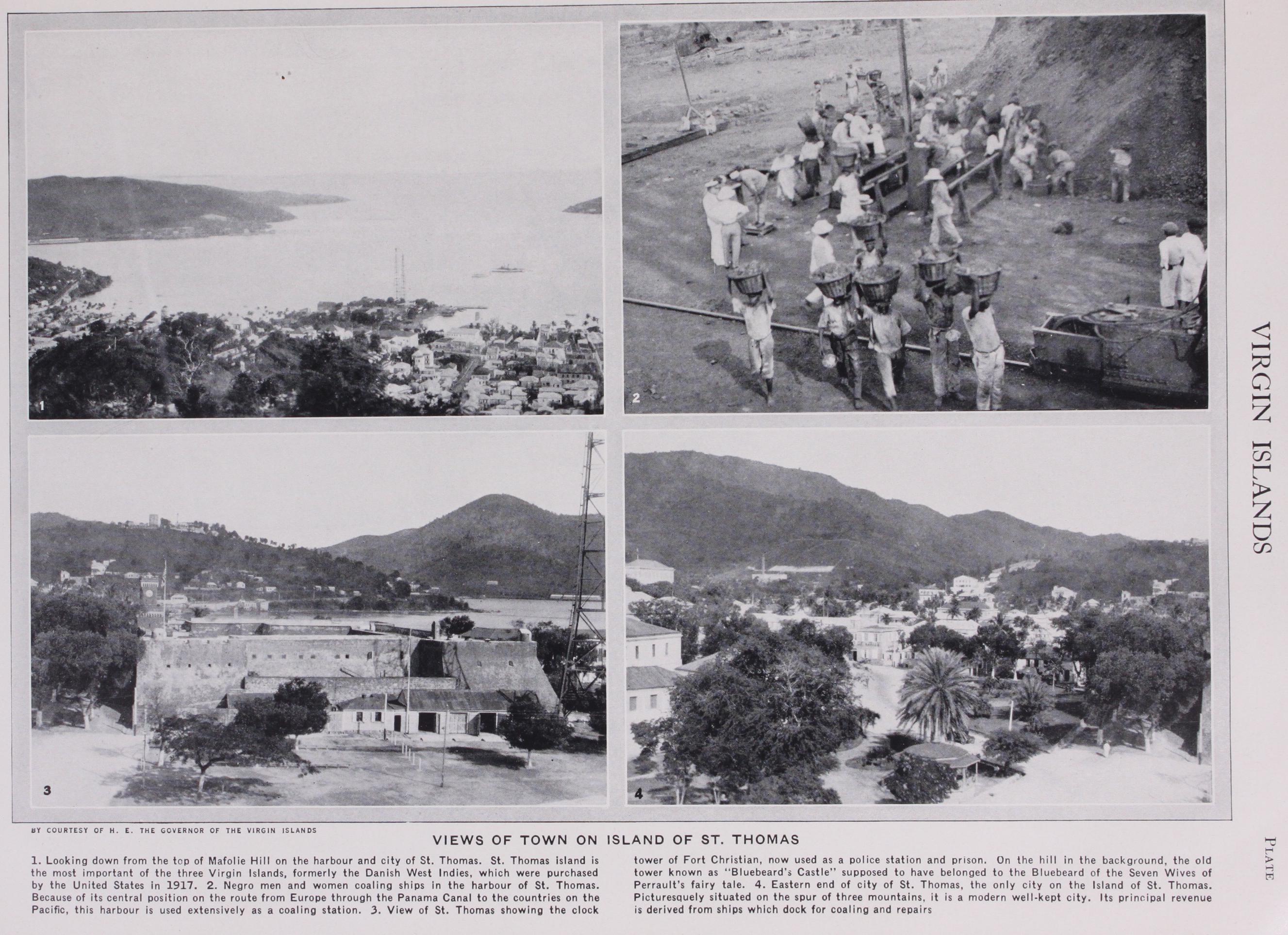
In 1917, after various unsuccessful negotiations begun before 1867, the three islands, St. Croix, St. Thomas and St. John, were bought from Denmark by the United States of America for $25,000,000. St. Thomas and St. John form one administrative municipality, St. Croix another and each has a local legislative council. The inhabitants of these islands have become (1927) citizens of the United States. They numbered 26,051 in 1917 and 2 2,012 in 1930, the decrease being largely due to emigration to the United States. In 1917, 92.6% of the population was negro, or coloured. The combined area of the American islands is 133 sq.m. In 1930 the Federal census gave St. Croix 11,413, St. Thomas 9,834 and St. John 765 inhabitants. Charlotte Amalie (now St. Thomas), with a population of 7,036 in 1930, is the largest town and the seat of government; it has a fine harbour and is 1,442 m. from New York and 1,029 m. from the Panama canal. Administrative officers for the islands are appointed by the United States Navy Department. St. Croix (towns Chris tiansted and Fredericksted) produces sugar, molasses and hides. St. John and St. Thomas have little agriculture, but from the Pimenta acris is produced bay-oil and bay rum. The export of bay rum in 1927 totalled 60,494 gallons.