Vitoria
left, zadorra, centre, french and road
VITORIA, an episcopal city of northern Spain, and capital of the province of Alava; on the Miranda de Ebro-Alsasua section of the Northern railways, among the southern outliers of the Cantabrian mountains, and on the left bank of the river Zadorra, a left-hand tributary of the Ebro. Pop. (1930) 40,641. Vitoria was founded in 581 by Leovigild, king of the Visigoths; but its importance dates from the loth century. In 1181 Sancho the Wise of Navarre granted it a charter and fortified it. The city is built on a hill 1,750 ft. high, and overlooks the plain of Alava. The cathedral of Santa Maria dates from 1181, but has been considerably spoiled by late additions: the church of San Miguel also dates from the 12th century; it has a beautiful altar, carved in wood by J. Velazquez and G. Hernandez, in the 16th century. Vitoria, from its favourable position on the main lines from Madrid to France and to the port of San Sebastian, is an important centre of trade in wine, wool, horses, mules and hardware.
Battle of Vitoria.
For the operations which preceded the battle of Vitoria see PENINSULAR WAR. On June 21, 1813, the French army in Spain (about 65,00o men with 150 guns), under King Joseph Bonaparte, held an extended position in the basin of Vitoria, south (with the exception of the extreme right) of the river Zadorra. The left rested on the heights of Puebla, north of the Puebla Pass, and Puebla de Arganzon, through which ran the Miranda-Vitoria-Bayonne road, Joseph's line of communica tion with France. Thence the line stretched to the ridge of Mar garita, the troops so far being under General Gazan, with a sec ond supporting line under D'Erlon between Arinez and Hermandad and a reserve behind Arinez. The right under Reille guarded the Bilbao-Vitoria road.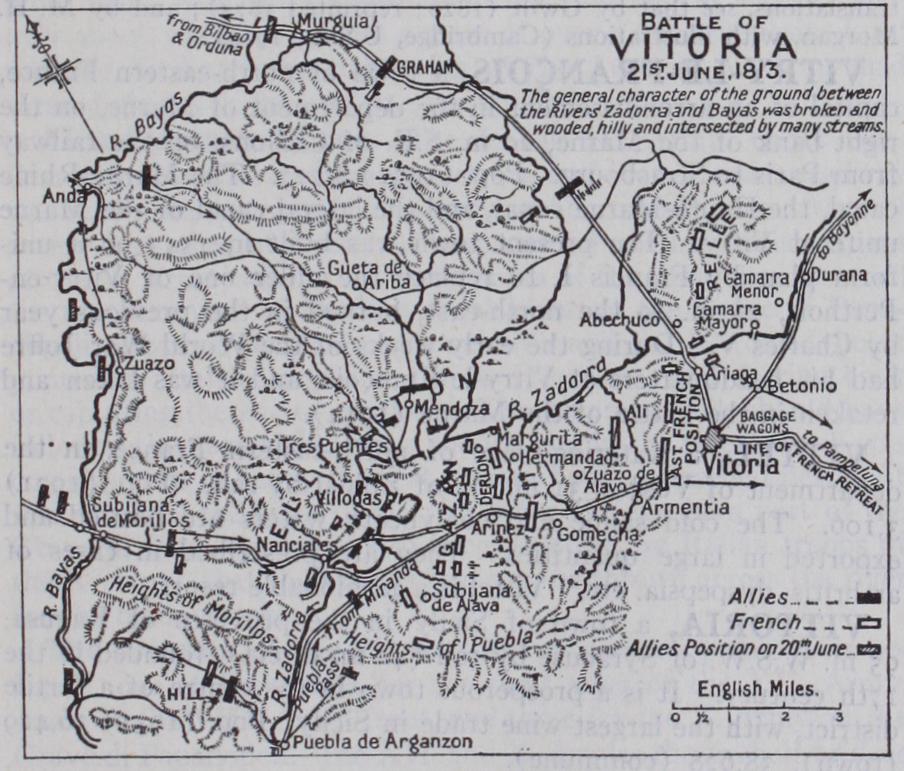
There were no troops between Hermandad and Ariaga, except a mass of cavalry near Ali. The Zadorra, fordable in certain spots only, was spanned by bridges at Puebla de Arganzon, Nanclares, Villodas, Tres Puentes, Mendoza, Abechuco and Gamarra Mayor, which French guns commanded ; but, for some reason, none of these had been destroyed. The faults of the French position and their occupation of it were its extension; that it was in prolongation of and (on the right especially) very close to their line of retreat, so that if the right were driven back this line could be at once seized; that the centre was not strongly held; and that all bridges were left intact.
The Allies (nearly 8o,000, with 90 guns), under Wellington, had moved from the river Bayas at daylight to attack Joseph, in four columns, the right being under Hill (20,00o, including Moril los's Spaniards), the right centre and left centre under Welling ton (30,000) and the left under Graham (20,000, including Longa's Spaniards). As the columns marched across the inter sected country between the Bayas and Zadorra, extending from near Puebla de Arganzon to the Bilbao-Vitoria road, they kept touch with each other; and as they neared the Zadorra the battle opened all along the line soon after io A.M. Wellington's instruc
tions to Graham were to undertake no manoeuvre which would sep arate his column from those on the right; but, with this proviso, to seize the Vitoria-Bayonne road if the enemy appeared decidedly in retreat. Hill after a sharp contest gained the Puebla heights, too weakly held ; and pushing through the pass carried the village of Subijana de Alava. The right centre column having reached Villodas, was waiting for Hill to gain further ground, when the bridge at Tres Puentes was observed to be unguarded, probably because it was commanded from the south bank; and, the French attention being now turned towards their flanks, it was surprised Licl rushed by Wellington with the Light division, supported quickly by cavalry and other troops, who maintained themselves on the south bank. Joseph's centre was partially forced, while his left was hard pressed by Hill; and, fearing that Gazan and D'Erlon might be cut off from Reille, he ordered them to withdraw to a ridge farther back, which they did, holding Arinez in front. Here there was no hard fighting; but, as Wellington had now passed three divisions, many guns and the cavalry (which, however, from the nature of the ground could be but little used) across the Zadorra, Margarita. Hermandad and Arinez soon fell to the Allies.
On the left, Graham, having turned the heights north of the Zadorra with Longa's Spaniards, seized Gamarra Menor close to the Bayonne road. He also with heavy loss carried Gamarra Mayor and Abechuco, but the bridges south of these villages, though more than once taken, were always recaptured by Reille. At length, when a brigade from the Allied centre had been pushed up from Hermandad against Reille's flank, he withdrew from the obstinately defended bridges, and before this Gazan and D'Erlon had also fallen back, fighting, to a third position on a ridge be tween Armentia and Ali west of Vitoria. Here, at about 6 P.M., they made a last stand, being compelled in the end to yield ; and as Graham, having now crossed the bridges, was close to the Bayonne road, the main body of Joseph's army fled by a bad cross road towards Pampeluna, abandoning artillery, vehicles and bag gage (of which an enormous quantity was parked near Vitoria), Reille afterwards joining it through Betonia. The Allies then oc cupied Vitoria and pursued the French until nightfall. All Jo seph's equipages, ammunition and stores, 143 guns, a million sterling in money, and various trophies fell into Wellington's hands, the French loss in men being nearly 7,000, that of the Allies over 5,000, of whom 1,600 were Portuguese and Spaniards. This decisive victory practically freed Spain from French domi nation. (C. W. Ro.)