Voice
vocal, cords, arytenoid, muscles and larynx
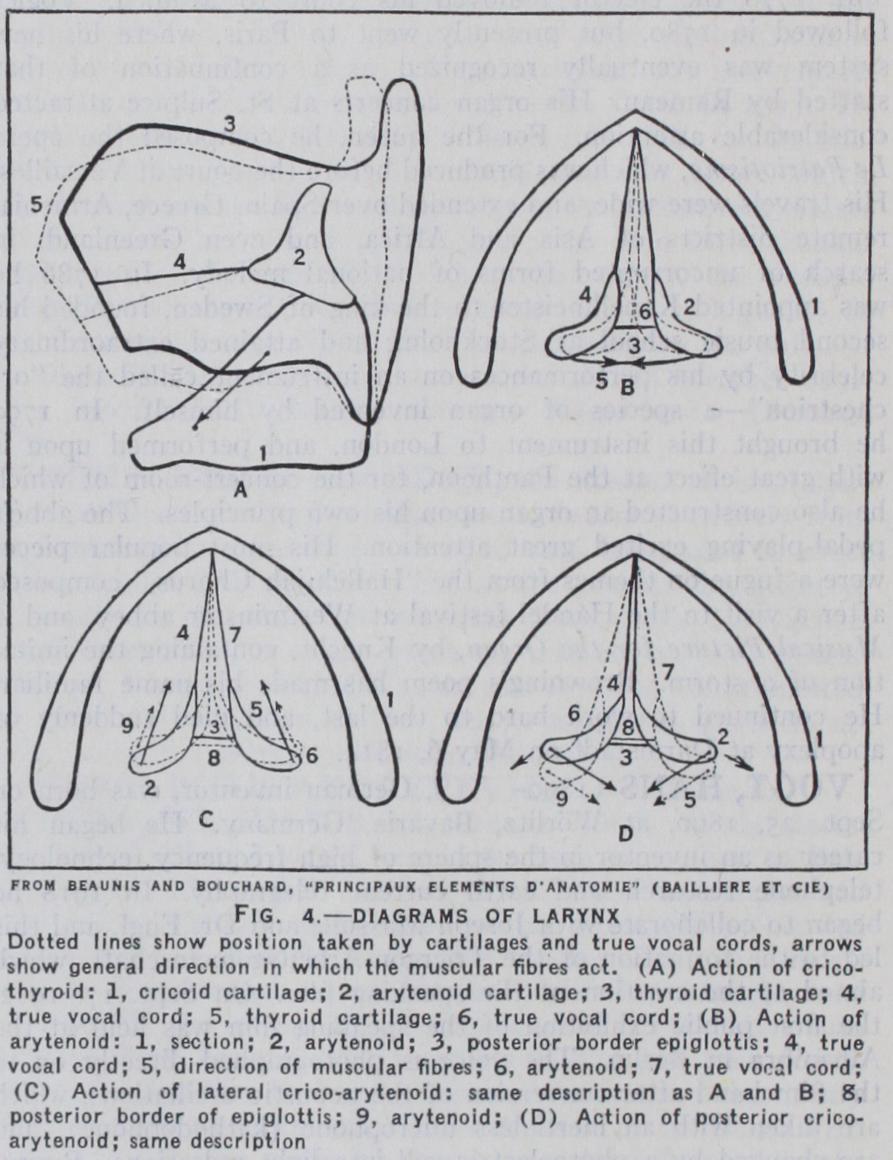
The Muscles of the Larynx. —We are now in a position to understand the action of the mus cles of the larynx by which the vocal cords, forming the rima glottidis, can be tightened or re laxed, and by which they can be approximated or separated. Be sides certain extrinsic muscles—sterno-hyoid, omohyoid, sterno thyroid and thyro-hyoid—which move the larynx as a whole, there are intrinsic muscles which move the cartilages on each other. These muscles are (a) the crico thyroid, (b) the posterior cri co-arytenoid, (c) the lateral crico-arytenoid, (d) the thyro arytenoid, (e) the arytenoid, and (f) the aryteno-epiglottidean. Their actions will be readily un derstood with the aid of the dia grams in fig. 4. (I) The crico thyroid is a short thick triangular muscle, its fibres passing from the cricoid cartilage obliquely up wards and outwards to be in serted into the lower border of the thyroid cartilage and to the outer border of its lower horn. When the muscle contracts, the cricoid and thyroid cartilages are approximated. (2) The thyro-arytenoid has been divided by anatomists into two parts —one, the internal, lying close to the true vocal cord, and the other, external, immediately within the ala of the thyroid cartilage. Many of the fibres of the anterior portion' pass from the thyroid cartilage with a slight curve (concavity in wards) to the processus vocalis at the base of the arytenoid car tilage. They are thus parallel with the true vocal cord, and when they contract the arytenoids are drawn forwards if the postreus muscles are relaxed; but if the arytenoid cartilages are braced back contraction of the muscle increases the elasticity of the margins of the glottis. (3) The posterior and lateral crico arytenoid muscles have antagonistic actions, and may be consid ered together. The posterior arise from the posterior surface of the cricoid cartilage, and passing upwards and outwards are at tached to the outer angle of the base of the arytenoid. On the other hand, the lateral arise from the upper border of the cricoid as far back as the articular surface for the arytenoid, pass back wards and upwards, and are also inserted into the outer angle of the base of the arytenoid before the attachment of the posterior crico-arytenoid. Imagine the pyramidal form of the arytenoid cartilages. To the inner angle of the triangular base are attached, as already described, the true vocal cords; and to the outer angle the two muscles in question. The posterior crico-arytenoids draw the outer angles backwards and inwards, thus rotating the inner angles, or processus vocalis, outwards ; the innermost fibres of the muscles draw the arytenoids away from one another and widen the rima glottidis. This action is opposed by the lateral crico-arytenoids, which draw the outer angle forwards and out wards, rotate the inner angles inwards, and thus approximate the cords. (4) The arytenoids pass from the one arytenoid cartilage to the other, and in action these cartilages will be ap proximated and slightly depressed. (5) The aryteno-epiglottidean muscles arise near the outer angles of the arytenoid; their fibres pass obliquely upwards, decussate and are inserted partly into the outer and upper border of the opposite cartilage, partly into the aryteno-epiglottic fold, and partly join the fibres of the thyro arytenoids. In action they assist in bringing the arytenoids to gether, whilst they also constrict the upper aperture of the larynx.
The Voice Registers.
The voice may be divided into the lower or chest register, the higher or head register, and the small or falsetto register. In singing, the voice changes in volume and in quality in passing from one register into another. There is remarkable diversity of opinion as to what happens in the larynx when the voice passes through the various registers. There has also been much discussion as to the production of falsetto tones. In the lower registers the membranous vocal cords vibrate, while the arytenoids remain stationary and in appo sition. The whole mass of inferior thyro-arytenoids fold—consist ing of mucous membrane, fatty elastic connective tissue and under lying muscle—vibrates. In the falsetto voice the vocal cords areblown apart and the rima glottis is of an elliptical shape; only the margins of the inferior thyro-arytenoid folds vibrate. The small register is a variant of the falsetto; in it only a part of the mem branous glottis is blown open.
The pitch of the voice -appears to depend on the relation of the elasticity of the glottal margins—as determined by the degree of contraction of the thyro-arytenoid muscles—to the pressure of air expelled from the trachea. The pitch can be raised by an increase of the former while the latter remains almost unchanged or vice versa; probably an increase of elasticity is accompanied by slightly raised air pressure in the changes of pitch in the chest register. In the head register it appears that the innermost fibres only of the thyro-arytenoid muscles are in contraction, rise of pitch being pro duced principally by rise of air pressure.
The Laryngoscope.
By means of the laryngoscope it is pos sible to see the condition of the rima glottidis and the cords in passing through all the ranges of the voice. In 1807 Bozzini first showed that it was possible to see into the dark cavities of the body by illuminating them with a mirror, and in 1829 W. Babing ton first saw the glottis in this way. In 1854 Garcia investigated his own larynx and that of other singers, and three years later Tiirck and especially J. N. Czermak, perfected the construction of the laryngoscope. In 1883 Lennox Browne and Emil Behnke ob tained photographs of the glottis in the living man. By using the stroboscope Oertel, Musehold, Flatau, Hegener and Panconcelli Calzia have in recent years enormously improved the technique of laryngoscopy. The endoscope devised by Flatau and the auto phonoscope originated jointly by Panconcelli-Calzia enable one to carry out extensive observations on the larynx while the mouth is closed.
Other apparatus employed for investigating the mechanism of the voice includes the breathing flask of Gutzmann, the spirometer, the stethograph and pneumograph (used in connection with the manometer and the phonetic kymograph), all of which are em ployed for investigating breathing. For observing the action of the vocal cords there are employed, in addition to the laryngoscope, the strobolaryngoscope and the endoscope, manometric flames, the Polsterpfeife of Wethlo, resonators, gramophones, microphones and oscillographs. For studying the supraglottal resonators radio grams are taken.
Action of the Vocal Cords.
The best view of the larynx is obtained with the tongue flat, while attempting to sing the vowel "ee," for this opens out the cavity immediately above the larynx. Now suppose the larynx is examined stroboscopically. The vocal cords are seen to be alternately opening and closing along the ligamentous portions in the chest notes. In falsetto the glottis is permanently open with the edges of the cords vibrating. In whis per the space between the arytenoids is open. Should this occur during phonation, it constitutes a faulty mechanism producing what is called breathy voice, which is particularly to be avoided in singing.