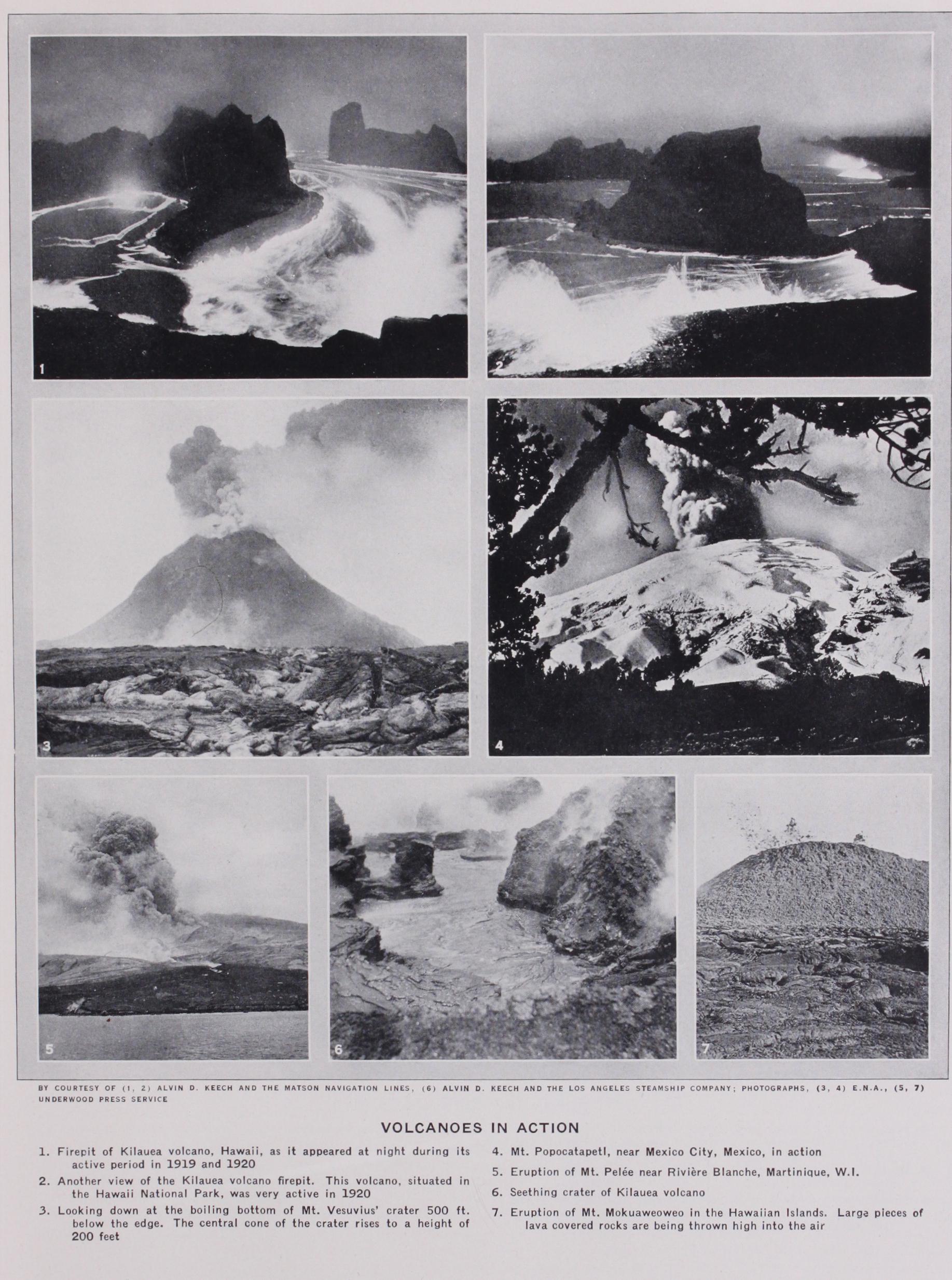
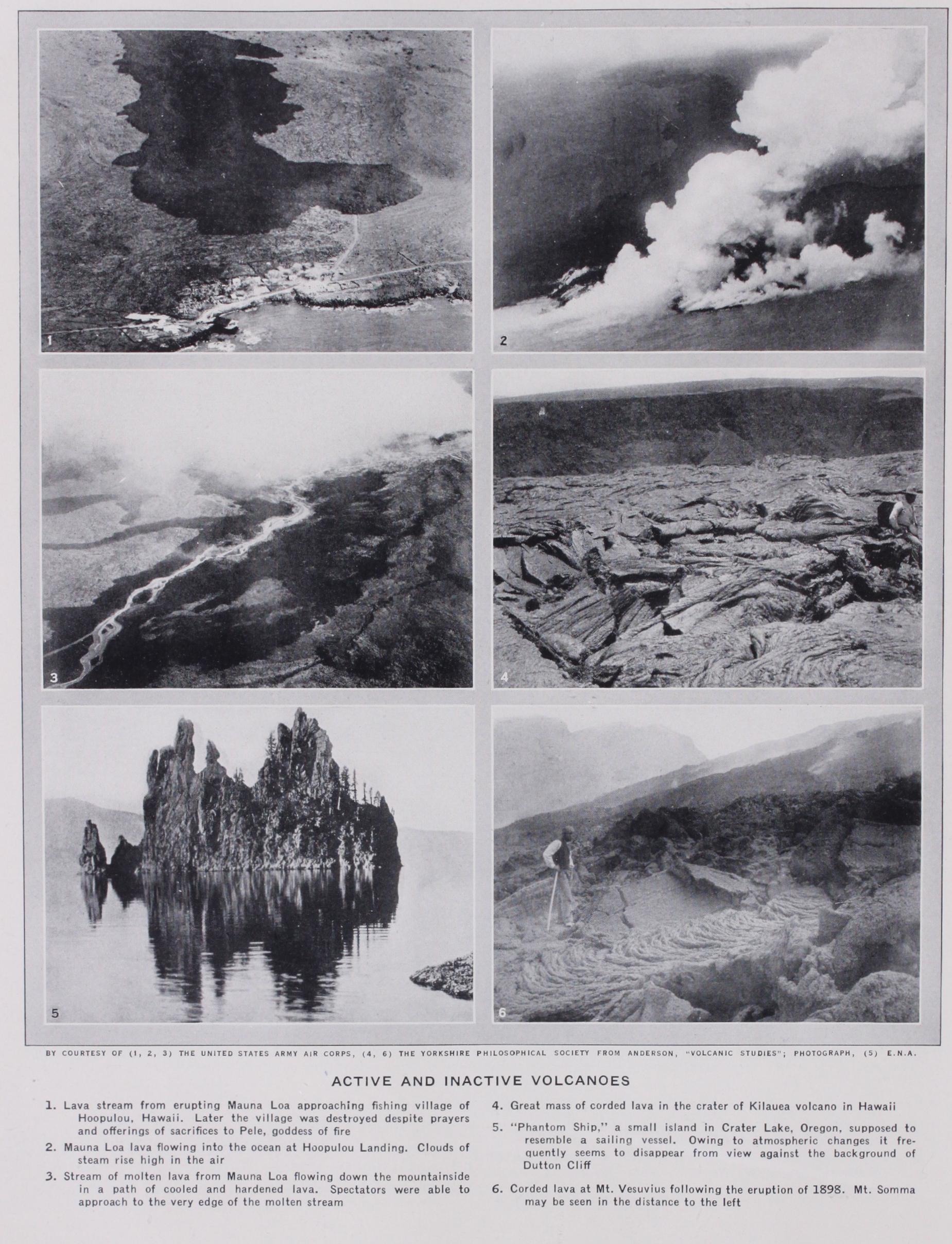
Volcano
eruptions, cones, fissure, volcanic and lava
Much of the fragmental matter ejected from a volcano rolls down the inside of the crater, forming beds of tuff which incline towards the central axis, or have a centroclinal dip. On the con trary, the sheets of cinder and lava which form the bulk of the cone slcpe away from the axis, or have a dip that is sometimes described as peri-centric. After the eruption of Krakatoa in 1883 a magnificent natural section of the great cone of Rakata, at the S. end of the island, was exposed—the northern half having been blown away—and it was then evident that this mountain was a solid cone, which was built up of a great succession of irregular beds of tuff and lava, braced together by intersecting dykes.
Parasitic Cones.—In the case of a lofty volcano the column of lava may not have sufficient ascensional force to reach the crater at the summit, or at any rate it finds easier means of egress at some weak spot, often along radial cracks, on the flanks of the mountain. Thus at Etna, which rises to a height of more than 0,800 ft., the eruptions usually proceed from lateral fissures, sometimes at least half-way down the mountain-side. When frag mental materials are ejected from a lateral vent a cinder-cone is formed, and by frequent repetition of such ejections the flanks of Etna have become dotted over with hundreds of scoria-cones much like the puys of Auvergne, the largest (Monte Minardo) rising to a height of as much as 75o ft. Hills of this character, seated on the parent mountain, are known as parasitic cones, minor cones, lateral cones, etc. Such subordinate cones often show a tendency to a linear arrangement, rising from vents or bocche along the floor of a line of fissure. Thus in 1892 a chain of five cones arose from a rift on the S. side of Etna, running in a N. and S. direction, and the hills became known as the Monti Silvestri, after Professor Orazio Silvestri of Catania. This rift, however, was but a continuation of a fissure from which there arose in 1886 the series of cones called the Monti Gemmellaro, while this in turn was a prolongation of a rent opened in 1883.
Fissure and Plateau Eruptions.—In certain parts of the world there are vast tracts of basaltic lava with little or no evi dence of cones or of pyroclastic accompaniment. To explain their formation von Richthofen suggested that they represent great floods of lava which were poured forth not from ordinary volcanic craters with more or less explosive violence, but from great fissures in the earth's crust, whence they may have quietly welled forth and spread as a deluge over the surface of the country. The eruptions were effusive rather than explosive. At the present day true fissure eruptions seem to be of rather limited occurrence, but excellent examples are furnished by Iceland. Here there are vast fields of black basalt, formed of sheets of lava which have issued from long chasms, studded in most cases with rows of small cones, but these generally so insignificant that they make no scenic features and might be readily obliterated by denudation.
It is believed that fissure eruptions must have played a far more important part in the history of the earth than eruptions of the familiar cone-and-crater type, the latter representing indeed only a declining phase of vulcanism. Sir Archibald Geikie, who specially studied the subject of fissure eruptions, regarded the Tertiary basaltic plateaux of N.E. Ireland and the Inner Hebrides as outflows from fissures, which are represented by the gigantic system of dykes that form so marked a feature in the geological structure of the northern part of Britain and Ireland. These dykes extend over an area of something like 40,000 sq.m., while the outflows form an aggregate of about 3,00o ft. in thickness. In parts of Nevada, Idaho, Oregon and Washington, sheets of late Tertiary basalt from fissure eruptions occupy an area of about 200,000 sq.m., and constitute a pile at least 2,000 ft. thick. In India the "Deccan traps" represent enormous masses of volcanic matter, probably of like origin but of Cretaceous date, whilst South Africa furnishes other examples of similar outflows.
Professor J. W. Gregory recognized in the Kapte plains of East Africa evidence of a type of vulcanism, which he distinguished as that of "plateau eruptions"; according to him a number of vents opened at the points of intersection of lines of weakness in a high plateau, giving rise to many small cones, and the simultaneous flows of lava from these cones united to form a broad sheet.
Submarine Volcanoes.
Since much of the face of the earth is covered by the sea, it seems likely that volcanic eruptions must frequently occur on the ocean-floor. When, as occasionally though not often happens, the effects of a submarine eruption are observed during the disturbance, it is seen that the surface of the sea is violently agitated, with copious discharge of steam; the water passes into a state of ebullition, perhaps throwing up huge fountains; shoals of dead fishes, with volcanic cinders, bombs and fragments of pumice, float around the centre of eruption, and ultimately a little island may appear above sea level. This new land is the peak of a volcanic cone which is based on the sea-floor, and if in deep water the submarine moun tain must evidently be of great magnitude. Christmas Island in the Indian Ocean, described by Dr. C. W. Andrews, appears to be a volcanic mountain, with Tertiary limestones, standing in water more than 14,00o ft. deep. Many volcanic islands, such as those abundantly scattered over the Pacific, must have started as submarine volcanoes which reached the surface either by con tinued upward growth or by upheaval of the sea-bottom. Etna began its long geological history by submarine eruptions in a bay of the Mediterranean, and Vesuvius in like manner repre sents what was originally a volcano on the sea-floor.