War Pensions
pension, service, hospital, disabled and commissioners
The pension system contemplated was at the outset essentially one of maintenance in a hospital, but in 1685 it was provided that the disabled should receive allowances out of the hospital's funds until they could be accommodated within it. With the recognition of the out-pensioner the in-pensioner of the hospital becomes a special class rather than the normal type. Within a few years, especially after the campaigns in the Low Countries, the number of the disabled increased to a point far beyond the accommoda tion of the hospital, which originally provided for 476 men and has never exceeded 558. By 1713 the out-pensioners had increased to 4,364: and by the middle of the 18th century they numbered 9,700. The early warrants contemplated the grant of pensions to those only who either (a) were wholly disabled for further service by wounds or injuries, those more slightly disabled being given gratuities, or who (b) had served 20 years. The rates of pension ranged from 5d. a day for a private to is. 6d. for a corporal of horse. The disability pensions were at flat rates according to rank, and without regard to the extent of disablement, the awards being made by the commissioners without examination of the men and solely on the strength of certificates from commanding offi cers. The natural result was in a few years a heavy pension list, and increasing demands on parliament, with the result that in 1713 the commissioners made a complete re-examination of all cases and struck off the pension list all—about one half the whole number—of whom they were satisfied were wholly able to sup port themselves. At the same time the pension rate was re duced to a uniform 5d. a day for all ranks. Complaints on the part of the pensioners and ex-pensioners were general but the principle of a uniform pension rate was adhered to until 1806.
The warrant of 1806 and the act of that year revolutionized the system of pensions. Henceforth disability pensions assume two permanent characteristics. The pension becomes a definite reward of service, in so far as whatever the degree of disability the pension may be varied according to the length and distinc tion of the man's service and his character as a soldier; at the same time pensions tend to approximate to civil compensation, in so far as they are granted, not, as before, simply on the fact of incapacity for further military service, but on physical dis ablement "caused in and by service"; and on the basis, not, as before, of a flat rate, but at a rate proportionate to the extent of the injury and to the ability of the man to provide for his own livelihood. The grant of a pension, and the determination of its amount are wholly at the discretion of the commissioners within the minimum and maximum limits set by the warrants.
On these lines the warrants of the 19th century developed, though, so far as rates of pension are concerned, with extraordi narily little change. The maximum rate for disablement rises" only from 14s. a week to z7s. 6d. The distinction between the scales of pension available for disablement due to "wounds or injuries received in action" and other disabilities—the latter be ing compensated at far lower rates—is gradually modified by the recognition of climatic disease, though not finally removed till after the South African War. The basis of pension remains dis
ablement "in and by" service and was very strictly interpreted until the World War. A widow's claims go unrecognized, except by the grant of gratuity equal to 11 months' pay of her husband until the Crimean War and then small pensions are only granted out of the funds raised by the Royal Patriotic Fund Corporation, supple mented by the unclaimed residue of the Soldiers Effects Fund handed over by the War Office. Not until the South African War are pensions provided for widows out of public funds by the War Office.
Pre-World War Pensions.
The scale of pensions in broad outline as it existed immediately prior to the World War may be stated as follows: Naval Pensions: 1695-1917.—Provision for disabled seamen was made by William III. on the same lines as had been applied by his predecessors to ex-soldiers, namely, on the plan of mainte nance in a hospital. The plan of Greenwich hospital was initi ated in 1695 and the building was opened in 1705 "for the relief and support of seamen . . . who by reason of age, wounds or other disabilities shall be incapable of further service at sea and be unable to maintain themselves and also for the sustentation of the widows and maintenance and education of the children of seamen happening to be slain or disabled in such sea service." The Admiralty adhered to the in-pension system more success fully than the Chelsea commissioners and, though the out-pension system had to be admitted in 1763, the accommodation of the hospital was continually expanded until, at the beginning of the 19th century, in-pensioners numbered 2,71o. The out-pensioners however, once allowed, more than kept pace in numbers with the development of the hospital and numbered about 12,000 at the same period. The in-pensioner establishment remained popu lar, and until the middle of the 19th century there were few vacancies. But thereafter the terms of out-pension were im proved and the in-pensioners steadily declined in number, until it was thought to be more economical to offer out-pensions to the whole establishment and in 1869 the hospital was closed to fresh admissions.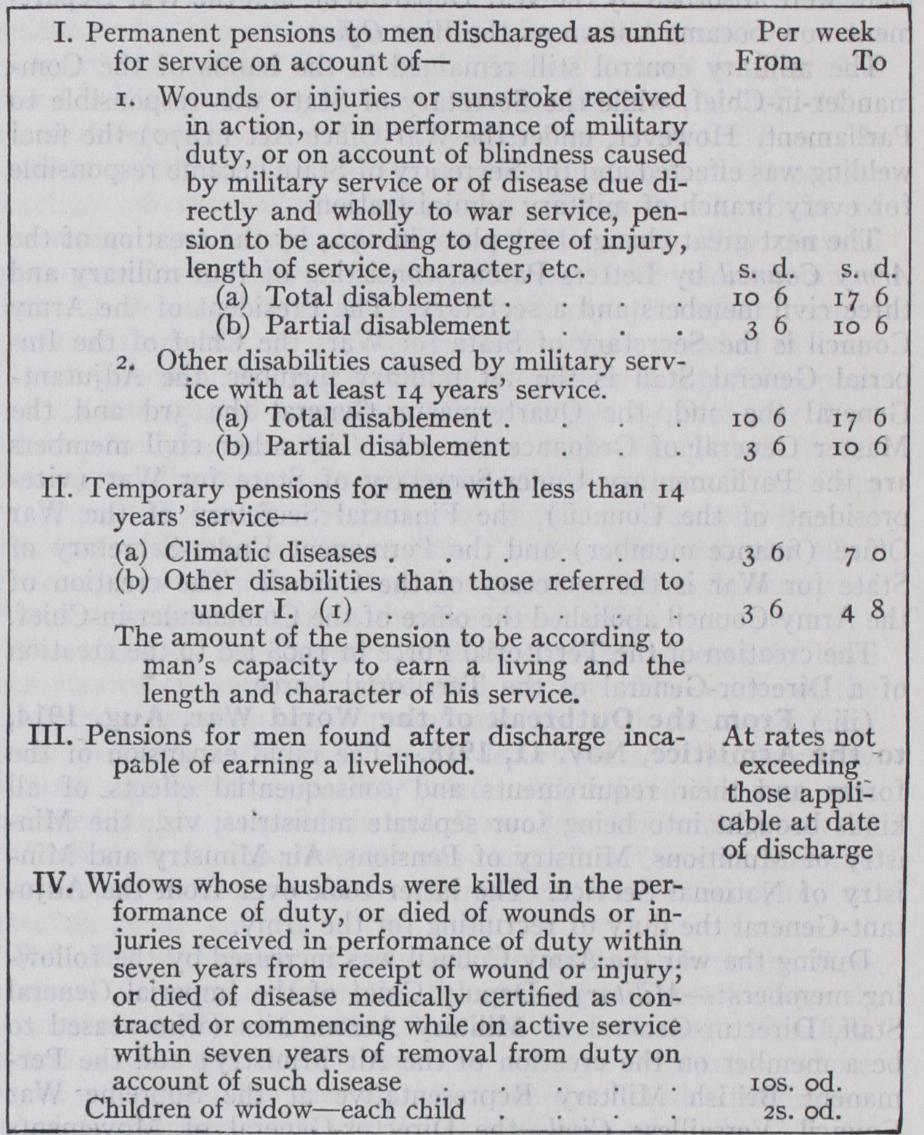
The out-pension rates for the sea service—which is adminis tered by the Admiralty itself, not by the commissioners of the hospital—followed very closely the terms of army warrants and it is unnecessary to detail the various stages of their history. The rates immediately prior to the World War were for total disable ment from ios.6d. to 14s.od. a week; and for partial disable ment, which was graduated in three stages, from 3/6d. to io/6d. a week. The widow and child were eligible for the same terms as in the army service. The naval disability pension like the army pension was subject to variation according to length and character of service, but the regulations provided for several additions to pension for good conduct badges and medals.