1922 T W F W a H
threads, warp, loom, odd and africa
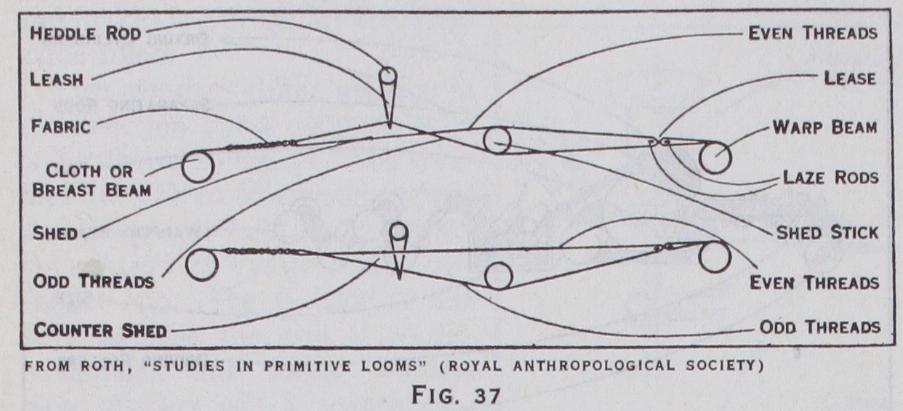
(1922). (T. W. F.; W. A. H.) True weaving consists "of the interlacing at right angles by one series of filaments or threads, known as the weft or woof, of another series known as the warp, both being in the same plane." The warp threads are stretched from a cloth- or breast-beam to another beam known as the warp-beam. The process of weaving is then carried out by raising the odd threads, leaving the even ones in position and passing the woof through the opening thus made. The odd threads are then lowered, the even ones raised, and the woof again passed between them. This is continued until the warp is full. The space between the odd and even threads when the former are raised is known as a shed, when the latter are raised as a counter-shed. The passing of the woof through either is termed making a pick. After each pick is made the woof is pressed home into position by a beater-in or sword usually a flat slat of wood. In some primitive looms the odd and even threads are laboriously raised by hand, but more commonly a heddle and shed stick are used. The simplest heddle consists of a bar of wood to which the odd warp threads are attached—this, the rod heddle, is always worked by hand. The frame heddle is composed of two parallel rods connected by a number of thin bars or strands, each with an eye or loop in the centre through which the odd warp threads pass (fig. 37). In Africa and Indo-China this is worked with the feet by means of treadles. The shed stick is a rod, usually of some thickness, which passes over the odd and under the even threads. When the heddle is not raised the thickness and weight of the shed-stick depresses the odd threads and so makes the counter shed (fig. 38). A more efficient form of shed-stick is a lath which is set on edge to form the counter-shed. To prevent the warp threads from becoming entangled, either two slender laths are passed close to the warp-beam, one over the even and under the odd, the other over the odd and under the even threads; this pre vents the warp threads from moving laterally or a warp-spacer is employed, i.e., two parallel rods united by a number of rigid bars between which the warp threads are passed in varying quantities. In many Indonesian and some African looms this is placed on the cloth-beam side of the heddles and serves as a beater-in as well. It is similar to the reed of a European hand loom. An appliance which is sometimes used is the temple, usually a slender rod with a point at either end, inserted in the fab ric horizontally close to the por tion under construction, serving to keep the width of the web even. Except where the weft threads are discontinuous, as in the raffia looms of West Africa, the weft is wound upon a spool. The arrangement is either as on a European bobbin or the threads may pass lengthwise as on a net ting needle. Where the former method is employed, the bobbin is usually encased in a shuttle, but among primitive peoples the latter is the more common. In Indonesia and Indo-China the material used in weaving is generally cotton, and this is also widely used in Africa; but here and in the west Pacific vegetable fibre and the filaments of shredded leaves are utilized.
Variants.
Outside Africa the horizontal loom is most com mon. In this the warp beam is fixed a short distance off the ground.
The cloth-beam is then either similarly fixed (as in the African specimens) or to it is fastened a girdle which passes behind the back of the weaver as she sits at work. By adjusting the position of her body she is able to regulate the tension on the warp threads. The looms of ancient Mexico and modern West Africa differ from other horizontal looms in that they lack a warp beam; instead the warp-threads are bunched together and anchored to a pole or to the ground.
The vertical loom is now found among primitive peoples in Africa, India and parts of North America. It was used in ancient Egypt and a special variety, with weights instead of a warp beam, in classical Greece. The African vertical loom has two varieties, that for weaving cotton and that for working raffia. They are probably related historically, possibly to the ancient Egyptian form. In them the warp-beam is the upper, the cloth-beam the lower; that is, the weaver begins his work at the bottom. A sloping loom is used by the Bushongo, wherein the warp is stretched at an angle of about 6o° and the weaver sits underneath it, working from the bottom upwards.
Distribution.
The art of weaving occurs sporadically among primitive peoples. The vertical loom is found in Africa, India, and among the Zuni, Navaho and kindred tribes of North Amer ica. The horizontal loom with fixed cloth-beam is mainly African; that with a back-strap is found in Farther India, Indo-China, in parts of Indonesia, Micronesia and north, central and south Amer ica, among the Ainu of Japan and in a few islands of Melanesia. In this last area its presence is almost undoubtedly due to Micronesian influence. In some islands, such as the Banks group and Santo (New Hebrides), it appears to have become a lost art, since there is evidence of its having been practised there formerly.
Sociological and Religious Aspect of Weaving.—Weav ing is often the prerogative of one or other of the sexes. In Africa all the weavers are men, and though women may spin they are often prohibited from touching a loom. With the exception of Oceania the horizontal loom with the back-strap is worked mainly by women. Weaving may be restricted to villages or families, and among the Tangkhul Nagas of Assam, if a woman of a weav ing village marries and goes to live elsewhere, she usually ceases to ply her craft. Even certain designs may be owned. In olden days in Ashanti the king appeared to hold "copyright" of all new designs, which were treated as a "tartan." Among the Sema Nagas a woman may not weave while her husband is away hunt ing, trading or fighting. The Ashanti hold it wrong to break or burn any part of a loom, and they therefore throw those which are past service into a stream. If a man weaver commits adultery with the wife of a weaver a sheep must be sacrificed in atonement to the loom as well as to the ancestral stools.