3 Weirs
gates, friction and doors
3. WEIRS The water discharge at a weir can be regulated and considerably increased in flood time by introducing a series of openings in a solid weir, with sluice gates or panels which slide in grooves at the sides of upright frames or masonry or concrete piers erected at convenient intervals apart. The sluice gates can be raised or lowered as desired from an overbridge. Ordinary draw-doors of moderate size and raised against a small head of water can be readily worked in spite of the friction of the sides of the doors against their supports; but with large draw-doors and a consider able head, the friction of the surfaces in contact offers a serious impediment in raising them. To overcome this difficulty F. G. M. Stoney about 1875 introduced roller sluice gates.
Stoney Gates.
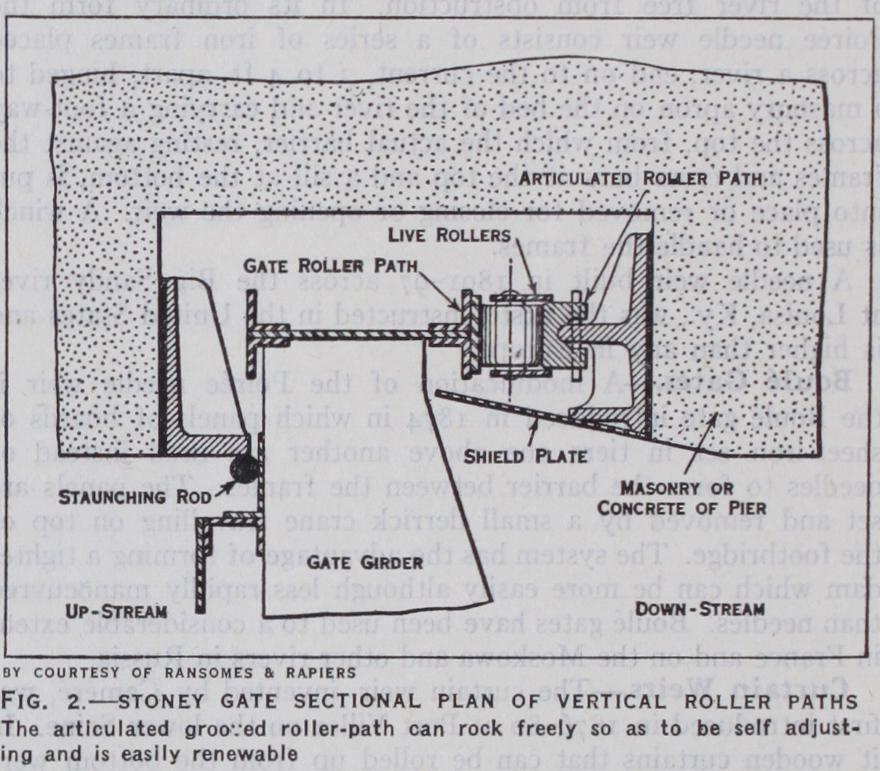
In the Stoney sluice gate two frames, con taining a number of free, or live, rollers, are interposed between the fixed framework and the moving face of the gate, so that, in stead of a sliding friction, which in very large sluices might amount to over 30o tons, a rolling friction only has to be over come, which is insignificant in amount. The working is facilitated by counterpoising the gates and roller trains. By these arrangements the friction is so reduced that gates subjected to a water pressure of over 400 tons can be easily moved by hand-operated gearing. Water-tight joints are obtained by means of suspended iron rods or tubes or by rubber strips which are jammed by the water-pressure against the small apertures between the gates and the fixed framework (fig. 2 and Plate, fig. 5).
Stoney gates have been used for openings up to 8o ft. in width and for depths exceeding 35 ft. The first example constructed in the United Kingdom was at Belleek in 1883 in connection with the Lough Erne drainage works. A well-known example is the weir across the Thames at Richmond with three spans of 66 ft. each closed by doors 12 ft. high (1892-94). In order that the doors when raised may not impede the view of the river under the arches, the doors are rotated automatically at the top by grooves at the sides of the piers, so as to assume a horizontal position and pass out of sight in the central space between the overhead footways.