Daniel Waterland
flowers, nymphaea, yellow, water-lily and lotus
WATERLAND, DANIEL , English theo logian, was born at Walesby on Feb. 14, 1683. He was educated at Magdalene College, Cambridge, of which he was made a fellow in 1704 and master in 1713. He graduated M.A. in 1706 and B.D. in 1714. On Nov. 14, 1715 he became vice-chancellor of the University and in the following year was appointed chaplain in ordinary to the king. In 1720 he published Eight Sermons in Defence of the Divinity of our Lord Jesus Christ, preached by him in St. Paul's Cathedral. In 1722 he was appointed Chancellor of the diocese of York, and in 1723 appeared his Critical History of the Athanasian Creed. He resigned his London rectory in 1730 when he became archdeacon of Middlesex and vicar of Twickenham. His other major works were Scripture Vindicated (1730-32), a reply to Matthew Tindal's Christianity as Old as Creation; The Importance of the Doctrine of the Holy Trinity Asserted (1734) ; and Review of the Doctrine of the Eucharist (1737). His work did much to check the increase of latitudinarian ideas within the church of England at the time. His wide learn ing and command of English and his dispassionate reasoning made him formidable in controversy. He died on Dec. 23, 1740.
(Pistia Stratiotes), an aquatic plant of the arum family (Araceae, q.v.), very widely distributed in tropical and subtropical regions; in the United States it is native to slow streams from Florida to Texas. It is a tender, floating perennial, rarely becoming anchored by its long feathery roots.
The wedge-shaped, light-green leaves form a rosette, about 6 in. broad, which is somewhat similar to a half-grown lettuce plant before the head is formed. In the cup-like centre of the rosette are borne the small white flowers. The water-lettuce is often grown in water gardens and as an aquarium plant.
a name somewhat vaguely given to almost any floating plant with conspicuous flowers, but applying more especially to the species of Nymphaea, Nuphar, and other mem bers of the family Nymphaeaceae. These are aquatic plants with thick fleshy rootstocks or tubers embedded in the, mud, and throwing up to the surface circular shield-like leaves, and leaf less flower-stalks, each terminated by a single flower, often of great beauty, and consisting of four or five sepals, and numerous petals gradually passing into the very numerous stamens without any definite line of demarcation between them. The ovary con
sists of numerous carpels united together and free, or more or less embedded in the top of the flower-stalk. The ovary has many cavities and is surmounted by a flat stigma of many radiating rows as in a poppy. The fruit is berry-like, and the seeds are remarkable for having their embryo surrounded by an endosperm as well as by a perisperm. The leaf-stalks and flower-stalks are traversed by longitudinal air-passages, whose disposition varies in different species. The species of Nymphaea are found in every quarter of the globe. Their flowers range from white to rose coloured, yellow and blue. Some expand in the evening only, others close soon after noon. Nymphaea alba is common in some parts of Great Britain, as is also the yellow Nuphar luteum (Nymphaea lutes). The seeds and the rhizomes contain an abundance of starch, and are used in some places for food.
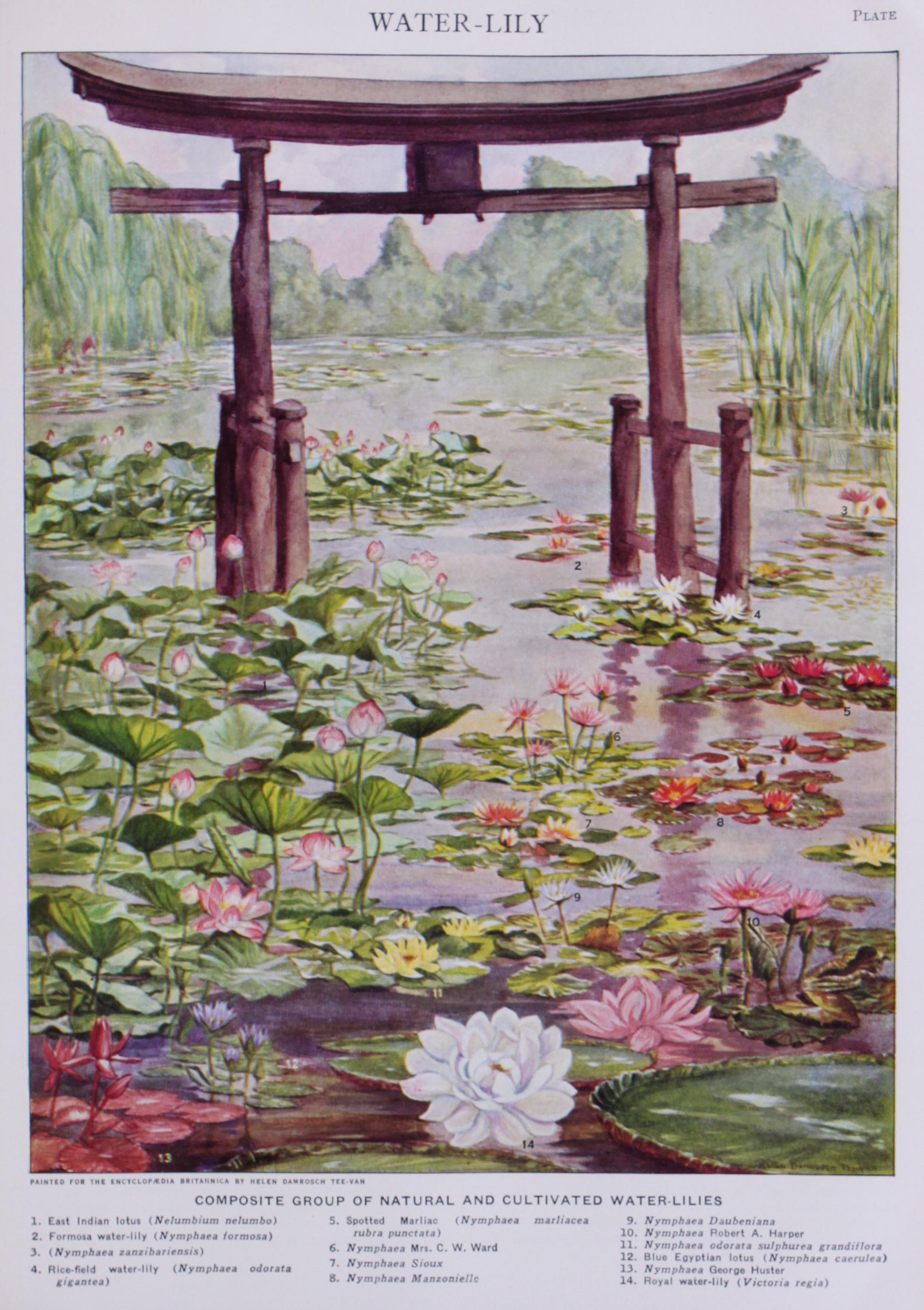
Nyrnphaea odorata, fragrant water-lily, and N. tuberosa, tuberous water-lily, are the conspicuous white water-lilies of eastern North America; Nuphar advenum is the common yellow water-lily or spatter-dock of the eastern States and Canada and N. polysepalurn, Indian pond-lily, is its counterpart on the Pacific coast; Brasenia Schreberi, the water-shield, with small yellow flowers, occurs across the continent.
Under the general head of water-lily are included the lotus of Egypt, Nymphaea Lotus, and the sacred lotus of India and China, Nelumbium speciosum, formerly a native of the Nile, as shown by Egyptian sculptures and other evidence, but no longer found in that river. Nelumbium luteum, of the eastern United States, is the American lotus or water chinquapin (q.v.). The gigantic Victoria regia, with leaves 6 to 7 ft. in diameter and flowers 8 to 16 in. across, also belongs to this group. It grows in the back waters of the Amazon, often covering the surface for miles: the seeds are eaten under the name water maize.