Fabric Structure and Designing
threads, gauze, warp and plain
Group 4. Crossed Weaving.
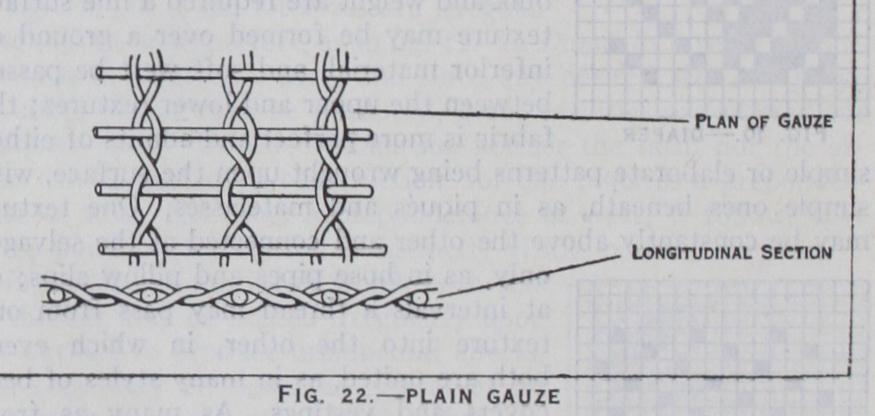
This group includes all fabrics, such as gauzes, in which the warp threads intertwist amongst themselves to give intermediate effects between ordinary weav ing and lace. Also those, such as Lappets, in which some warp threads are laid transversely in a piece to imitate embroidery. Plain gauze embodies the principles that underlie the construction of all crossed woven textiles. In these fabrics the twisting of two warp threads together leaves large interstices between both warp and weft. But although light and open in texture, gauze fabrics are the firmest that can be made from a given quantity and quality of material. One warp thread from each pair is made to cross the other at every pick, to the right and to the left alter nately, therefore the same threads are above every pick, but since in crossing from side to side they pass below the remaining threads, all are bound securely together, as in fig. 2 2, which shows a longitudinal section and also a plan of gauze. Leno is a muslin composed of an odd number of picks of a plain weave followed by one pick of gauze. In texture it is heavier than gauze, and the cracks are farther apart transversely. Fancy gauze may be made in many ways, such as (a) by using crossing threads that differ in colour or count from the remaining threads, provided they are subjected to slight tensile strain; (b) by causing some to twist to the right, others to the left simultaneously; (c) by combining gauze with another weave, as plain, twill, satin, brocade or pile; (d) by varying the number of threads that cross, and by causing those threads to entwine several ordinary threads; (e) by passing two or more weft threads into each crossing, and operating any assortment of crossing threads at pleasure.
Lappet weaving consists in diapering the surface of a plain or gauze fabric with simple figures. This is done by drawing certain warp threads into a transverse position and then lifting them over a thread of weft to fix them in the texture, after which they are moved in the opposite direction and lifted over the following pick, the cloth being generally woven with the face side down, The material between one binding point and another must float loosely, and this limits the usefulness of lappet figur ing. In fig. 23 the thick lines show a lap pet spot upon a plain texture.
Notwithstanding diverse structure, intricate machines are not essential to the production of either simple or complex textures; the most elaborate and beautiful specimens of the weaver's art have been manufactured upon simple machinery.