History of the Woodcut
colour, books, medium, century and religious
HISTORY OF THE WOODCUT The principle of cutting relief characters in metal, wood or stone has been practised far back toward the dawn of history. Cut metal plates were used in Egypt, India, Greece and Rome. Carved stamps or dyes were used for pressing letters into the moist clay of bricks in Egypt and for branding slaves in Rome. Both intaglio and relief carvings were known and used for these various purposes. Woodcuts were used in the Middle Ages to stamp monograms and to print colour designs on textiles, a cus tom practised in the Orient from time immemorial.
The earliest prints on paper so far found come from China of the T'ang dynasty (A.D. 618-905) when woodcuts in one colour were produced in great quantities as cheap substitutes for religious paintings. The oldest of such cuts now known is dated A.D. 868 and was found by Sir Aurel Stein in 1907 in the caves of a thousand Buddhas at Tun-huang in Chinese Turkistan. Throughout their history in China no artist of any note designed expressly for the woodcut. Even when the complex colour print ing from many blocks came into use, beginning, so far as is known, about the time that colour printing began in the Chiaroscuro prints of Europe, i.e., in the 17th century, this medium was used by craftsmen for the reproduction of paintings. The earliest known Chinese colour print is from a book called "Shih chu chai Shu hua p'u" and is dated 1625.
The method spread to Japan in the 8th century and for a long time was confined to reproducing popular religious figures. In Japan, however, there arose a whole school of artists who, though like the Chinese, still valuing painting as the supreme medium, did design expressly for the woodcut, thus conceiving their designs in terms of the carved line and colour block. The best of these were masters of the first rank.
For the greater part of their entire history, then, particularly as a reproductive process, woodcuts have been a widely used pictorial medium. Cheap in price, printed in quantity, close to the hearts and minds of common people in their choice of subject and story, they were used not as the collectors' items they have become to day, but in every home as part of the furniture of actual life.
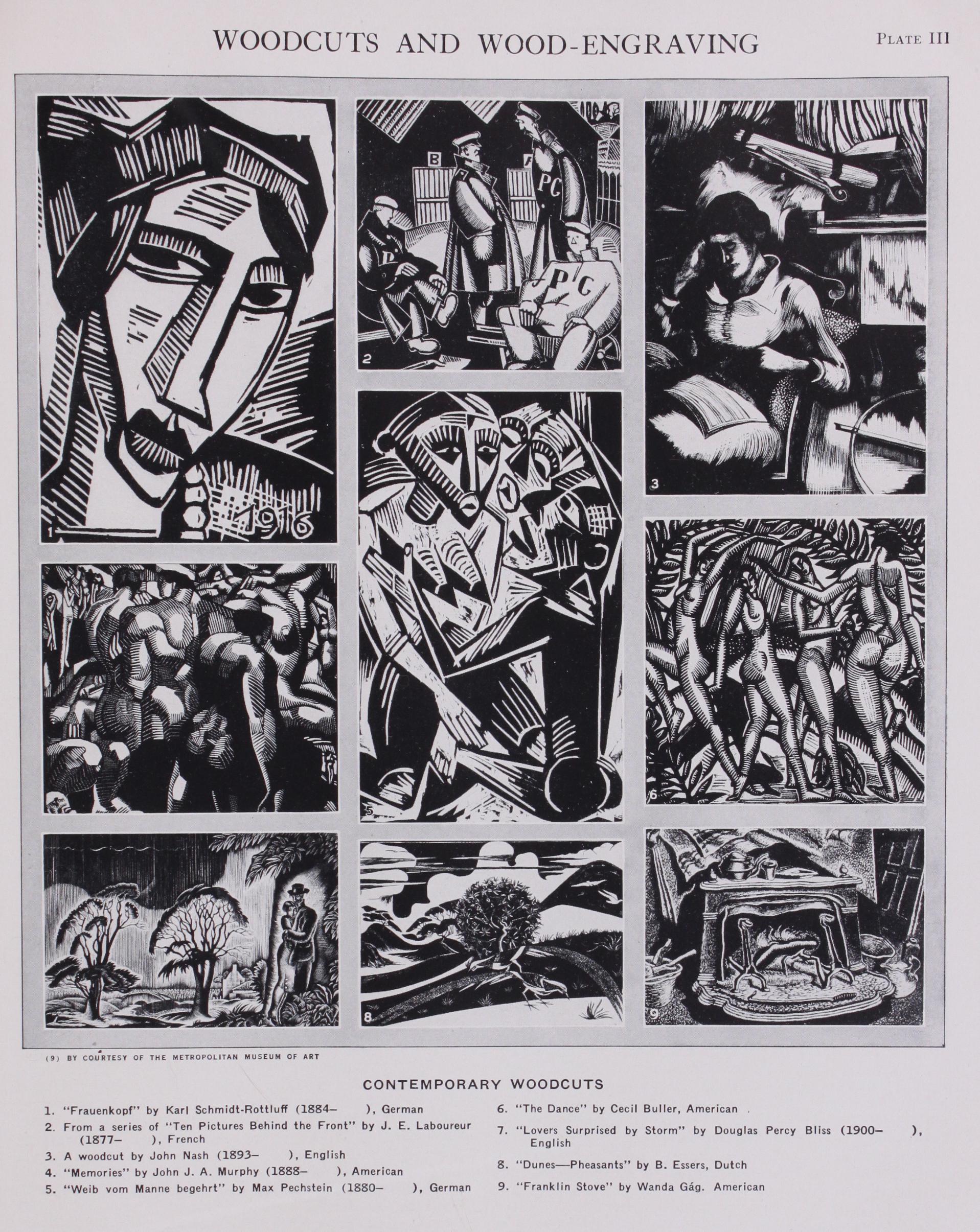
They were looked at, studied, talked about, absorbed. They took the part of picture books when books were still the hand-lettered creations of monks, chained to the "library" tables of churches and kings. They were books in embryo, in fact.
In the religious cuts (and in the beginning practically all were religious) the people could see the characters of the Christian drama intimately in a form different from but related to the great paintings in the churches. Brief printed captions began to appear beneath the pictures telling the story of their heroes. These cut into the block were the first type. Later, about 1436, when Gutenberg invented printing, cut into separate letters, they became the first movable type. When the printing of books began the woodcut inevitably became the means of illustration. Being pictorial type it went with letter-press type. In fact the harmony between text and illustration of the 15th and 16th centuries has never since been equalled in general practice. So right was the combination that even when, in the 18th century, taste ran to the greater elegance of copper plate engraving and the almost total abandonment of the woodcut, the latter still kept alive in incredibly rude form in chap books and other popular literature. It carried over in fact to the revival in the 19th century when again it became the main medium of illustra tion in press and books. Memory in this country can easily go back to its general use in magazines and elsewhere. The form was decadent as it gradually died out before the advance of the cheaper photo-engraving process, but it was still the medium of the people as it had always been. Taking its history as a whole through its great period in the 16th century, decline in the 17th, decay in the 18th and revival in the weakened form of the white line toned picture in the 19th, the woodcut is undoubtedly a close second to the book in the role of entertainer, instructor and guide to the human race in the last 500 years of its struggle toward its present civilization.