Ment 1930
school, college, west, virginia and coal
On the assessed valuation in 1932 ($1,671,276,370) a direct tax totalling $50,657,489 was levied by the State, counties, school dis tricts and municipalities. Out of each $1000 taxed, $0.76 was levied by the State, $5.48 by counties, $6.51 by school districts and $2.45 by municipalities in 1935. Including the property tax, the State collected during the fiscal year ending June 30, 1936, a total of $123,924,249 from all revenues. Of this $12,329,920 was derived from a gross sales tax. A sales tax of four cents a gallon on gasolene (raised from two cents in 1927) netted $6,411,191. An inheritance tax contributed $509,946. The remainder was obtained from miscellaneous sources. Total receipts for the year contrasted with total disbursements of $120,660,390 leave a balance of $8,752,050. For the year ending June 30, 1935, the receipts were $116,057,481 and the disbursements $117,881,418 leaving a bal ance of $5,488,191. In 1915 the amount of the debt to Virginia, which had been in controversy since the Civil War, was fixed by the U.S. Supreme Court at $12,393,929, plus 5% interest until paid. Besides this debt, the State had incurred a bonded debt of $78,950,000 for highway construction. Money to pay the annual interest and sinking fund is derived from auto licences and the gasolene sales tax. The total bonded indebtedness on July 2, 1936, was $85,330,800.
On June 30, 1936, there were in the State 185 banks (79 of them national banks) with resources and liabilities totalling $322, 979,000. The capital, surplus and undivided profits amounted to $46,705,000. The deposits were $272,986,000, of which over $110,000,00o were on time accounts.
Education.
Rapid progress in education between 1930 and 1934 is shown by the increase in the public school enrolment from tO 434,864, the increase in the days of attendance per pupil from an average of 146.6 to 151.1 per year, but a decrease in public school expenditures from $28,219,000 to $19,761,000 or from $71.35 to $45.44 per child of school age. The expenditures per pupil but not the days of attendance per pupil are still below the averages throughout the United States as a whole, but they represent an increase sufficient to place West Virginia in the lead of all other States south of the Mason and Dixon line except Maryland and Delaware. Of the 1934 enrolment 355,958 were in the kindergartens or elementary schools. High school enrolment increased from 48,814 in 193o to 78,906 in 1934, of whom 4,391 were enrolled in the coloured high schools. There were in 1934, 11,554 elementary and 4,474 high school teachers to whom a total of $13,503,000 was paid in salaries. There were, in 1934, 8,909 pupils in private schools.
The New River State school at Montgomery and the Potomac State school at Keyser came into existence as State-supported pre paratory schools at a time when there was a dearth of public high schools. They continue to offer the final two years of prepara tory work and have added the first two years of college work, so that they operate as junior colleges. There were in 1936 six State normal schools for whites. Three of them, located at Huntington, Fairmont and Athens, gave complete four-year teacher's courses. One, located at Glenville, gave a two-year normal course, while the remaining two, located at West Liberty and Shepherdstown gave both a two-year normal and a two-year junior college course.
Bluefield Coloured Institute at Bluefield, serving the coloured population in the southern part of the State, gives a regular high school course, plus normal and junior college courses. West Vir ginia Collegiate Institute at Institute, also serves the coloured population, offering preparatory, normal and college courses. There are State schools for the white deaf and blind at Romney and for the coloured at Institute. West Virginia university is located at Morgantown, and is divided in its organization into colleges of arts and science, engineering, agriculture, law and school of medicine and pharmacy. Private denominational colleges of importance are Bethany college at Bethany, West Virginia Wesleyan college at Buckhannon, Davis and Elkins at Elkins, Greenbriar college (for women) at Lewisburg, Salem college at Salem and Morris Harvey college at Barboursville.
Charities and Corrections.
In 1936 there were 21 State hospital, correctional or penal institutions in operation, all of them managed and governed by the State board of control. The governor appoints the chief executive officer or head of each in stitution. There is a State board of children's guardians which has control and custody over dependent and neglected children.
Mines and Quarries.
The extraction of minerals is the most important industry in the State. Mineral products were valued at $346,565,000 in 1929, and $241,474,000 in 1934. In 1923 West Virginia ranked second among the States in total value of its min eral output, but by 1934 it dropped to fourth place. The decrease in the value of the coal output and the increased value of petro leum produced in other States were chiefly responsible for the de crease in rank. Next to coal the chief minerals, according to the value of their 1934 output, were: natural gas, clay products, petro leum, coke, stone, sand and gravel and natural gas gasolene.
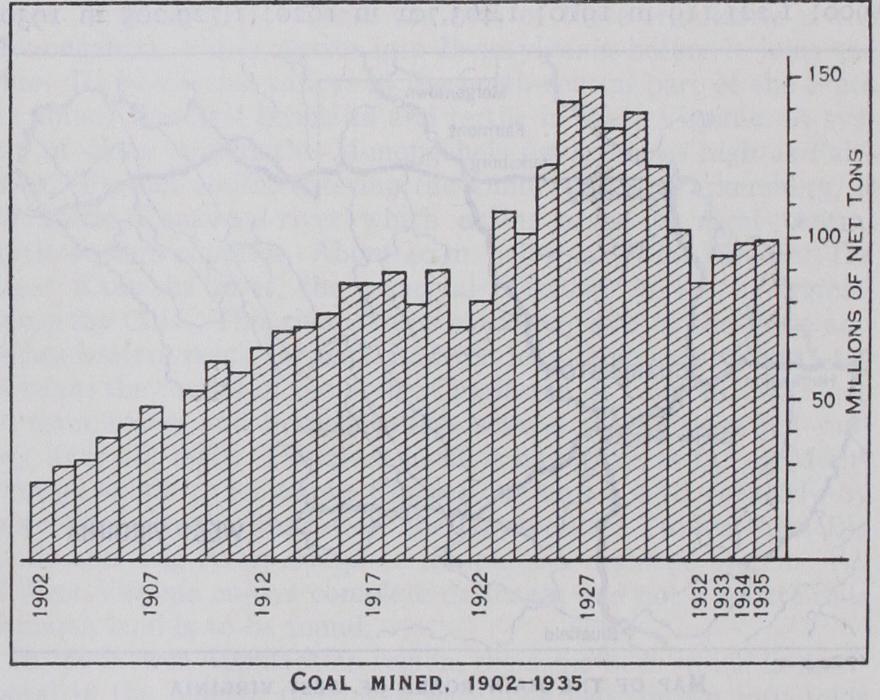
The production of coal has increased with remarkable rapidity. In 1924, for the first time the State's production exceeded 100,000,000 tons. In 1929 it amounted to 139,297,946 tons, but by 1932 it fell to 86,114,506 tons, a decrease of approximately 6o,000,000 tons in three years, but in 1935 it had risen to 99, 810,908 tons. In 1935 the output was far above that of Pennsyl vania, formerly the leading State in the production of bitumi nous coal. It amounted also to more than one-fourth the supply of bituminous coal mined in the United States in that year. During 1934 there were 60o companies reporting 764 operating coal mines. The total of all men employed in connection with the coal mines was 105,906. During the year 1934 the average number of tons mined per man per day was 4.17 and the average production per mine was 129,000. Mines operated an average of 155 days in 1924 and 196 days in 1934. The State department of mines regu larly inspects all mines and maintains mine rescue stations at Charleston, Kilsythe, Elkins, Meadowbrook and Williamson. Be tween 1930 and 1935 labour troubles were frequent in the mining districts, due mainly to the determined attempts of the unions to organize the West Virginia miners. During the unrest attending the formation of the C.I.O., however, West Virginia remained generally quiet. At the present rate of consumption West Virginia alone could supply the whole United States with coal for 25o years to come.