Wasp
wasps, cells, solitary and species
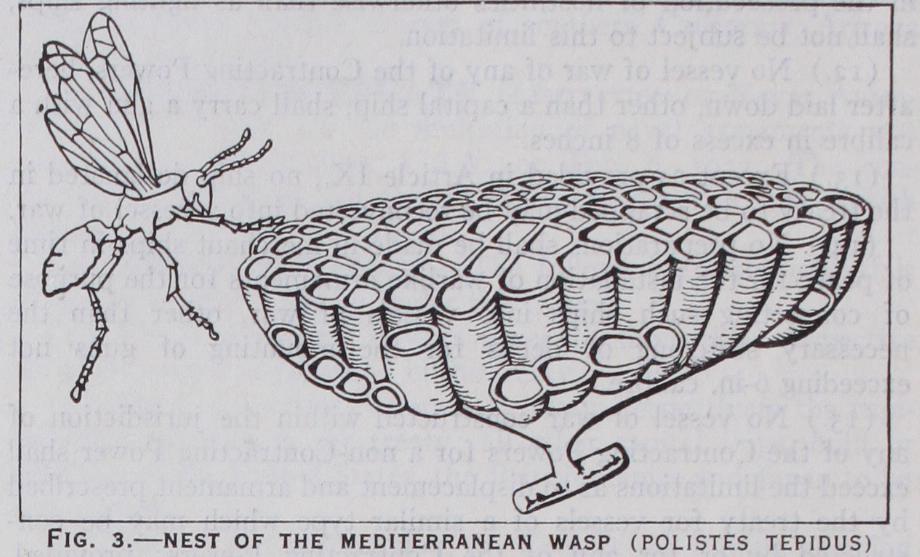
WASP, the ordinary name for a well-known kind of stinging insect belonging to the order Hymenoptera (q.v.). At least ro,000 species of wasps are known and unlike bees, they are primarily predacious in habit, feeding their young mainly upon other insects. They form two great groups, Sphecoidea and Vespoidea, with the vast major ity of the species solitary in habit. Most of these solitary kinds are known as fossorial or digging wasps, from the fact that so many of them make receptacles for their young by excavating burrows in the ground or tunnel ing in wood or in stems of plants. The true wasps form a separate section of the Vespoidea and were formerly grouped into a single division—the Diploptera, in allusion to the fact that the fore wings are longitudinally folded when at rest. They are further distinguished from other wasps by the posterior lateral angles of the pronotum, which end above the tegulae. They include three families, one of which, the Vespidae, consists of social species and includes the wasps most familiar to the ordi nary observer : for these see SOCIAL INSECTS. The Eumenidae are solitary wasps and the best-known genera are Eunienes and Odynerus. These insects have the curious habit of suspending their eggs by slender threads from the roofs of the cells in which they are laid. Each cell is commonly provisioned with several
caterpillars previously paralysed by stinging. In Eumenes the abdomen is joined to the thorax by a slender petiole or stalk: they are potter wasps making neat vase-like cells attached to stems or other objects. In Odynerus the petiole is wanting and the cells are made on walls, in wood, or in the ground; some species utilize key holes or even deserted cells of other wasps. Both genera occur in Great Britain and North America. The third family, or Masaridae, is chiefly tropical and remarkable because its cells are provisioned with a paste of honey and pollen. The species are all solitary and have the wings either incapable of being folded or imperfectly plicate.
See E. Saunders, Hymenoptera Aculeata of the British Islands (1896) ; P. and N. Rau, Wasp Studies Afield (Princeton, N.J., 1918) ; G. W. and E. G. Peckham, Wasps, Solitary and Social (Boston and New York, 1905) ; E. Berland, "Hymenopteres Vespiformes," Faune de France, vol. x. (1925). (A. D. I.)