Watches
invention, century, time, escapement and called
WATCHES. The word watch by derivation means that which keeps observation. It is thus the term for the body of persons who patrolled the streets, called the hours, and performed the duties of the modern police. The application of the term to a period of time is due to the military division of the night by the Greeks and Romans into watches marked by the change of sen tries; similarly, on shipboard, time is also reckoned by watches, and the crew is divided into two portions, the starboard and port watches, taking duty alternately.
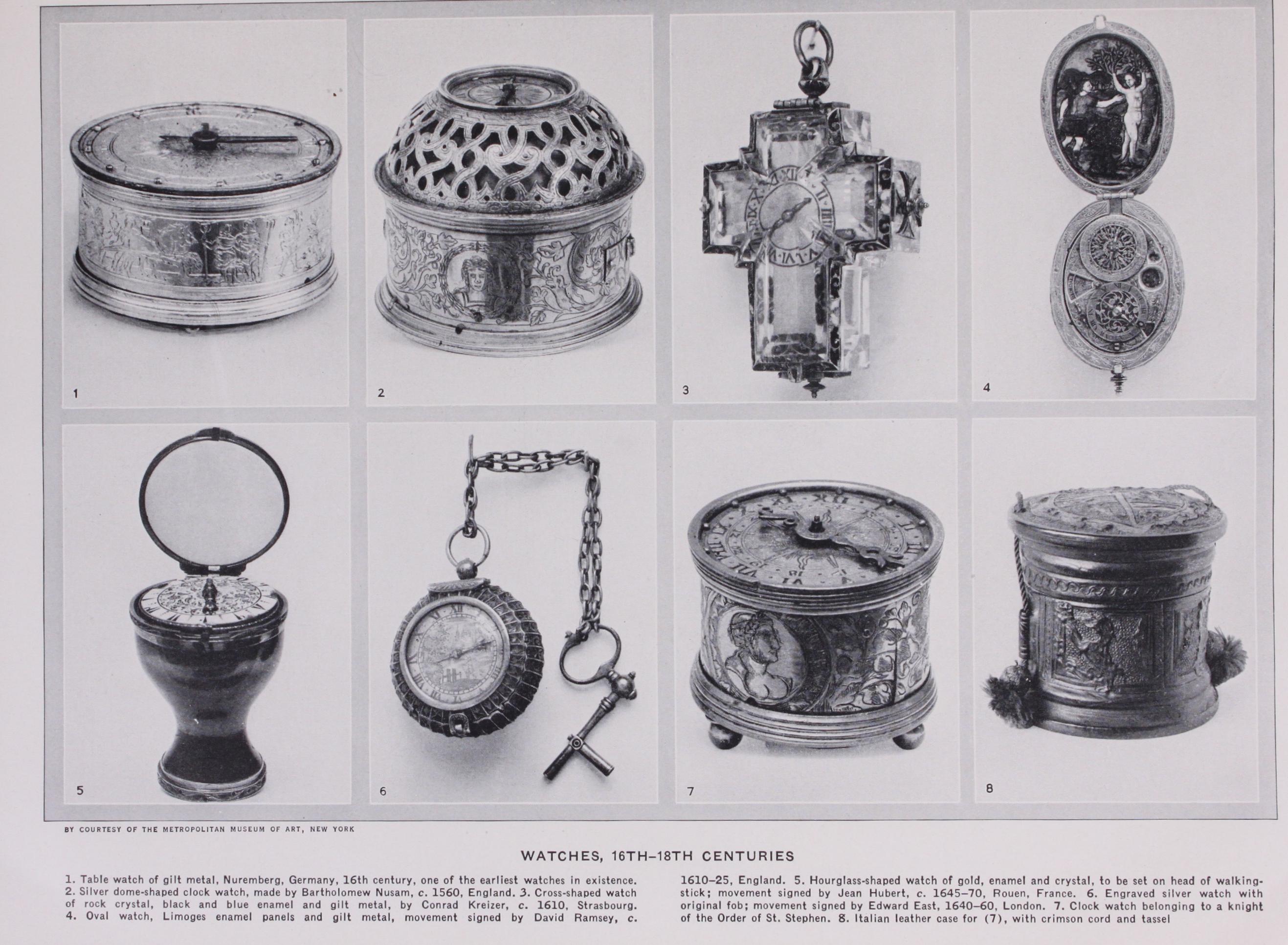
The invention of portable timepieces dates from the end of the 15th century, and the earliest manufacture of them was in Ger many. They were originally small clocks with mainsprings en closed in boxes; sometimes they were of a globular form and were often called "Nuremberg eggs." Being too large for the pocket they were frequently hung from the girdle. The difficulty with these early watches was the inequality of action of the main spring. An attempt to remedy this was provided by a contriv ance called the stack-freed, which was little more than a sort of rude auxiliary spring. The prob lem was solved about the years 1525-40 by the invention of the fusee. By this contrivance the mainspring is made to turn a barrel on which is wound a piece of catgut, which in the latter part of the 16th century was replaced by a chain. The other end of the catgut band is wound upon a spiral drum, so contrived that as the spring runs down and becomes weaker, the leverage on the axis of the spiral increases, and thus gives a stronger impulse to the works (fig. I).
In early watches the escapement was the same as in early clocks, namely, a crown wheel and pallets with a balance ending in small weights. Such an escapement was, of course, very imperfect, for since the angular force acting on the balance does not vary with the displacement, the time of oscillation varies with the arc, and this again varies with every variation of the driving force. An immense improvement was therefore effected when the hair-spring was added to the balance, which was replaced by a wheel. This
was done about the end of the 17th century. During the 18th century a series of escapements were invented to replace the old crown wheel, ending in the chronometer escapement, and though great improvements in detail have since been made, yet the watch, even as it is to-day, may be called an 18th-century invention.
The watches of the 16th century were usually enclosed in cases ornamented with the beautiful art of that period. Sometimes the case was fashioned like a skull, and the watches were made in the form of octagonal jewels, crosses, purses, little books, dogs, sea shells, etc., in almost every instance being finely engraved. Queen Elizabeth was very fond of receiving presents, and a number of the gifts presented to her were jewelled watches.
The man to whom watch-making owes perhaps the most was Thomas Tompion (I639-1713), who invented the first dead-beat escapement for watches. But a defect remained, namely, the in fluence of temperature upon the hair-spring of the balance-wheel. Many attempts were made to provide a remedy. But the best solution of the problem was ultimately proposed by Pierre le Roy (1717-85) and perfected by Thomas Earnshaw This was to diminish the inertia of the balance-wheel in propor tion to the increase of temperature, by means of the unequal expansion of the metals composing the rim.
Invention in watches was greatly stimulated by the need of a good timepiece for finding longitudes at sea, and many successive rewards were offered by the Government for watches which would keep accurate time and yet be able to bear the rocking motion of a ship. The difficulty ended by the invention of the chronometer, which was so perfected towards the early part of the 19th cen tury as to have even now undergone but little change of form. In fact the only great triumph of later years has been the invention of watch-making machinery, whereby the price is so lowered that an excellent watch (in a brass case) can now be purchased for about £2, and a really accurate timekeeper for about £18.