Whale Fisheries
boilers, factory, whaling, warp and usually
Whaling in the main Atlantic, the Pacific and the Antarctic was developed chiefly from the Newfoundland ports, and from Nan tucket and New Bedford. Before 1700 the industry had passed through most of the coastal stages. Part was taken in the Green land fishery, and from the capture of a sperm whale (Physeter catodon) offshore in 1712, American whaling spread down the whole length of the Atlantic, and before 1800 had reached the Pacific. The industry grew rapidly and was well established by the Revolution. Notwithstanding the vicissitudes of wars, from which American whaling suffered, perhaps, even more than did the European industry, a marked power of recovery was always shown. Shortly before 185o the fleet numbered 68o sail in all; and all but 40 odd ships were employed in the Pacific in the pursuit of sperm and right whales. About the same date the right whales found in the neighbourhood of Bering strait, the bowheads, were hunted for the first time. The value attached to sperm oil, which was used for both ointments and candle making, had much to do with this development. A similar recovery followed the American Civil War; but the use of petroleum for lighting, and the more con stant prospects offered to capital in other industries, caused American whaling to dwindle away. By 190o the sperm whaling was nearly entirely dead, and the main whaling that of the small fleet following the bowhead. The grey whale, Rhacinactes glaucus, was also hunted in the lagoons of the western coast, but did not long en dure the destruction. In the fisheries of the open sea mentioned above (all south of the Arctic) Great Britain took an active part. They were first in the Pacific and predominated for a time in the Indian ocean ; their participation, however, began in 1775 and lasted less than a century. The hardships of these fisheries, known collectively as the Southern Whaling, must have been extreme. The ships were away three or more years and provisioned accordingly. Their crews must endure and work in tropical conditions, and in the rigorous climate of South Georgia and even of more southern latitudes. The attack by open boats (though usually four worked together) in mid ocean, with the added possibility of being towed out of sight of the mother ship, and the risk of fire in such whalers as tried out the blubber on board, must have made the calling hazardous in the extreme.
Modern Whaling.
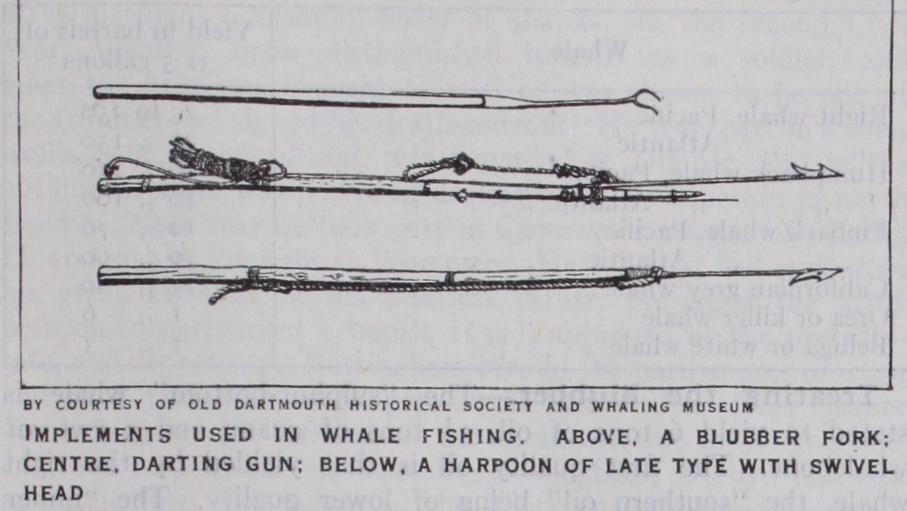
The Sven Foyn gun was first used near the Norwegian coast ; it was carried on small steamers, and the whales, being taken near shore, were towed back to harbour for flensing and extraction of oii. The harpoon, which weighs over 100 lb., is some 4 ft. long. The cap contains an explosive and a time fuse, which sets it off three seconds after striking. The head behind the cap has four hinged 12 in. barbs, which open out in the body of the whale. The warp is attached to a ring, which is free to slide along a groove running nearly the whole length of the shank; when ready for use, Lhe head, forepart of the shank and ring are in front of the gun-barrel, and the first part of the warp is coiled on a plate projecting over the ship's bows and immediately below the gun. A charge of 220 grammes of explosive such as ballisite or of black powder is used, in a cotton bag which is fastened to an hourglass-shaped wooden buffer, ended with rubber discs, and fit ting the barrel. This buffer acts as tamping, and disappears on dis charge. With the explosive named the barrel remains clean. The guns used are mostly muzzle loaders, though breech loaders are available. The range is usually 3o to 4o yards. The first discharge is sometimes immediately fatal, and slaughter is, in many cases, quicker than with the older methods.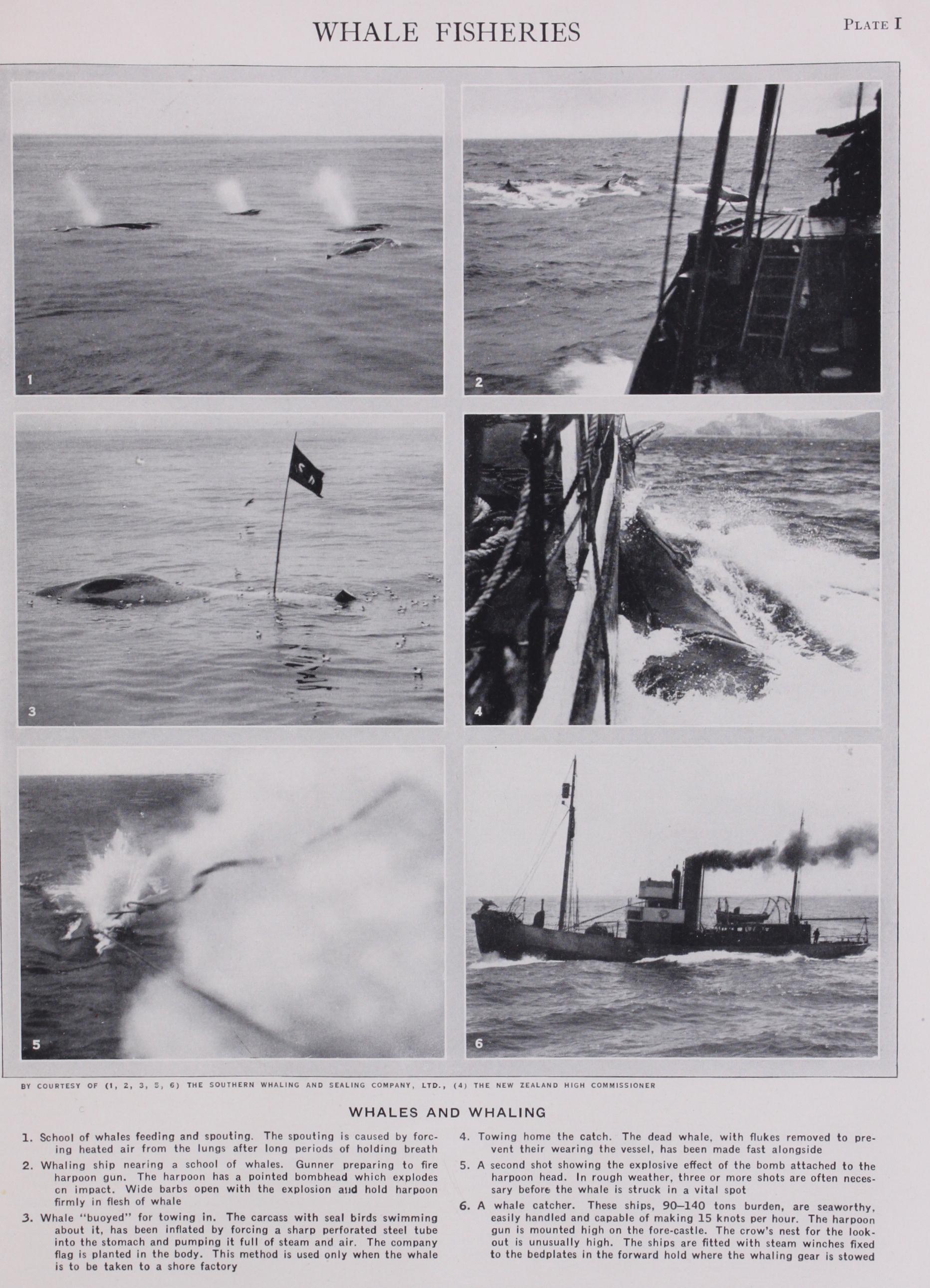
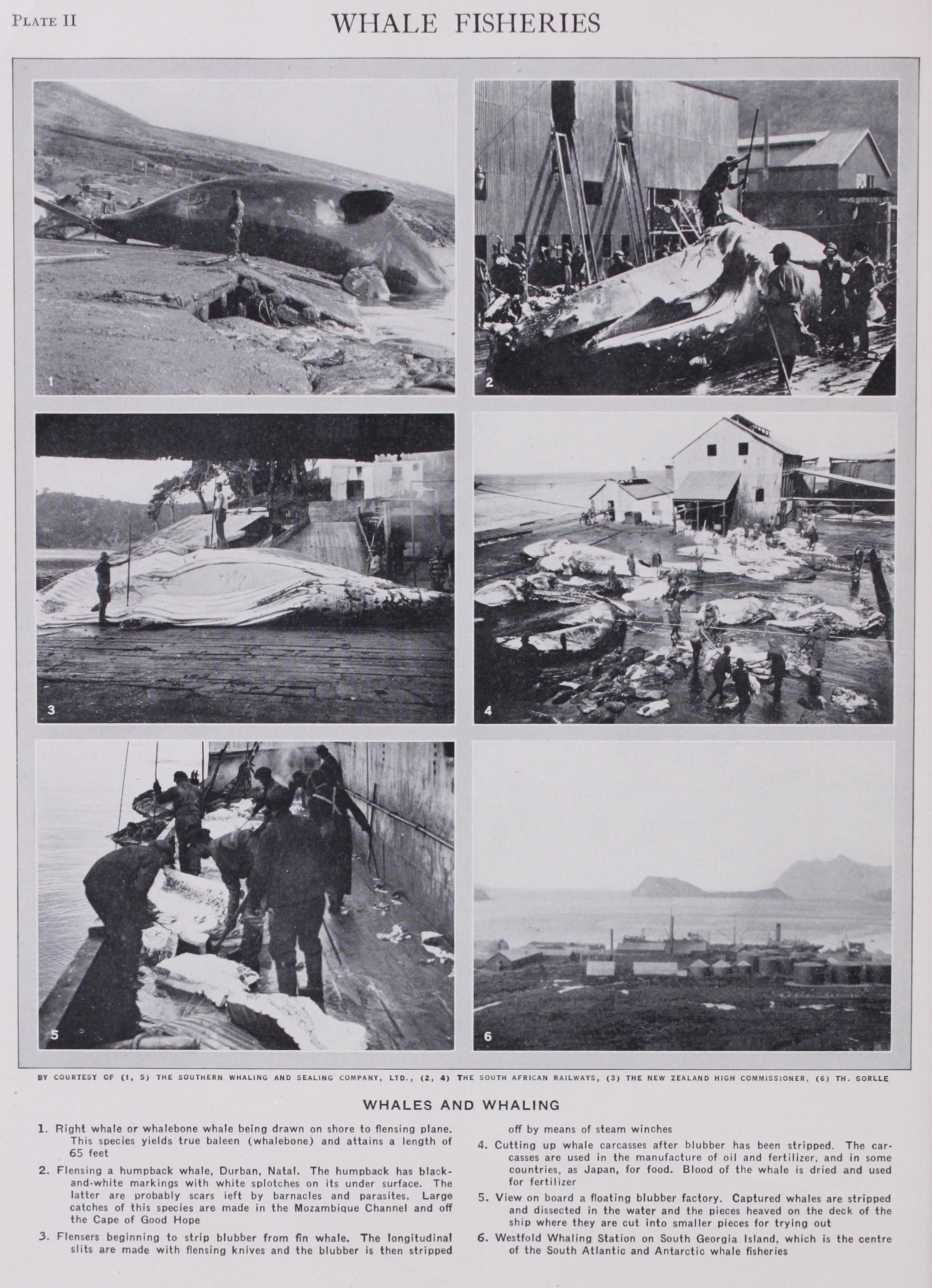
The "catchers" have grown in size, power and speed. They can now, though not without difficulty, travel from the Cape to South Georgia under their own power. Essentially they are small steam
ers with fore-foot much cut away for facility in turning, with a high bow on which the gun is mounted, built with a pronounced flare to minimize the shipping of water at the gun. A first class boat will exceed 200 tons gross, and is about 13o ft. long. She has a powerful winch, and to reach it the warp passes from the bows over a sheave or pulley on the mast, which in turn is suspended by a warp which communicates with two powerful accumulator springs lying along the keel of the ship; excessive and sudden strain on the warp is in this way minimized. The main length of warp is not on the winch drums, but in bins on each side of the hold, from which it is paid out to them. A good catcher will have a speed of 14 knots and a complement of i r men, under the gunner, who is also the master. Several catchers, usually from three to six, work in co-operation with one factory.