Wheat Production in America
red, united, export, quantities and winter
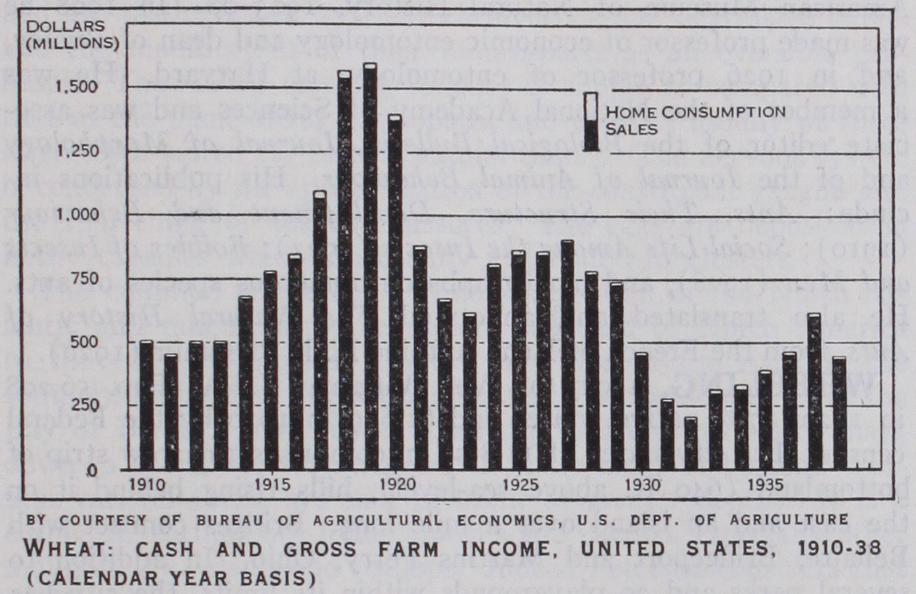
Consumption of wheat per capita increased in America until about the end of the last century. This was due to increasing prosperity, abundance of cheap wheat, improved milling and bak ing, and increasing population in cities where bread was largely used in a somewhat restricted dietary. More recently per capita consumption seems to be decreasing. Among the causes are (a) increasing buying power of the workers in industry, (b) broaden ing dietary due to greater production of truck crops around cities, refrigerator transportation, cold storage, and household refrigera tion, (c) campaigns against white bread (probably a temporary influence), and (d) relatively higher price of wheat. While the influence of these different factors may vary in the future, it is doubtful if the per capita consumption ever will rise to its former level. On the other hand, many peoples in other lands, now sub sisting chiefly on millets, grain sorghums, and rice, may eat more wheat when it is economically possible. (C. R. BL.) Wheat Trade in the United States.—More than two-thirds of the wheat crop of the United States enters into domestic trade. Exports average around i oo,000,000bu. a year, or about 18% of the international trade in wheat, although in some years the United States has exported two and three times that amount, be cause of bumper crops at home and short crops in other wheat exporting countries. While the United States for many years never failed to have an export surplus, the droughts of 1934 and 1936 resulted in net imports for three seasons but with the large crop of 1937 the export status was resumed.
Most of the wheat entering into trade is produced west of the Mississippi river. The Great Plains States from Texas north and Oregon, Washington and Idaho produce large quantities of wheat in excess of local requirements.
Most of the surplus of the northern Great Plains moves to Minneapolis, a large milling centre, or to Duluth for shipment to eastern mills or to the Atlantic Coast ports for export. Much of the grain from the central Great Plains moves through Chicago, St. Louis and Milwaukee for eastern milling centres and for ex port, and from the central and southern Great Plains to Kansas City or smaller primary markets for milling, or to New Orleans and Galveston for export.
The most important concentration point on the Pacific Coast is Portland.
The diversity of the wheat of the United States is an important factor in its marketing. Each of the five leading commercial classes of wheat is produced within a reasonably well defined region from which it is regularly marketed. Most of the hard red spring is produced in the northern States, Minnesota, the Dakotas, Wisconsin, and Montana. Most of the durum is produced in North Dakota, South Dakota, and Minnesota. The hard red winter wheat is the product of the southern and central Great Plains, whereas the soft red winter wheat is the product of the more humid southern and eastern parts of the United States.
There are two chief centres of white wheat production, the eastern lake states, the Pacific Coast states and Idaho. A very large part of the hard red spring wheat is marketed through Minneapolis or Duluth and practically all of it is annually con sumed within the United States. A large proportion of the durum is marketed through Minneapolis and Duluth and a large part of the durum marketed is for export, mostly through Duluth. The most important hard red winter wheat market is Kansas City but large quantities of this wheat also move through Chicago, St. Louis, New Orleans and Galveston. There is nearly always a sur plus of this wheat for export. A large proportion of the soft red winter wheat is consumed within or near the areas of production. St. Louis is an important primary market for this class of wheat. Considerable quantities are distributed through eastern markets and small quantities are exported. On the average, however, there
is very little soft red winter wheat available for export. Small quantities are normally produced for export from the Pacific Coast states. Most of the white wheat produced in the eastern states is used locally while considerable quantities of western white wheats are exported. In years of normal production in all classes considerable quantities of hard red winter, durum and white wheats are exported, but only small amounts of soft red winter and hard red spring wheats.
Wheat: Exports from the United States, by classes, for nine years Agricultural Statistics 1938, United States Department of Agriculture. *Less than Soo bushels.
Activities of the U.S. Government in aid to the growing and marketing of wheat, and other farm crops, have centred chiefly in the Federal Farm Board, from 1929 to May 26, 1933, when it was succeeded by the Farm Credit Administration, which in turn was succeeded by the Agricultural Adjustment Administration and other governmental agencies.
In 1938, eight years after the Federal Farm Board's unpopular campaign to reduce the U.S. wheat acreage, the AAA proposed that the 1939 wheat crop be limited to 55,000,000ac., which, un der normal conditions would produce about 66o,000,000 bushels. The normal disappearance of wheat in the U.S. is about 68o,000, 000bu. a year. The ever-normal granary program was inaugurated in 1938 with provisions for Government loans on stored grain. The AAA also instituted in 1938 its wheat insurance program by which growers may be insured 5o to 75% of a crop. The largest grain markets are Minneapolis, with terminal elevators of 91,685, 000bu. capacity; Kansas City, 6o,o32,000bu. elevator capacity; Chicago, 54,226,000; Duluth and Superior, 50,875,000; Buffalo, 50,378,000; Omaha and Council Bluffs, 26,485,00o. Minneapolis and Kansas City are the largest cash markets. The Chicago mar ket does 87% of the country's trading in futures. In recent years Buffalo has superseded Minneapolis as the most important milling centre, owing in part to the development of a considerable amount of milling Canadian wheat in bond. (0. C. S.; X.) WHEATEAR, Oenanthe oenanthe, one of the earliest spring migrants, often reaching England by the end of February. The cock bird, with his bluish-grey back and light buff breast, set off by black ear-coverts, wings, and part of the tail, is rendered con spicuous in flight by his white rump. When alarmed both sexes have a sharp monosyllabic note that sounds like chat. The nest is placed underground; a large amount of soft material is col lected, and on it from five to eight pale blue eggs are laid. Wheat ears were formerly trapped for the table in enormous numbers on the Downs. The wheatear ranges throughout the Old World. It also breeds in Greenland and some parts of North America. About eight species are included in the European fauna; but the major ity are inhabitants of Africa. Several of these are birds of the desert. Amongst allied genera is Saxicola which includes two well known British birds, the stonechat (q.v.) and whinchat (q.v.). The wheatear and its allies belong to the family Turdidae, the thrushes (q.v.).