Worcester
teme, charles, severn, bank and bridge
Battle of Worcester, 1651.
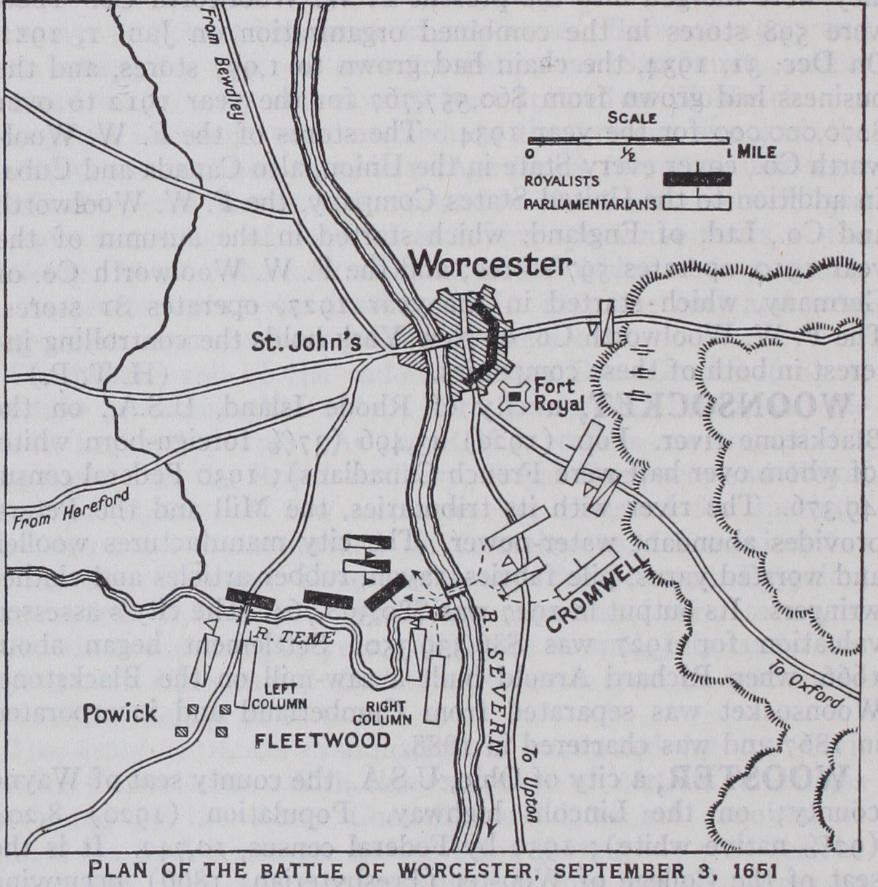
Early in Aug. 1651 (see GREAT REBELLION) Charles II. crossed the Scottish border with 16,000 men, nearly all Scots, in a last attempt to regain the English throne by invasion. His first intention was to march on London, hoping that recruits would flock to his standard; on the contrary, the local militia everywhere took arms to oppose him, Cromwell's cavalry clung to his flank and heels, and Cromwell himself fol lowed a few days' march behind. In despair Charles turned west ward, still hoping for a rising in his favour, and on Aug. 22 reached Worcester, where he was brought to bay. Worcester lies on the left bank of the Severn, with a small suburb, St. John's, on the right bank, a bridge connecting the two. The city was fortified, but its walls had been demolished in 1646 and, though partially restored, presented in 1651 no formidable obstacle. Fort Royal, outside the south-eastern gate, was still of some strength, and this and the rest of the fortifications were now strengthened by Charles to the best of his limited means. The nearest bridges to Worcester were at Upton, 6 m. down stream, and Bewdley, 15 m. north. Bewdley bridge was already in the hands of the Parliamentarians, but Upton bridge the Royalists destroyed; on Aug. 28, however, it was seized by Lambert and repaired, Charles' last hope of commanding a considerable stretch of west country being thus snatched from him. None the less, his position was a strong one. About a mile below Worcester the river Teme joins the Severn, making a formidable obstacle to an advance up the right bank of the Severn from the south, whilst a smaller stream, running into the Teme from the north, formed some defence for the western approach to St. John's. If only the walls of the city itself on the left bank had been in their proper condition Charles might well have held out for a considerable time. The king posted the main body of his army between the Severn and the Teme, using the city and its walls as a bridge-head. Cromwell himself reached Worcester on the 28th, and found himself in command of about 30,00o men, with many thousands more, chiefly militia, within a few days' march. He at once reconnoitred the Royalist position and, realizing that Charles could, by reason of Worcester bridge, operate upon either bank, decided that his numerical superiority entitled him to divide his army and to act simulta neously upon both. He directed Fleetwood to advance up the right bank of the Severn, force the passage of the Teme, and destroy the Scottish forces between that river and Worcester; he himself would attack Fort Royal and the city. To connect the two opera tions a bridge of boats was to be laid across the Severn just above its junction with the Teme, and a similar bridge across the Teme close to its junction with the Severn. A force of cavalry was sent to Bewdley to cut off the Royalists' line of retreat to the north. The preparation of the bridges took a few days, but the time was well employed by Cromwell's guns on the high ground east of the city, which pounded the fortifications mercilessly and reduced the already exhausted defenders to a state of despair. Sept. 3, theanniversary of his great victory at Dunbar, was chosen by Crom well for the day of his attack, and its watchword, "The Lord of Hosts," repeated. Fleetwood advanced in two columns, that on the right being directed upon the junction of the Teme and Severn, where the bridges were to be laid, that on the left against Powick, just north of which a bridge crossed the Teme. Little opposition was met with till the Teme was reached, but here the Scots were found to be in great strength, whilst the road bridges over this river, both at Powick and further west, had been destroyed. The left column's attempt to cross the Teme was repulsed with some loss, but in the meantime the bridge of boats had been successfully thrown across the Severn and Cromwell himself led a brigade of horse across on to the right bank. The second bridge over the Teme was quickly laid, and Fleetwood's right column joined Crom well's horse, which had been already reinforced by foot. For a time the Scots fought fiercely to recover their river defences, but the odds against them were too heavy and they fell slowly back towards St. John's. Fleetwood's left column now crossed near Powick and it looked as if the battle would soon be over. But Charles was soldier enough to make the one throw still left to him, and for which his dispositions had been designed. Seeing that Cromwell had transferred a considerable part of his own force to the right bank to join Fleetwood's attack, the king decided to make a sortie from his bridge-head on the left bank and strike the re mainder of the Parliamentary forces still lying on that side of the river. Issuing from the walls under cover of Fort Royal, Charles' cavalry supported by such infantry as he could collect, made a furious attack upon the troops opposing them. The militia wavered, but they were stiffened by two regiments of regulars, and before long cavalry joined in the fight. For an hour or more the issue was in doubt, but Cromwell, warned of the danger, recrossed the Severn with reinforcements and gradually forced the exhausted Scotsmen back within the walls. Following close upon their heels, Crom well's men burst into the city and, before any fresh resistance could be organized, had fallen upon the unfortunate Scotsmen and put them to the sword. Panic spread like wildfire through the city and, in spite of all the efforts of Charles and his generals, the Royalist army dissolved into a rabble of fugitives. Fleetwood blocked the line of retreat to the west but some of the cavalry, including Charles himself, escaped northwards, though most of them were cut down or captured in the relentless pursuit. Charles himself got clear away to France, but his army was completely de stroyed-3,00o of his men were dead, more than ro,000 prisoners —whilst the Parliamentarians admitted a loss of but 200 men. The "Crowning Mercy" was complete.