
BULL RUN, a small river in Virginia, U.S.A., which gave the name to two famous battles in the American Civil War.
(I) The first battle of Bull Run (called by the Confederates Manassas) was fought on July 21, 1861, between the Union forces under McDowell and the Confederates under Gens. Joseph E. Johnston' and Beauregard. Both armies were newly raised and almost untrained. After a slight action on the 18th at Blackburn's ford, the two armies prepared for a battle. The Confederates were posted along Bull Run, guarding all the passages from the stone bridge down to the railway bridge. McDowell's forces concen trated around Centreville, and both commanders, sensible of the temper of their troops, planned a battle for the 21st. On his part McDowell ordered one of his four divisions to attack the stone bridge, two to make a turning movement via Sudley ford, 2m. dis tant; the remaining division (which had a stiffening of regular troops) was to be in reserve and to watch the lower fords. The local Confederate commander, Beauregard, had also planned a turning movement by the lower fords against the Federal left, but Johnston, who arrived by rail on the evening of the 2oth with reinforcements, now assumed command of the whole force. The change in control caused delay, orders miscarried, and the Federal attack opened before the movement had begun. Johnston and Beauregard then decided to fight a defensive battle, and hurried up troops to support the single demi-brigade of Evans which held the stone bridge. Thus there was no serious fighting at the lower fords of Bull Run throughout the day.
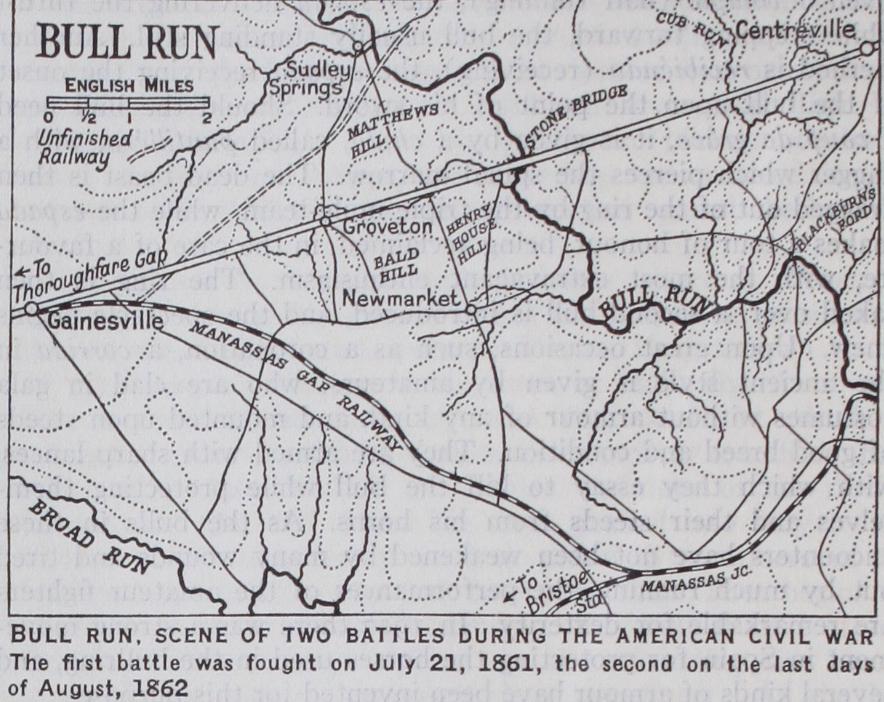
The Federal staff was equally inexperienced, and the divisions engaged in the turning movement were two hours late at Sudley ford. At 6 A.M., when the troops, told off for the frontal attack, appeared before the stone bridge, the turning movement was by no means well advanced. Evans had time to move II of his 15 companies to Matthews hill, covering Sudley springs, leaving the rest to hold the stone bridge, and he was promptly supported by the brigades of Bee, Bartow and T. J. Jackson. About 9:3o the leading Federal brigade from Sudley springs came into action ; two hours later a flank threat by two other brigades, which had crossed at an intermediate ford, drove Evans, Bee and Bartow from Matthews hill in considerable confusion. But on the Henry House hill Jackson's brigade stood, as Gen. Bee said to his men, "like a stone wall," and the defenders rallied, though the Federals were continually reinforced. The fighting on the Henry House hill was very severe, but McDowell, who dared not halt to re-form his enthusiastic volunteers, continued to throw in piecemeal attacks. About I :3o P.M. he brought up two regular batteries to the fight ing line ; but a Confederate regiment, being mistaken for friendly troops and allowed to approach, silenced the guns by close rifle fire, and the Federal attack, despite repeated efforts, made no further headway. By 4 P.M. some more of Beauregard's troops came up; Jackson's brigade charged with the bayonet, and at the same time the Federals were assailed in flank by the last brigade of Johnston's army, which arrived at the critical moment from the railway. They gave way at once, melting away slowly to the rear, the handful of regulars alone keeping their order. But when, 'In this and other American Civil War articles the names of federate generals, statesmen, and ships are given in italics.
at the bridge over the Cub Run, they came under shell fire the retreat became a panic flight to the Potomac. The victors were too exhausted to pursue, and the U.S. regulars of the reserve division formed a strong and steady rearguard. The losses were: Federals, 2,896 men out of about 18,5oo engaged; Confederates, 1,982 men out of 18,000. (X.) The second battle was fought (Aug. 29-30, 1862) between the Army of Northern Virginia under R. E. Lee and a Federal force commanded by Pope, who had been recently appointed to com mand a new army consisting of three corps, which had been con ducting independent and unsuccessful operations against Jackson in the Shenandoah Valley. When Halleck, the newly appointed General-in-Chief, decided to withdraw McClellan's army from the Peninsula, it became Pope's duty to cover Washington until a junction of the two armies could be effected for a fresh cam paign against Richmond. Pope retired from the Rapidan behind the Rappahannock (Aug. 19), followed by Lee from Gordons ville. As Halleck had directed that McClellan's troops should disembark at Aquia Creek, Pope was instructed to hold on to the line of the Rappahannock and prevent Lee from crossing. Pope had only 45,000 against Lee's 55,00o, but aided by a sudden freshet in the river he was able to hold Lee in check till the 25th, when, screened by Stuart's cavalry, Jackson started his famous flank march round Pope's right flank. Passing through Thorough fare Gap he marched 5om. in two days, reaching the railway at Bristoe before sunset (Aug. 26) and capturing Manassas Junction, Pope's supply depot, by midnight. Having rested and refreshed his troops (Aug. 27) he set fire to the depot in the night and withdrew his force north of the Warrenton turnpike, where by noon (Aug. 28) his three divisions were hidden in the woods, his right within of Thoroughfare Gap, and an alternative line of retreat open behind him to Aldie Gap. Federal signallers had early detected Jackson's march, but at first Pope believed that he was most probably bound for the Valley. When next day Jackson was reported coming through Thoroughfare Gap, Pope in the evening ordered a general concentration about Warrenton (Aug. 26). He had just been reinforced by two corps from the Army of the Potomac and had now fully 70,000 men under his command. But on hearing that his railway communications had been interrupted, later in the night he ordered a concentration of his right wing at Gainesville with three divisions in support at Greenwich, and sent Hooker's division up the railway to reopen communications with Alexandria. When Hooker's encounter with Ewell on Broad Run in the afternoon (Aug. 27) showed that Jackson's whole force was at Manassas, he ordered a general concentration on that place, expecting next morning to find Jack son holding the entrenchments. At noon (Aug. 28) he reached Manassas and found that Jackson had disappeared, but at 4:15 P.M. hearing that A. P. Hill's division had been seen at Centre ville (Hill had marched there from Manassas and then recrossed Bull Run at the Stone Bridge) he ordered his whole army to march on Centreville. McDowell on his own initiative sent Rick ett's division to hold Thoroughfare Gap, but Pope had entirely left Longstreet out of his calculations. Lee with Longstreet's wing (less Anderson's division left at Waterloo Bridge) followed Jackson (Aug. 26) but at nightfall (Aug. 27) was still west of the mountains. The next afternoon his advanced guard encountered Ricketts in the Gap. The Federals held their ground, but after dark retired to Gainesville. About 5:3o P.M. (Aug. 28) King's division of McDowell's corps was marching along the turnpike towards Centreville, when it was attacked by two of Jackson's divisions near Groveton. A fierce but indecisive engagement en sued. Jackson had deliberately revealed his position in order to lure Pope back into Lee's clutches. He supposed that Pope was in full retreat, and sought to prevent him getting behind Bull Run, where he could take a strong defensive position and await reinforcements. Pope fell into the trap. Believing that Jackson was retreating but had been intercepted by McDowell's corps, he ordered his forces to assemble on the Warrenton pike and at tack Jackson next morning. But he had now lost touch with sev eral of his units. During the night King and Ricketts withdrew to Manassas and Bristoe respectively. Only Sigel's corps and Reynolds' division were available to attack Jackson before noon (Aug. 29). Sigel made two ineffectual attacks in the morning. Then Pope arrived from Centreville with four divisions. These made three more attacks on Jackson's left, but from lack of co ordination they all failed. Jackson held a strong position ; his front line occupied the embankment of an unfinished railway; his artil lery was posted on a ridge 5ooyd. in the rear; as his line was only 3,000yd. long, he could hold half of his 18,000 infantry in reserve and, when Longstreet came upon the field, draw troops from his own right to aid his hard-pressed left. All five Federal attacks had been directed against Hill's division, because on its front a belt of wood extended south of the railway cutting and afforded cover for the assailants. Reynolds' division on the left, which would have had to attack over open ground, was held in check by artillery fire. Pope had expected that while he was attacking Jackson's left Porter's and McDowell's corps would fall upon the enemy's right flank and rear. But these troops encountered Longstreet. The latter had marched through the Gap at sunrise (Aug. 29) and by noon had drawn up his line of battle across the turnpike. Jones's division he placed across the Manassas Gap R.R. to hold off any force advancing from Manassas. Thrice Lee urged him to attack down the pike. But Longstreet in Ander son's absence would only send late in the evening Hood's division to make a reconnaissance in force. Porter and McDowell were marching from Manassas to Gainesville, when they encountered Jones's division. It was plain that Pope when writing his "Joint Order" at Centreville had entirely misread the situation. Mc Dowell withdrew his corps and marched to join Pope on the turn pike, where King's division encountered Hood and was driven back some distance. Porter remained on Longstreet's front until dark, when he retired to Manassas. Lee did not intend to assume the offensive next day. Three divisions from Richmond had crossed the Rappahannock and till their arrival he would leave Pope the initiative. Pope believing that the enemy was retreat ing, at noon (Aug. 3o) ordered a general pursuit under McDow ell's charge. McDowell soon realized his commander's mistake and, whilst organizing an attack against Jackson, endeavoured to secure his exposed flank by occupying in force the Bald and Henry House Hills. Porter's corps and King's division attacked with such determination that Jackson signalled to Lee for help. Long street brought up more batteries on his left, and their fire enfilad ing the Federal lines quickly stopped the attack. At 4 P.M. Lee launched his counterstroke. Longstreet with all his five divisions bore down upon the Federal left, which he already overlapped. But the attack was made too late for Lee to achieve a complete victory. Bald Hill, only held by one brigade, because Pope had withdrawn Reynolds's division to take position in Porter's rear, was captured and all attempts to recapture it failed, and Jackson pressed the Federal right back towards the turnpike. But Sykes's two brigades of regulars and other troops held the Henry House Hill against all assaults, and in the gathering darkness Pope with drew his beaten army across Bull Run and retreated to Centre ville, where Franklin's corps from Alexandria had just arrived. Lee resorted to another outflanking movement and Jackson had a sharp but indecisive encounter at Chantilly (Sept. 1) with two Federal divisions sent by Pope to protect his retreat against a flank attack. Though reinforced at Centreville by Sumner's corps and still considerably outnumbering Lee in spite of the latter's reinforcements, Pope had lost heart and sought safety in the forti fications of Washington (Sept. 2). His losses from Aug. 28 to Sept. 1 amounted to over 14,00o men and 3o guns; Lee's were between 9,00o and 1o,000. (\V. B. Wo.)