
BURGOS, the capital formerly of Old Castile, and since of the Spanish province of Burgos. Pop. (193o) 40,061. Burgos occupies a site of great strategical importance, commanding both the natural route from the Ebro to the plateau of Old Castile by the Pancorbo defile, now followed by the main road and railway line from France, and also the road from Pamplona, formerly part of the Pilgrims' Way leading to Santiago, which runs closer to the foothills of the Sierra de la Demanda (25m. east) . Its site on the lower slopes of a castle-crowned hill, overlooking narrows of the river Arlanzon, is also one of tactical strength. Side valleys which enter the main valley here, from the north with the road from Bivar, the home of the Cid Campeador, and from the south, with the main road from Madrid, contribute further to the impor tance of Burgos as a nodal point.
The oldest quarter of the town, with the older churches, stands on the eastern slope of the Castle Hill; a broad alley, cobbled and terraced, descends steeply to the cathedral, which presses closely to the hillside at the foot, its great mass dominating the entire town. Eastwards along the flat ground extends the rest of the old town, whose life centres in the arcaded Plaza Mayor, the Plaza de Prim, a busy market-place, and the Plaza de la Libertad, with the late 15th century Casa del Cordon. Beyond these, along the road to France, and on the eastern outskirts, are the military headquarters, barracks, parade and exercise grounds. Across the river, and separated from the old town by long lines of avenues fringing the two banks, a new suburb, with the railway station and some modern factories, has been built on no very regular plan, round an older manufacturing quarter, and absorbing a number of convents and ex-convents and the Casa de Miranda, the last a building representative of the best domestic architecture of i6th century Spain. Six bridges connect the two sides of the river, the most important, the Puente de Santa Maria, leading to the Arco de Santa Maria, the finest of the four gates left to the old town. This gate, with its sculptures illustrating the history of Burgos, was built to commemorate the return of the citizens to their allegiance to the emperor Charles V. after the suppression in 1522 of the rising of the comuneros.
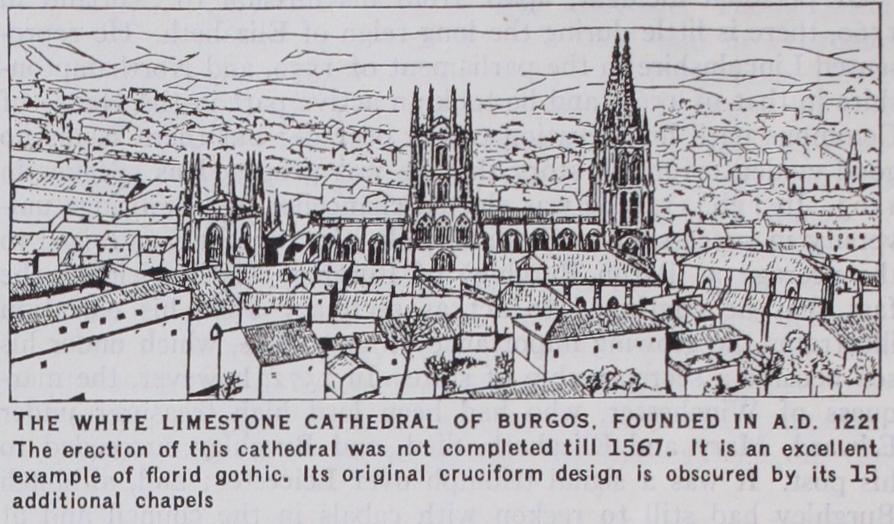
Burgos is the see of an archbishop, whose province comprises the dioceses of Leon, Palencia, Osma, Calahorra and Santo Do mingo, Vitoria and Santander. The cathedral, founded in 1221 by Ferdinand III. of Castile and the English bishop Maurice of Burgos, is a fine example of florid Gothic, built of white limestone. It was not completed until 1567, and the architects principally responsible for its construction were a Frenchman in the 13th century and a German in the 15th. Its cruciform design is almost hidden by the 15 chapels added at all angles to the aisles and tran septs, by the beautiful 14th-century cloister on the north-west and the archiepiscopal palace on the south-west. Over the three central doorways of the main or western facade rise two lofty and graceful towers. Many of the monuments within the cathedral are of considerable artistic and historical interest. The chapel of Corpus Christi contains the chest which the Cid is said to have filled with sand and subsequently pawned for a large sum to the credulous Jews of Burgos. The legend adds that he redeemed his pledge. In the aisleless Gothic church of Santa Agueda, or Santa Gadea, tradition relates that the Cid compelled Alphonso VI. of Leon, before his accession to the throne of Castile in 1072, to swear that he was innocent of the murder of Sancho, his brother and predecessor on the throne. San Esteban, completed between 1280 and 1350, and San Nicholas, dating from 1505, are small Gothic churches, each with a fine sculptured doorway. Many of the convents of Burgos have been destroyed, and those which survive lie chiefly outside the city. At the end of the Paseo de la Isla stands the nunnery of Santa Maria la Real de las Huelgas, originally a summer palace (huelga, "pleasure-ground") of the kings of Castile. In 1187 it was transformed into a Cistercian con vent by Alphonso VIII., who invested the abbess with almost royal prerogatives, including the power of life and death, and absolute rule over more than 5o villages. Alphonso and his wife Eleanor, daughter of Henry II. of England, are buried here. The Cartuja de Miraflores, a Carthusian convent, founded by John II. of Castile (1406-54), lies 2m. south-east of Burgos. Its church contains a monument of exceptional beauty, carved by Gil de Siloe in the 15th century, for the tomb of John and his second wife, Isabella of Portugal. The convent of San Pedro de Car dena, 7m. south-east of Burgos, was the original burial-place of the Cid, in 1099, and of Ximena, in 1104. About 5om. from the city is the abbey of Silos, which appears to have been founded under the Visigothic kings, as early as the 6th century. It was restored in 919 by Fernan Gonzalez, and in the iith century became cele brated throughout Europe, under the rule of St. Dominic or Domingo. It was reoccupied in 188o by French Benedictine monks.
After its foundation in 884 as an outpost in the east of the Asturian kingdom, Burgos became rapidly the capital of the count ship, and, later, the kingdom of Castile declared independent in 1035. The traditions of its earliest period are preserved in the statues, occupying niches on the face of the Arco de Santa Maria (vide supra), representing the founder Porcellos, the two first popularly elected "Judges of Castile," the Toth century hero Fernan Gonzalez and the II th century hero, the Cid Campeador, whose bones (since 1919) rest in the cathedral. The rival at first of Leon, and later—af ter the final absorption of the Leonese king dom by Castile—of Toledo and Valladolid, Burgos, as the recog nized "head of Castile," enjoyed the prestige of a capital city until the reign of Philip II. Like its rivals it sank to political insignificance after 156o, when Madrid was declared the Tunica torte. There remained, however, to Burgos the commercial supremacy in Castile which resulted from the powers with which its merchant guild was invested by the Catholic sovereigns in By a decree of that year the whole foreign trade of Castile, particularly the valuable trade in fine wool, and the loading and allocation of the ships belonging to the fleets sailing from the ports of the north coast were put under the administration and jurisdiction of the prior and consulado of the Burgos guild; the shipping department of this organization became the model for the more famous Casa de Contratacion at Seville. With the decline of Castilian trade, Burgos languished until its revival in the 18th century under Charles III. To-day it is an agricultural centre, with manufactures of heavy woollen and leathern goods, chemical manures, chocolate and paper.
A general description of the city and its monuments is given by A. Llacayo y Santa Maria in Burgos, etc. (Burgos, 1889). See also Architectural, Sculptural and Picturesque Studie, in Burgos and its Neighbourhood, a valuable series of architectural drawings in folio, by J. B. Waring (London, 1852) . The following are monographs on particular buildings:—Historia de la Catedral de Burgos, etc., by P. Orcajo (Burgos, 1856) ; El Castillo de Burgos, by E. de Oliver Copons (Barcelona, 1893) ; La Real Cartuja de Miraflores, by F. Tarin y Juaneda (Burgos, 1896) ; Luis de Pablo Ibanez, Catedral de Burgos (Burgos, 1921) . For the history of the city see En Burgos, by V. Balaguer (Burgos, 1895) ; Eloy Garcia de Quevedo y Concellon, Ordenanzas del Consulado de Burgos de 1S38 (Burgos, 19o5) ; O. Jiirgens, Spanische Stddte (Hamburg, 1926) . For the history of Silos see M. Ferotin, Histoire de l'Abbaye de Silos (Paris, 1897).