
BURNISHER, a tool used principally in the arts, as the name implies, to give a high polish to a decorated surface. The tool differs in size, shape and material, according to the purpose for which it is intended. The burnisher used by the artist is gen erally about io to 12 in. in length. At one end is an agate, flint or blood stone, very smoothly polished, and cut in various shapes, ranging from a point to a round, square or oblong end, curved hook or spear shape, firmly set in a metal ferrule. The burnisher, as a finishing tool, is brought into the process of gilding after the surface has been carefully prepared—scraped, cleaned, polished, washed in an acid solution and thoroughly dried. The gold leaf is then applied and the colour brought out by means of rubbing with the burnisher.
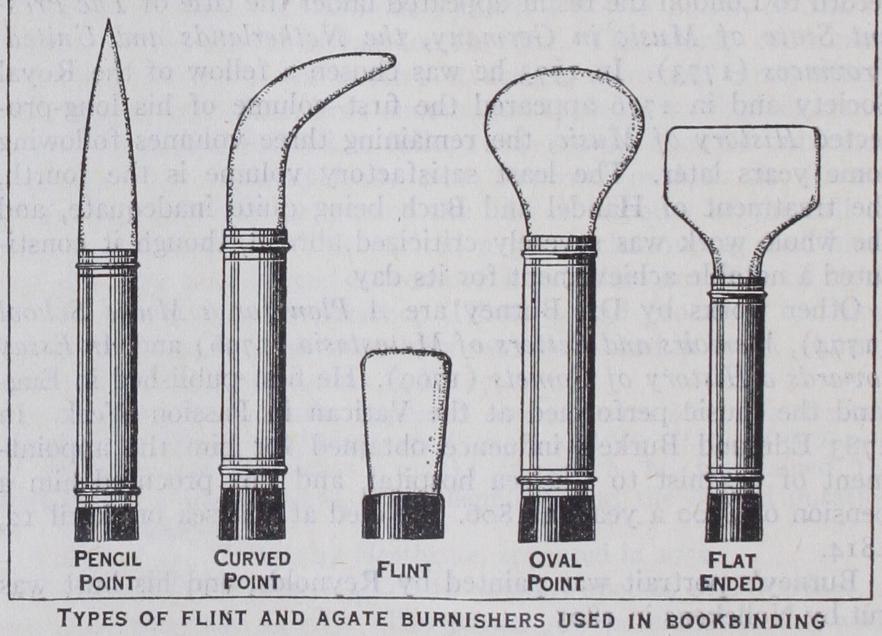
We find on very early panel and mural paintings, and on illumi nated manuscripts, a thinly beaten gold-leaf or finely powdered metallic gold, applied over a smooth priming or foundation, similar to what we to-day call burnish gold size. This was pre pared by the early gilders from a very high grade of rabbit or hide glue, mixed together with natural red bolus, a variety of clay. After the gold size has dried smooth and hard, the gold-leaf or powder is carefully applied and then very gently rubbed with the burnisher until the desired high finish is obtained. It is necessary, that the gold to be burnished be laid on a very smooth and hard surface to obtain the most brilliant results. Today, burnish gold leaf, a variety differing only slightly from the ordinary gold-leaf about one karat softer—is used extensively. Genuine metallic gold powder is but seldom employed owing to its high cost. As substi tute, the imitation gold powder, or so-called burnishing bronze, is widely used commercially. The gilders of picture and mirror frames, book edges, greeting and playing card edges, illuminated manuscripts and other productions are the principal users of these burnishers.
Another style of burnisher made of a very high grade steel is used by the artist etcher and metal worker to remove rough burrs or to obtain a highly polished surface to parts of the copper or zinc plate, or to make corrections. The carver of leather also em ploys a burnisher to give a desired finish to the tooled leather. The burnisher used by the ceramic artist to finish gold decora tions on china or porcelain, is made of spun glass. The gold on the china is quite dull after leaving the firing kiln. It is carefully bur nished with the glass burnisher until the finish which is required is obtained.
There is no record of any definite date or period when bur nishers were introduced in the arts. From earliest times there is evidence of their use. (Sec also POTTERY AND PORCELAIN ; CHINAWARE; GILDING.) (F. W. WE.)